
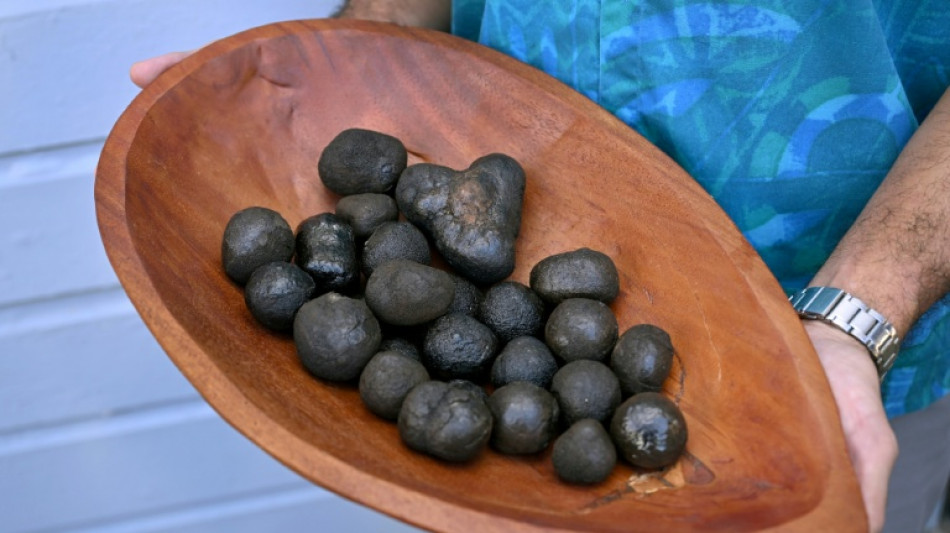
'Significant declines' in some species after deep-sea mining: research / Photo: William WEST - AFP
Deep-sea mining could impact marine life stretching from the tiniest bottom dwellers to apex predators like swordfish and sharks, a major piece of industry-funded research found Thursday.
The Metals Company -- a leading deep-sea mining firm -- paid Australia's government science agency to pore through data collected during test mining in the remote Pacific Ocean.
Huge tracts of Pacific Ocean seabed are carpeted in polymetallic nodules, bulbous lumps of rock that are rich in metals used in battery production -- such as cobalt and nickel.
The Metals Company is pushing to be the first to mine these nodules in international waters, striving to exploit a remote expanse known as the Clarion-Clipperton Zone.
Australia's government science agency released a series of technical reports on Thursday detailing how mining could be managed.
Bottom-dwellers such as sea cucumbers, marine worms, starfish and crustaceans could see "significant declines in abundance immediately following mining", research found.
Some of these species would partially bounce back within a year, but filter feeders and other tiny organisms that feast on seabed sediments showed "minimal recovery".
"On the seafloor, our research shows that there are substantial local impacts from different mining operations," scientist Piers Dunstan said during a briefing.
Deep-sea mining companies are still figuring out the best way to retrieve nodules that can lie five kilometres (three miles) or more beneath the waves.
Most efforts focus on robotic harvesting machines, or crawlers, which hoover up nodules as they rove the ocean floor.
The Australian scientists looked at how sharks and fish might be harmed by plumes of sediment discharged as mining waste.
In some scenarios, apex predators could see toxic metals start to build up in their blood after prolonged exposure to these plumes.
"Long-lived top predators, such as swordfish and large sharks, accumulated the highest simulated metal concentrations," scientists noted in one report.
- 'Risk of harm' -
Simulations showed blood metal concentrations would not exceed international health guidelines, and impacts were less pronounced if sediment was discharged at a greater depth.
"This project helps ensure that if deep-sea mining were to go ahead, there is a clear approach to understand potential risks and impacts to marine life and ecosystems," Dunstan said.
Canada-based The Metals Company is striving to start industrial deep-sea mining in the Clarion-Clipperton Zone within the next two years.
The International Seabed Authority -- which oversees deep-sea mining in international waters -- has yet to adopt long-awaited rules governing the industry.
The Metals Company has indicated it could forge ahead even without the authority's approval, pointing to an obscure US law that says American citizens can recover seabed minerals in areas beyond the nation's jurisdiction.
The firm paid Australia's Commonwealth Scientific and Industrial Research Organisation -- or CSIRO -- around US$1 million to compile the reports.
CSIRO stressed it was not for, or against, deep-sea mining -- but that its work would help to measure and monitor impacts should it go ahead.
Energy transition expert Tina Soliman-Hunter said it was one of the "most comprehensive" pieces of research on deep-sea mining to date.
"Without such research, there is a risk of harm from mining activities that can persist for generations," said Soliman-Hunter, from Australia's Macquarie University.
Found in international waters between Mexico and Hawaii, the Clarion-Clipperton Zone is a vast abyssal plain spanning some 4 million square kilometres (1.7 million square miles).
I.El-Hammady--DT



