
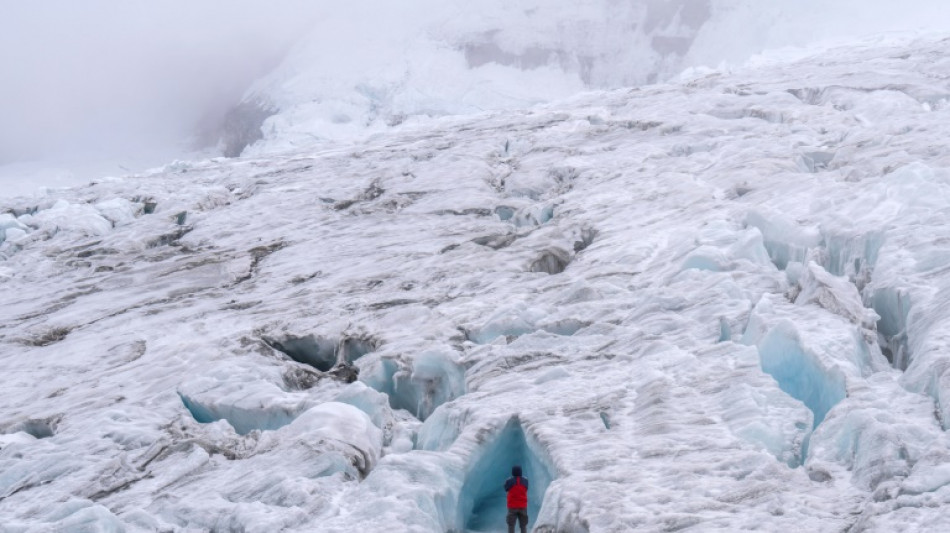
Climate action could save half of world's vanishing glaciers, says study / Photo: Luis ACOSTA - AFP/File
More than three-quarters of the world's glaciers are set to vanish if climate change continues unchecked, a major new study warned Thursday, fueling sea-level rise and jeopardizing water supplies for billions.
Published in Science, the international analysis provides the clearest picture yet of long-term glacier loss, revealing that every fraction of a degree in global temperature rise significantly worsens the outlook.
It may sound grim, but co-lead author Harry Zekollari, a glaciologist at Vrije Universiteit Brussel and ETH Zurich, told AFP the findings should be seen as a "message of hope."
Under existing climate policies, global temperatures are projected to reach 2.7 degrees Celsius (4.9F) above pre-industrial levels by 2100 -- a pathway that would ultimately erase 76 percent of current glacier mass over the coming centuries.
But if warming is held to the Paris Agreement's 1.5C target, 54 percent of glacial mass could be preserved, according to the study, which combined outputs from eight glacier models to simulate ice loss across a range of future climate scenarios.
"What is really special about this study is we can really show how every tenth of a degree of additional warming matters," co-lead author Lilian Schuster of the University of Innsbruck told AFP.
The paper's release comes as Swiss authorities monitor flood risks following the collapse of the massive Birch Glacier, which destroyed an evacuated village.
While Swiss glaciers have been heavily impacted by climate change, it remains unclear how much the latest disaster was driven by warming versus natural geological forces.
- Cultural and economic importance -
Glaciers are found on every continent except Australia -- from Mount Kilimanjaro to the Austrian Alps and the Karakoram range in Pakistan.
While most are clustered in the polar regions, their presence in mountain ranges across the world makes them vital to local ecosystems, agriculture and human communities.
Vast bodies of snow, ice, rock, and sediment that gain mass in winter and lose it in summer, glaciers formed in the Earth's deep past when conditions were far colder than today.
Their meltwater sustains rivers critical for farming, fisheries, and drinking water.
Their loss can have profound ripple effects, from disrupting tourism economies to eroding cultural heritage.
In recent years, symbolic glacier funerals have been held in Iceland, Switzerland and Mexico.
"The question I always get is, why are you a glaciologist in Belgium?" said Zekollari. "Well -- sea level rise. Glaciers melt everywhere on Earth... and that affects coastal defenses even in places far from mountains."
Around 25 percent of current sea-level rise is attributed to glacier melt.
Even if all fossil fuel use stopped today, the study finds that 39 percent of glacier mass loss is already locked in -- enough to raise sea levels by at least 113 millimeters (4.4 inches).
- Uneven impacts -
One key finding of the study is that some glaciers are far more vulnerable than others -- and the global average obscures drastic regional losses.
Glaciers in the European Alps, the Rockies of the US and Canada, and Iceland are expected to lose nearly all their ice at 2C of warming -- the fallback goal of the Paris accord.
In the central and eastern Himalayas, whose rivers support hundreds of millions of people, only 25 percent of glacier ice would remain at 2C.
By contrast, the west of the range may retain 60 percent of its ice at the same temperature thanks to its wide range of elevations, which allows some glaciers to persist at colder, higher altitudes, said Shuster.
Glacier loss is already affecting communities.
In a related commentary in Science, Cymene Howe and Dominic Boyer of Rice University describe how the retreat of Oregon's Glisan Glacier has imperiled orchards, fisheries, and the cultural heritage of the Indigenous Quinault people.
"Unfortunately we'll lose a lot, but with ambitious targets we can still save many of these glaciers -- which are not only beautiful, but vital for water supply, sea-level regulation, tourism, hydroelectricity, spiritual values, ecology, and more," said Zekollari.
J.Alaqanone--DT



