
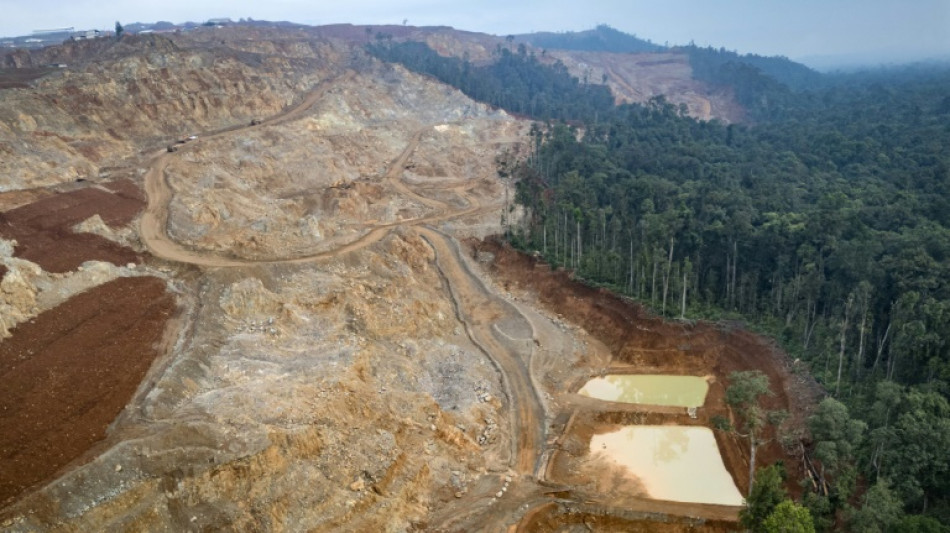
Nickel rush for stainless steel, EVs guts Indonesia tribe's forest home / Photo: STR - AFP
Sitting deep in east Indonesia's lush jungle, Bokum, one of the country's last isolated hunter-gatherers, has a simple message for the nickel miners threatening his home: "This is our land."
He belongs to the Hongana Manyawa Indigenous tribe, which includes around 3,000 "contacted" members like him, and another 500 who reject contact with the modern world.
Their home on Halmahera Island was once a breathtaking kaleidoscope of nature that provided sanctuary and sustenance.
But it is being eaten away by the world's largest nickel mine, as Indonesia exploits vast reserves of the metal used in everything from electric vehicles to stainless steel.
"I'm worried if they keep destroying the forest," Bokum told AFP in a clearingin central Halmahera.
"We have no idea how to survive without our home and food."
The plight of the Hongana Manyawa, or "People of the Forest", started gaining attention in Indonesia last year after a video widely shared on Facebook showed emaciated, uncontacted members emerging from their rapidly changing forest home to beg for food.
But the remote region -- about 1,500 miles (2,414 kilometres) from capital Jakarta -- mostly remains far from the public consciousness.
AFP travelled into the Halmahera jungle to see how the sprawling Weda Bay Nickel concession has affected the once-pristine tribal lands that the Hongana Manyawa call home.
During a three-day, 36-kilometre (22-mile) trek across parts of the 45,000-hectare concession, the mining operation's impacts were starkly clear.
Booms from controlled explosions to expose nickel shook birds from trees, while helicopters buzzing overhead shared the skies with green parrots, Moluccan owls, hornbills and giant bees.
Tree stumps provided evidence of logging, and off-duty mine guards were seen hunting tropical birds with air guns.
Throughout the night, the sound of excavators scratching the topsoil penetrated the thick vegetation, competing with frog calls and the drone of insects.
Mud that locals say is stirred up by mining has stained rivers copper, and the water leaves skin irritated.
In 22 river crossings, only a few fish were visible. Tribe members say they have mostly disappeared.
AFP did not seek to meet uncontacted Hongana Manyawa.
Bokum emerged from isolation earlier in his life, but still has very limited contact with the outside world.
He and his wife Nawate agreed to meet AFP around 45 minutes from his home deeper in the jungle.
But he could not stay long: en route, he spotted miners and wanted to return to ward them off.
"The company workers have been trying to map our territory," he told AFP, wearing a black cowboy hat, shirt and rolled-up jeans.
"It's our home and we will not give it to them."
- 'Prevent their annihilation' -
Indonesia's constitution enshrines Indigenous land rights, and a 2013 Constitutional Court ruling promised to give local communities greater control oftheircustomary forests
But environmental groups say the law is not well enforced.
With no land titles, the Hongana Manyawa have little chance of asserting their claims to stewardship of forest that overlaps with Weda Bay's concession.
According to Weda Bay Nickel (WBN), its mine on Indonesia's Maluku islands accounted for 17 percent of global nickel production in 2023, making it the largest in the world.
WBN is a joint venture of Indonesia's Antam and Singapore-based Strand Minerals, with shares divided between French mining giant Eramet and Chinese steel major Tsingshan.
WBN told AFP it is "committed to responsible mining and protecting the environment", and trains employees to "respect local customs and traditions".
It said there is "no evidence that uncontacted or isolated groups are being impacted by WBN's operations".
Eramet told AFP it has requested permission from WBN's majority shareholders for an independent review of "engagement protocols" with Hongana Manyawa, expected this year.
Further review of how the tribe uses the area's forests and rivers is also underway, it added, though it said there was currently "no evidence" of members living in isolation in its concession.
The Indonesian government, which acknowledges most of the concession was previously protected forest, told AFP otherwise.
There is "recognition of evidence of the existence of isolated tribes around Weda Bay", said the directorate general of coal and minerals at Indonesia's energy ministry.
It said it was committed to "protecting the rights of Indigenous peoples and ensuring that mining activities do not damage their lives and environment".
Indigenous rights NGO Survival International said that was Jakarta's first acknowledgement of uncontacted, or "isolated", Hongana Manyawa in the area.
It called the admission a "hammer blow" to Eramet's claims and said a no-go area to protect the tribe was "the only way to prevent their annihilation".
Both WBN and Eramet said they work to minimise impact on the environment. Eramet's new CEO will be in Indonesia this week, seeking permission to expand the mine's capacity.
Tsingshan and Antam did not respond to AFP requests for comment.
Bokum said mining has driven away the wild pigs, deer and fish he once caught for food. Now, he looks for shrimp and frogs in less-affected smaller streams.
"Since the company destroyed our home, our forest, we've been struggling to hunt, to find clean water," he said in the Indigenous Tobelo language.
"If they keep destroying our forest we cannot drink clean water again."
- 'Go away' -
Nickel is central to Indonesia's growth strategy. It banned ore exports in 2020 to capture more of the value chain.
The country is both the world's largest producer, and home to the biggest-known reserves.
Mining -- dominated by coal and nickel -- represented nearly nine percent of its GDP in the first quarter of 2025, government data shows.
Nickel mined in the Halmahera concession is processed at the Weda Bay Industrial Park.
Since operations began in 2019, the area has transformed rapidly, into what some call a "Wild West".
At a checkpoint near the industrial park, men stopped AFP to demand cash and forced their vehicle to move elsewhere, before a local government official intervened.
The towns on the mine edge -- Lelilef Sawai, Gemaf and Sagea -- form a chaotic frontier.
Employees in hard hats crisscross muddy roads that back up with rush-hour traffic.
Shops catering to labourers line the roadside, along with prostitutes looking for business in front of bed bug-infested hostels.
The mining workforce has more than doubled since 2020 to nearly 30,000 people.
Locals say these are mostly outsiders whose arrival has sparked tensions and coincided with rising cases of respiratory illness and HIV/AIDS.
Smelter towers belch a manmade cloud visible from kilometres away.
"Mining companies have not implemented good practices, have violated human rights and there is rarely any evaluation," said Adlun Fiqri, spokesman for the Save Sagea campaign group.
Inside the jungle, a similar story is playing out, said Hongana Manyawa member Ngigoro, who emerged from the uncontacted as a child.
"Long before the mining, it was really quiet and good to live in the forest," said the 62-year-old, as he marked his route by slicing pock-marks into trees with his machete.
He remains at ease in the forest, using reeds for shade and bamboo shoots to boil water.
"There was no destruction. They were not afraid of anything," he said.
He climbed nimbly down a steep slope by clinging to tree roots before crossing a riverbed peppered with garnierite -- green nickel ore.
"This land belongs to the Hongana Manyawa," he said.
"They existed living in the rainforest before even the state existed. So go away."
That sentiment echoes elsewhere on Halmahera.
At least 11 Indigenous people were recently arrested for protesting mining activity in the island's east, Amnesty International said Monday.
- 'We will not give our consent' -
Despite their "contacted" status, Bokum and Nawate have rarely met outsiders.
They approached haltingly, with Nawate refusing to speak at all, instead surveying her visitors with a cautious smile.
Bokum described moving at least six times to outrun encroaching miners.
NGOs fear the mine operation risks wiping out the tribe.
"They rely entirely on what nature provides for them to survive and as their rainforest is being devastated so too are they," said Callum Russell, Asia research and advocacy officer at Survival International.
"Any contact with workers in the forest runs the risk of exposing them to deadly diseases to which they have little to no immunity."
The government told AFP it has "conducted documentation" to understand isolated tribes near Weda Bay, and involved them "in the decision-making process".
Activists say this is impossible given most of the group do not use modern technology and limit contact with outsiders.
Amid growing scrutiny, there have been rumblings of support for the tribe, including from some senior politicians.
Tesla, which has signed deals to invest in Indonesian nickel, has mooted no-go zones to protect Indigenous peoples.
And Swedish EV company Polestar last year said it would seek to avoid compromising "uncontacted tribes" in its supply chain.
For Bokum however, the problem is already on his doorstep.
A 2.5-kilometre-long (1.5 miles) open pit lies just over the hill from a plot where he grows pineapple and cassava.
Bokum and Nawatereceived mobile phones from mine workers -- in an unsuccessful attempt to convince them to approve mining operations.
They and other tribe members use numerical codes to identify contacts and make calls.
They must approach the concession to pick up signal, but when mine workers near his home, Bokum wields his machete to scare them off.
"This is our land. Our home," he said.
"We will not give our consent to destroy it."
A.Ansari--DT



