
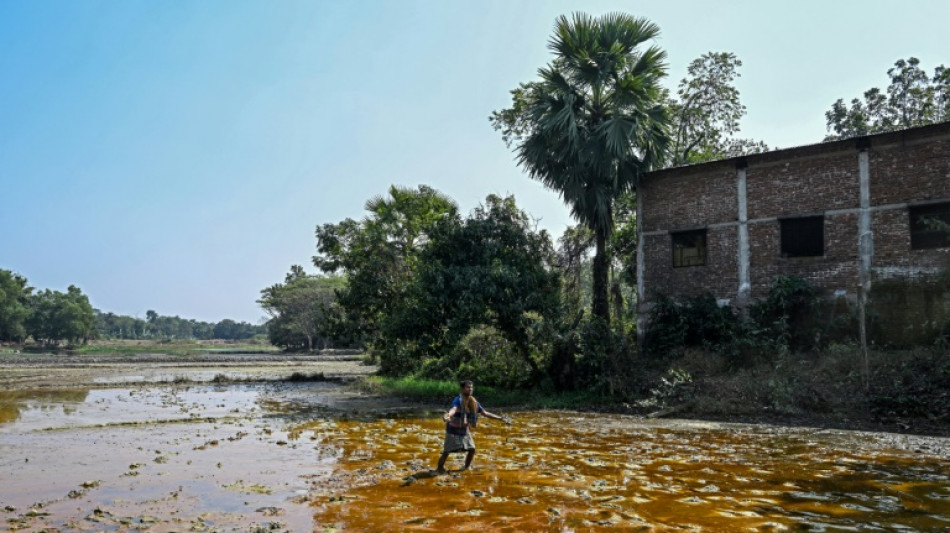
Battery boom drives Bangladesh lead poisoning epidemic / Photo: Munir UZ ZAMAN - AFP
Bangladeshi Junayed Akter is 12 years old but the toxic lead coursing through his veins has left him with the diminutive stature of someone several years younger.
Akter is one of 35 million children -- around 60 percent of all children in the South Asian nation -- who have dangerously high levels of lead exposure.
The causes are varied, but his mother blames his maladies on a since-shuttered factory that hastily scrapped and recycled old vehicle batteries for profit, in the process poisoning the air and the earth of his small village.
"It would start at night, and the whole area would be filled with smoke. You could smell this particular odour when you breathed," Bithi Akter told AFP.
"The fruit no longer grew during the season. One day, we even found two dead cows at my aunt's house."
Medical tests showed Junayed's blood had twice the level of lead deemed by the World Health Organization to cause serious, and likely irreversible, mental impairment in young children.
"From the second grade onward, he didn't want to listen to us anymore, he didn't want to go to school," Bithi said, as her son sat next to her while gazing blankly out at the courtyard of their home.
"He cried all the time too."
Lead poisoning is not a new phenomenon in Bangladesh, and the causes are manifold.
They include the heavy metal's widespread and continued use in paint, in defiance of a government ban, and its use as an adulterant in turmeric spice powder to improve its colour and perceived quality.
A great many cases are blamed on informal battery recycling factories that have proliferated around the country in response to rising demand.
Children exposed to dangerous levels of lead risk decreased intelligence and cognitive performance, anaemia, stunted growth and lifelong neurological disorders.
The factory in the Akter family's village closed after sustained complaints from the community.
But environmental watchdog Pure Earth believes there could be 265 such sites elsewhere in the country.
"They break down old batteries, remove the lead and melt it down to make new ones," Pure Earth's Mitali Das told AFP.
"They do all this in the open air," she added. "The toxic fumes and acidic water produced during the operation pollute the air, soil and water."
- 'They've killed our village' -
In Fulbaria, a village that sits a few hours' drive north of the capital Dhaka, operations at another battery recycling factory owned by a Chinese company are in full swing.
On one side are verdant paddy fields. On the other, a pipe spews murky water into a brackish pool bordered by dead lands, caked with thick orange mud.
"As a child, I used to bring food to my father when he was in the fields. The landscape was magnificent, green, the water was clear," engineer and local resident Rakib Hasan, 34, told AFP.
"You see what it looks like now. It's dead, forever," he added. "They've killed our village."
Hasan complained about the factory's pollution, prompting a judge to declare it illegal and order the power be shut off -- a decision later reversed by the country's supreme court.
"The factory bought off the local authorities," Hasan said. "Our country is poor, many people are corrupt."
Neither the company nor the Chinese embassy in Dhaka responded to AFP's requests for comment on the factory's operations.
Syeda Rizwana Hasan, who helms Bangladesh's environment ministry, declined to comment on the case because it was still before the courts.
"We regularly conduct operations against the illegal production and recycling of electric batteries," she said.
"But these efforts are often insufficient given the scale of the phenomenon."
- 'Unaware of the dangers' -
Informal battery recycling is a booming business in Bangladesh.
It is driven largely by the mass electrification of rickshaws -- a formerly pedal-powered means of conveyance popular in both big cities and rural towns.
More than four million rickshaws are found on Bangladeshi roads and authorities estimate the market for fitting them all with electric motors and batteries at around $870 million.
"It's the downside of going all-electric," said Maya Vandenant of the UN children's agency, which is pushing a strategy to clean up the industry with tighter regulations and tax incentives.
"Most people are unaware of the dangers," she said, adding that the public health impacts are forecast to be a 6.9 percent dent to the national economy.
Muhammad Anwar Sadat of Bangladesh's health ministry warned that the country could not afford to ignore the scale of the problem.
"If we do nothing," he told AFP, "the number of people affected will multiply three or fourfold in the next two years."
A.Ansari--DT



