
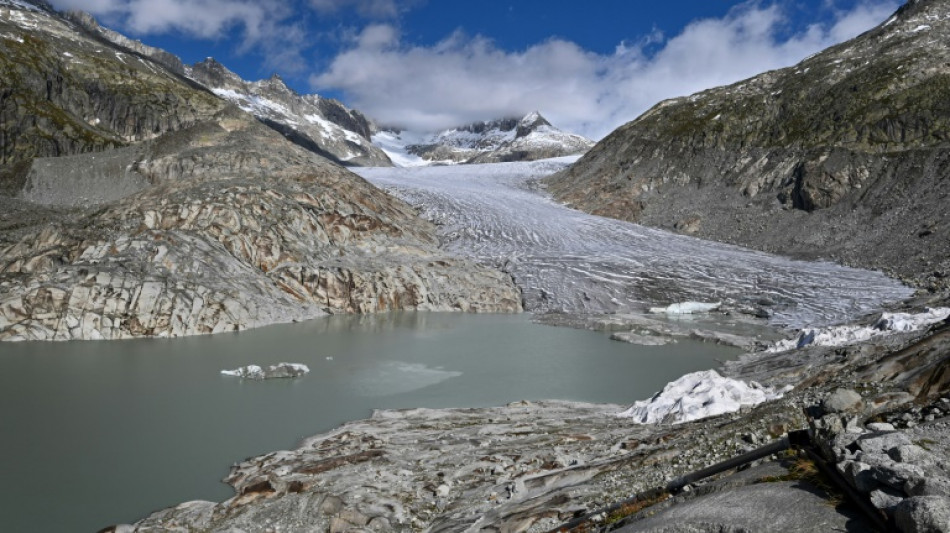
Global glacier melt is accelerating, scientists say / Photo: Fabrice COFFRINI - AFP/File
Ice loss from the world's glaciers has accelerated over the past decade, scientists said on Wednesday, warning that melting may be faster than previously expected in the coming years and drive sea levels higher.
The world's glaciers, which are important climate regulators and hold freshwater resources for billions, are rapidly melting as the world warms.
In a first-of-its-kind global assessment, an international team of researchers found a sharp increase in melting over the past decade, with around 36 percent more ice lost in the 2012 to 2023 period than in the years from 2000 to 2011.
On average some 273 billion tonnes of ice are being lost per year -- equivalent to the world population's water consumption for 30 years, they said.
The findings are "shocking" if not altogether surprising as global temperatures rise with humanity's greenhouse gas emissions, said Michael Zemp, a professor at the University of Zurich, who was a co-author of the assessment published in the journal Nature.
Overall, researchers found that the world's glaciers have lost around five percent of their volume since the turn of the century, with wide regional differences ranging from a two-percent loss in Antarctica to up to 40 percent in the European Alps.
Zemp said that regions with smaller glaciers are losing them faster, and many "will not survive the present century".
The research -- coordinated by the World Glacier Monitoring Service (WGMS), The University of Edinburgh and research group Earthwave -- was an effort to bring together field and satellite measurements to create a "reference estimate" for tracking ice loss.
Zemp, who leads the WGMS, said the team's observations and recent modelling studies suggest that glacier melt this century will be faster than projected in the most recent assessment by United Nations IPCC climate experts.
"Hence, we are facing higher sea-level rise until the end of this century than expected before," he told AFP, adding that glacier loss would also impact fresh water supplies, particularly in central Asia and the central Andes.
Glaciers are the second-largest contributor to global sea-level rise -- after the rise caused by the expansion of seawater as it warms.
The nearly two centimetres (0.8 inches) of sea level rise attributed to glacier melt since 2000 means almost four million more people on the world's coasts made vulnerable to flooding, scientists have estimated.
- 'Survival strategy' -
So far smaller glaciers are the main contributors to sea level rise, but Martin Siegert, a Professor at the University of Exeter who was not involved in the study, said the research was "concerning".
That is because it predicts further glacier losses and could indicate how Antarctica and Greenland's vast ice sheets react to global warming.
"Ice sheets are now losing mass at increasing rates -- six times more than 30 years ago -- and when they change, we stop talking centimetres and start talking metres," he said.
Glaciers have been a key bellwether for human-caused climate change for decades, with WGMS data going back more than a century.
In the 20th century, assessments were based on field measurements from some 500 glaciers -- involving scientists digging a hole on the top to record the amount of fresh snow that year and then assessing ice amounts lost on the "tongue" where the melting ice flows.
More recently, satellites have allowed scientists to better track changes across the world's 275,000 glaciers -- using cameras, radar, lasers and methods to assess the Earth's mass.
In January, the United Nations said saving the world's glaciers was an important "survival strategy" for the planet.
To do that, "you have to reduce the greenhouse gas emissions, it is as simple and as complicated as that," said Zemp.
"Every tenth of a degree warming that we avoid saves us money, saves us lives, saves us problems."
K.Javed--DT



