Dubai Telegraph - Scientists artificially inseminate leopard sharks to boost diversity

EUR -
AED 4.304535
AFN 74.415645
ALL 95.657107
AMD 433.266248
ANG 2.097923
AOA 1075.987332
ARS 1632.462783
AUD 1.618609
AWG 2.10978
AZN 1.995685
BAM 1.95696
BBD 2.355816
BDT 143.515066
BGN 1.955182
BHD 0.442264
BIF 3480.663113
BMD 1.1721
BND 1.493585
BOB 8.08179
BRL 5.777048
BSD 1.169703
BTN 111.388975
BWP 15.895422
BYN 3.311291
BYR 22973.155008
BZD 2.352414
CAD 1.593832
CDF 2713.410971
CHF 0.915931
CLF 0.026961
CLP 1061.125158
CNY 8.005851
CNH 7.994049
COP 4354.596695
CRC 532.117675
CUC 1.1721
CUP 31.060643
CVE 110.330397
CZK 24.387118
DJF 208.285235
DKK 7.472581
DOP 69.691606
DZD 155.219479
EGP 62.848343
ERN 17.581496
ETB 184.078001
FJD 2.563206
FKP 0.866016
GBP 0.863679
GEL 3.153155
GGP 0.866016
GHS 13.111772
GIP 0.866016
GMD 85.5636
GNF 10265.084482
GTQ 8.926425
GYD 244.705045
HKD 9.184562
HNL 31.091562
HRK 7.536132
HTG 153.080736
HUF 361.208245
IDR 20385.100166
ILS 3.445502
IMP 0.866016
INR 111.392962
IQD 1535.450666
IRR 1542483.264488
ISK 143.183982
JEP 0.866016
JMD 184.059098
JOD 0.831057
JPY 185.02061
KES 151.059928
KGS 102.465547
KHR 4691.780986
KMF 492.899268
KPW 1054.893514
KRW 1708.523207
KWD 0.360983
KYD 0.974686
KZT 543.506793
LAK 25685.443819
LBP 104960.575553
LKR 374.295051
LRD 214.629049
LSL 19.57457
LTL 3.460905
LVL 0.708991
LYD 7.420462
MAD 10.810308
MDL 20.188138
MGA 4875.934547
MKD 61.666821
MMK 2461.06562
MNT 4194.484409
MOP 9.441277
MRU 46.704082
MUR 55.029953
MVR 18.11485
MWK 2028.202188
MXN 20.298431
MYR 4.633318
MZN 74.895135
NAD 19.57457
NGN 1600.967936
NIO 43.028082
NOK 10.812432
NPR 178.221398
NZD 1.974344
OMR 0.450665
PAB 1.169693
PEN 4.100631
PGK 5.086015
PHP 71.917685
PKR 325.951694
PLN 4.24541
PYG 7087.261339
QAR 4.27424
RON 5.239167
RSD 117.373693
RUB 88.494306
RWF 1710.213705
SAR 4.397511
SBD 9.414608
SCR 16.200818
SDG 703.844816
SEK 10.812479
SGD 1.492646
SHP 0.875091
SLE 28.862896
SLL 24578.341116
SOS 668.496242
SRD 43.92678
STD 24260.098268
STN 24.514531
SVC 10.234153
SYP 129.553035
SZL 19.570266
THB 38.077418
TJS 10.936276
TMT 4.10821
TND 3.386779
TOP 2.822135
TRY 53.020046
TTD 7.928767
TWD 36.943993
TZS 3044.157544
UAH 51.401968
UGX 4415.617294
USD 1.1721
UYU 47.088068
UZS 14094.499388
VES 578.424145
VND 30857.869995
VUV 138.92257
WST 3.183342
XAF 656.34604
XAG 0.015522
XAU 0.000252
XCD 3.167658
XCG 2.107967
XDR 0.816284
XOF 655.789907
XPF 119.331742
YER 279.674102
ZAR 19.389753
ZMK 10550.300729
ZMW 22.077274
ZWL 377.41564
  • CMSD

    0.0400

    23.29

    +0.17%

  • NGG

    0.1400

    87.64

    +0.16%

  • RYCEF

    0.1500

    16.5

    +0.91%

  • CMSC

    0.0099

    22.88

    +0.04%

  • BCE

    0.1700

    24.1

    +0.71%

  • RBGPF

    0.0800

    63.18

    +0.13%

  • RELX

    -0.2000

    36.16

    -0.55%

  • BCC

    -2.2000

    72.13

    -3.05%

  • RIO

    1.8700

    100.5

    +1.86%

  • VOD

    -0.3100

    15.74

    -1.97%

  • JRI

    0.1100

    13.04

    +0.84%

  • GSK

    -0.5200

    50.38

    -1.03%

  • BTI

    1.0500

    59.4

    +1.77%

  • BP

    -0.4400

    46.5

    -0.95%

  • AZN

    -2.2200

    181.24

    -1.22%

Scientists artificially inseminate leopard sharks to boost diversity
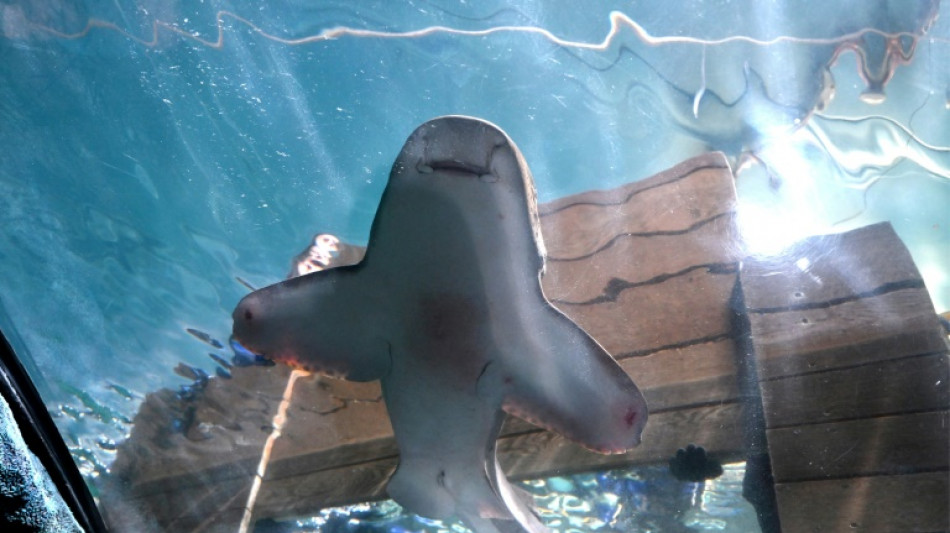
Scientists artificially inseminate leopard sharks to boost diversity / Photo: Saeed KHAN - AFP

Scientists artificially inseminate leopard sharks to boost diversity

A black-and-cream leopard shark enters a hypnotic-like state of relaxation as scientists at Sydney Aquarium carefully roll her onto her back in a small pool.

Text size:

The shark, named Zimba, is one of the first captive leopard sharks in the world to be artificially inseminated with the sperm of wild sharks in an attempt to build populations around the world.

If the process is successful, Zimba's shark pups will be sent to the Raja Ampat region in Indonesia, where the local population is on the brink of extinction due to unsustainable fishing practices and habitat destruction.

Artificial insemination allows sharks that would never normally interact to breed and increase genetic diversity, said SEA LIFE Australia and New Zealand regional coordinator Laura Simmons.

Simmons hopes that eventually the leopard shark population will be "genetically viable and capable of maintaining a self-sustaining population in the wild".

That could take years, she told AFP, but "this is one step closer to where we need to be".

The procedure is one part of a larger worldwide leopard shark breeding programme, known as StAR, that involves more than 60 conservation groups, aquariums and government agencies.

Globally, about 37 percent of oceanic shark and ray species, including the leopard shark, are now listed as either endangered or critically endangered by the International Union for Conservation of Nature, a global database for threatened species.

- 'Species belongs outside' -

Australia's leopard shark populations remain plentiful and of least concern, and scientists hope they can help bolster the numbers in other regions.

Back at the Sydney Aquarium pool, Ocean Park Hong Kong's chief veterinarian Paolo Martelli inserts a metal tube filled with the sperm of wild leopard sharks into Zimba's underside.

The shark is still in a natural state called tonic immobility -- a relaxed condition that allows scientists to work without getting injured.

The whole process takes a matter of minutes and everyone claps and cheers once it is over. Zimba is flipped back onto her stomach and swims around the pool as if nothing happened.

Martelli is using a technique he developed and has successfully used on other species, but this is the first time it has been used on leopard sharks.

"It's not straightforward," he said.

Martelli and his team collected the sperm of wild leopard sharks off the coast of Queensland -- which has a large shark population -- and brought the precious cargo to Sydney.

Only three of four samples taken survived the journey.

"This species belongs in outside habitats, not in a museum," Martelli said.

But as the shark's habitat declines, scientists must give a "helping hand" in protecting and conserving this valuable species, he added.

"It is safe to say that sharks have suffered a lot in the last century."

A.Murugan--DT



