
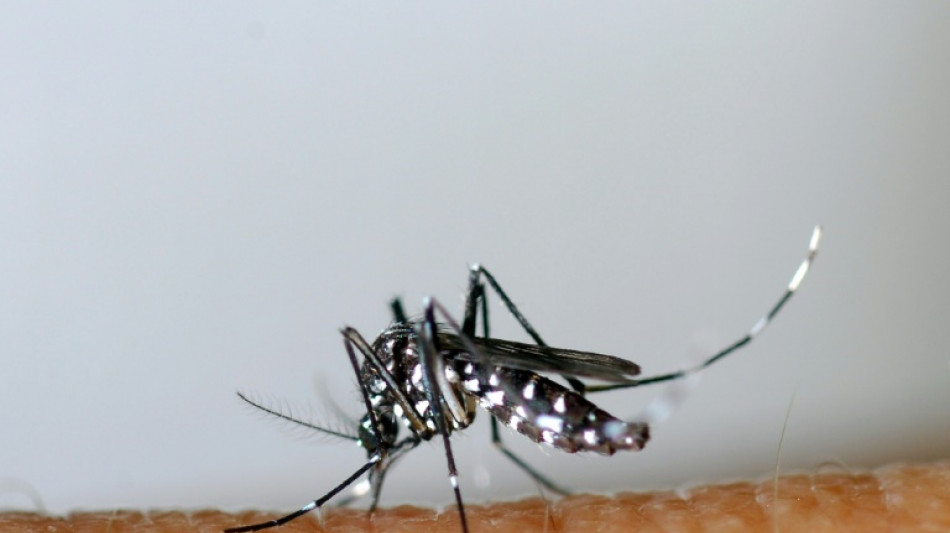
Fifth of dengue cases due to climate change: researchers / Photo: - - EID Mediterranee/AFP/File
Climate change is responsible for nearly a fifth of the record number of dengue cases worldwide this year, US researchers said on Saturday, seeking to shine a light on how rising temperatures help spread disease.
Researchers have been working to swiftly demonstrate how human-driven climate change directly contributes to individual extreme weather events such as the hurricanes, fires, droughts and floods that have battered the world this year.
But linking how global warming affects health -- such as driving outbreaks or spreading disease -- remains a new field.
"Dengue is a really good first disease to focus on because it's very climate sensitive," Erin Mordecai, an infectious disease ecologist at Stanford University, told AFP.
The viral disease, which is transmitted via bites from infected mosquitoes, causes fever and body aches and can, in some cases, be deadly.
It has typically been confined to tropical and sub-tropical areas but rising temperatures have led to mosquitoes encroaching on new areas, taking dengue with them.
For the new study, which has not yet been peer-reviewed, a US team of researchers looked at how hotter temperatures were linked to dengue infections in 21 countries across Asia and the Americas.
On average, around 19 percent of current dengue cases around the world are "attributable to climate warming that has already happened", said Mordecai, the senior author of the pre-print study.
Temperatures between 20-29 degrees Celsius (68-84 degrees Fahrenheit) are ideal for spreading dengue, Mordecai said.
Elevated areas of Peru, Mexico, Bolivia and Brazil that will warm into this temperature range could see dengue cases rising by as much as 200 percent in the next 25 years, the researchers found.
The analysis estimated that at least 257 million people are currently living in areas where global heating could double the rate of dengue during that period.
This danger is just "another reason you should care about climate change", Mordecai said.
- Bacteria to the rescue? -
More than 12.7 million dengue cases were recorded worldwide this year as of September, nearly double 2023's total record, according to World Health Organization figures.
But Mordecai said a "massive amount of under-reporting" meant the real number was likely to be closer to 100 million.
The research was presented at the annual meeting of the American Society of Tropical Medicine and Hygiene in New Orleans.
Another set of research, also not peer-reviewed, raised hopes of a potential tool to help fight the rise of dengue.
It involves breeding mosquitoes infected with a common bacteria called Wolbachia that can block the insect's ability to transmit dengue.
Five years ago, Wolbachia-infected mosquitoes were introduced across most of the Brazilian city of Niteroi.
When Brazil endured its worst-ever dengue outbreak this year, there was only a small increase in dengue in Niteroi, they found.
The number of cases was also 90-percent lower than before the Wolbachia mosquitoes were deployed -- and "nothing like what was happening in the rest of Brazil", said Katie Anders of the World Mosquito Program.
That the city fared so well showed that "Wolbachia can provide long-term protection for communities against the increasingly frequent surges in dengue that we're seeing globally", Anders said.
The researchers said they have partnered with the Brazilian government to build a Wolbachia mosquitoes production facility, in the hope of protecting millions of people.
A.Ansari--DT



