
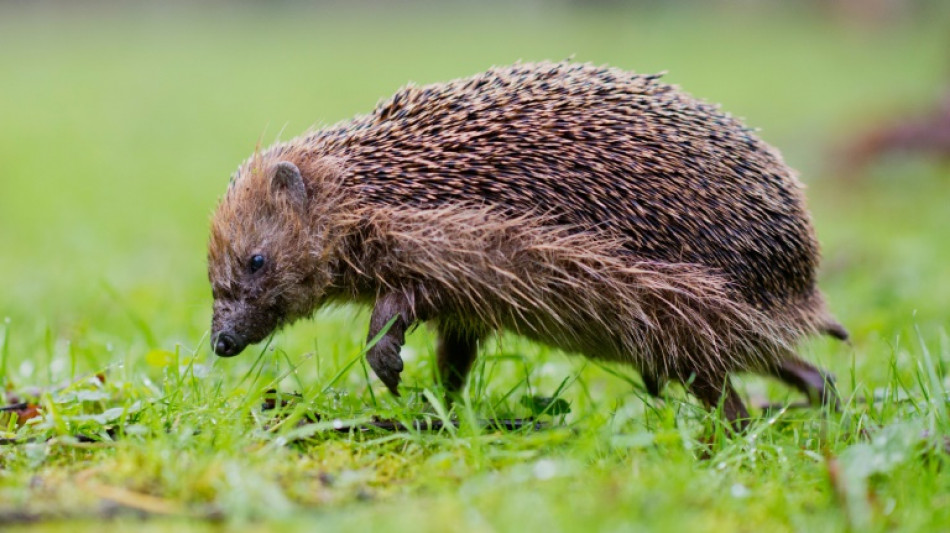
Mowed down by cars, European hedgehog numbers shrinking / Photo: JULIAN STRATENSCHULTE - DPA/AFP/File
The Western European hedgehog -- the prickly, nocturnal critter people love to encounter in the garden -- is in decline, mowed down by cars as its shrinking habitat forces it to move ever closer to humans.
An updated Red List of Threatened Species published Monday at the UN's COP16 biodiversity summit in Cali, Colombia, downgraded the hedgehog's status from "least concern" to "near threatened."
The next level on the list kept by the International Union for Conservation of Nature (IUCN), is "vulnerable," then "endangered."
The European hedgehog, expert Sophie Rasmussen told AFP, "is very close to being 'vulnerable,' and it will likely go into that category the next time we evaluate it."
Numbers of the tiny mammal have plunged by more than half its host countries including Britain, Norway, Sweden, Denmark, Belgium, the Netherlands, Germany and Austria.
The estimated decline was between 35 and 40 percent of populations measured in Britain, Sweden and Norway in the last decade or so, said Rasmussen, a researcher with the University of Oxford's Wildlife Conservation Research Unit.
In the Netherlands, it is already considered endangered.
The main killer of hedgehogs is cars -- which the animals encounter more and more as they lose their natural habitat to human expansion.
"Humans are the worst enemies of hedgehogs," said Rasmussen.
- 'Hedgehog highways' -
To protect itself from predators such as badgers, foxes and owls at night, the hedgehog uses the strategy of standing completely still as it assesses the threat.
If the menace approaches, it runs as far as its little legs can carry it. But if there is no time, it rolls up into a ball -- protected by as many as 8,000 spines, sharp to the touch.
"In front of a car, it is not a really good strategy," Rasmussen, who calls herself Dr Hedgehog and speaks with great passion about the spiky mammals, told AFP in a video interview from Lejre in Denmark.
Other threats include pesticides used by farmers and gardeners, and a decline in the insects that make up a large part of the hedgehog's diet.
Hedgehogs generally live for about two years, though some as old as nine or 12 have been documented.
They can start breeding from around 12 months of age, usually giving birth to three or five hoglets at a time.
"This means that many hedgehogs get to breed once, or twice perhaps if they're lucky, on average before they die," said Rasmussen -- just enough "to keep the population going at some level."
Soon, this may not be enough.
Rasmussen, whose research went into the Red List update, said the fight to save hedgehogs "is actually going to take place in people's gardens" as forests and other wild areas are torn down.
She suggested people build "hedgehog highways" -- basically a CD-sized hole in the outer fence to allow the animals to get in off the road, with bowls of water and nesting materials such as garden waste placed inside.
"The best thing you can do is to let your garden grow wild to attract... all the natural food items of the hedgehog" such as insects, worms, snails and slugs," said Rasmussen.
She concedes "it's not like the world is going to end tomorrow if the hedgehogs are not there."
However, "for a species so popular and so loved, can we really accept the fact that we are causing their extinction?
"And if we let it get so bad with a species we actually really care about, what about all the species we don't care about?"
The new, updated Red List has evaluated 166,061 species of plants and animals in all, of which 46,337 -- more than a quarter -- are threatened with extinction.
G.Koya--DT



