
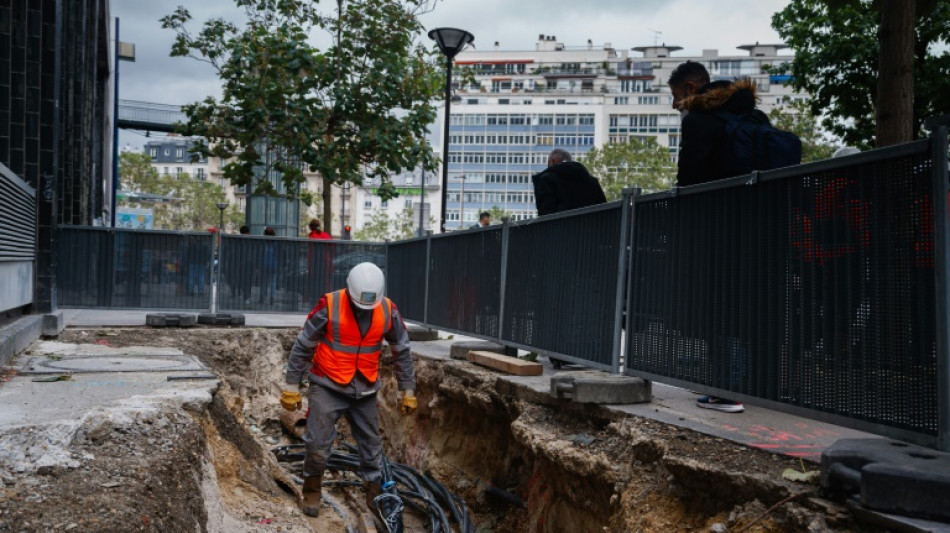
France's City of Light switches to climate-resilient power cables / Photo: STRINGER - AFP
To maintain the glow of the City of Light, Paris is modernising its underground electric cables, vulnerable to damage during heatwaves and dating back 60 years.
With power cables melting from Portland to Sicily, the world's 80 million kilometres (50 million miles) of power lines are largely unprepared to resist extreme temperatures, scientists have warned.
The French capital over the next few months will be replacing its obsolete paper-insulated lead-covered cables (PILC), which are made of oil-impregnated paper encased in a lead sheath.
"We're anticipating the renewal of these cables, which are starting to be affected by heat, to have a very resilient network in Paris," said Olivier Lagnel, deputy regional director for utility firm Enedis.
Nearby, workers in orange vests worked in a trench close to the Montparnasse train station to replace the medium voltage PILC, which were installed in 1965, with modern, plastic cables.
State-owned Enedis says Paris is not alone: its counterparts in Chicago, London, Shanghai, Hong Kong, Osaka, Tokyo, Singapore and Sydney also plan to update their cables.
- 'Climate emergency' -
Trouble has mounted in recent years.
Paper-insulated during a 2003 heatwave in France showed weaknesses with "an incident rate multiplied by eight across the medium-voltage underground network", according to a March 2024 report by France's Court of Audit.
Overhead tramway cables melted in Portland in 2021 during record-high temperatures in the northwest US state of Oregon.
A searing heatwave in July 2023 left hundreds of thousands of Sicilians without electricity and water for days.
Heat damage to underground cables was to blame, said supplier e-distribuzione, the distribution arm of energy giant Enel.
"We find ourselves operating in conditions of exceptional climatic emergency," where the temperature of the asphalt on roads reached 50 degrees Celsius (122 degrees Fahrenheit), it said in a statement at the time.
A 2021 study led by Alessandro Bosisio, an assistant professor at the University of Pavia in Italy, found that "an abnormal increase of faults in underground Medium Voltage cable joints has been recorded, especially during summer" worldwide in recent years.
Climate scientists say the period being lived through right now is likely the warmest the earth has seen for the last 100,000 years, back at the start of the last Ice Age.
- Avoid cuts -
PILC cables, which were the international standard from the late 19th century until the 1970s, were long considered highly reliable.
They were wrapped in layers of oily paper intended to isolate the centre of the cable, which heats up as electrons pass through.
The cables were conceived to resist temperatures up to 90C (194F). But when heat is trapped for days under the asphalt, they can reach 120-130C (248-266F) -- ageing faster and eventually risking failure.
Paris's 9,200 kilometres of low- and medium-voltage power cables are entirely buried underground -- to save space and protect them from the wind, Lagnel said.
Enedis plans to phase out the obsolete cables in French cities by 2050.
"The main problem is that the insulator can dry up, and in that case the cable can be sensitive," said Lagnel.
"The idea is to avoid cuts as much as possible" and to "desensitise the network... as heatwaves come back more and more often, stronger and stronger."
Y.I.Hashem--DT



