
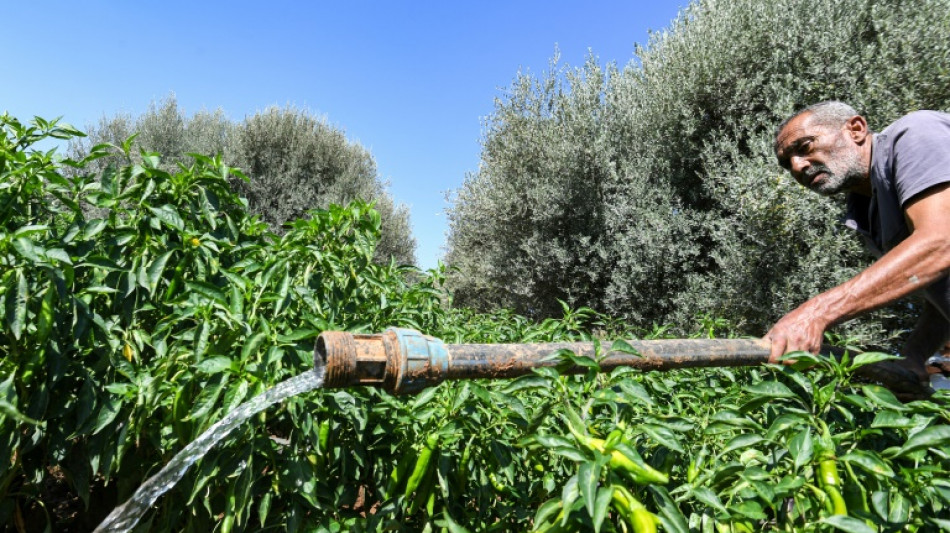
With EU funding, Tunisian farmer revives parched village / Photo: FETHI BELAID - AFP
With parched crops on one side and lush green plants on the other, a small farming project in northwest Tunisia demonstrates how foreign funding coupled with dogged local efforts can help tackle the impact of climate change.
A local dam built by woman farmer Saida Zouaoui in the village of Ghardimaou after years of effort has turned her into a local hero for her fellow smallholders, who say it helped increase their production despite a six-year drought.
Zouaoui's stone and cement dam was constructed with European Union funding and technical support from the International Labour Organization, illustrating how such assistance is helping vulnerable nations adapt to climate change.
The COP29 climate summit in Azerbaijan this November will focus on global funding by wealthier, high-polluting nations to help poorer countries adjust to a warming planet. But deep divisions remain over how much should be paid, and who should pay it
"We must adapt to climate change," Zouaoui, 44, said as she cleared fallen branches and debris from a stream flowing off the dam.
"We know the region and its water-related issues, but we must come up with solutions and not lose hope."
As a child, Saida Zouaoui saw both her father and grandfather attempt to build a makeshift reservoir using sandbags in her village of Ghardimaou near the Algerian border.
But without proper infrastructure and money, their effort failed.
In the meantime, Tunisia's water stress worsened.
- EU funding -
Already the 20th most water-stressed country according to the World Resources Institute, Tunisia has seen its national dams shrink to less than a quarter of their capacity, according to official figures.
In Zouaoui's village, traditional dykes provided irrigation for up to 48 hectares (117 acres) during the 1970s and 80s but that has shrivelled to only 12 hectares, Monaem Khemissi, Tunisia's ILO coordinator, told AFP.
Zouaoui said a number of farmers, and particularly younger people, left the village for urban areas.
Those who stayed were forced to "reduce cultivated areas and no longer planted crops that require a lot of water".
Zouaoui had pitched the idea of building the small dam to Tunisian authorities before her country's 2011 revolution but they turned it down as unprofitable, she said.
Heavily indebted Tunisia is grappling with weak economic growth.
"I understand the authorities have limited capabilities and do not have the financial resources to implement the idea as they have other priorities," Zouaoui told AFP.
But she persisted.
She told officials that her "lifetime project" would even "irrigate the entire area, for farmers to return and life to resume".
It was European Union funding that eventually provided 90 percent of the 350,000 dinars (around $115,000) needed to build her dam in 2019.
Local farmers contributed about 10 percent of the cost, according to the ILO, and also offered their labour and logistics.
The EU, the North African country's top aid and commercial partner, allocated $241 million in 2023 to support projects mainly linked to agriculture and water management.
Since 2021, the EU has also funded $18 million in rural development projects.
- 'Changed my life' -
ILO's Khemissi said Zouaoui's initiative was a "model of local development".
He said his organisation "does not aim to replace the state but rather offer technical and financial support for projects to combat climate change and create jobs in marginalised areas".
Tunisia's northwest, though impoverished, is one of its most fertile areas, known for its production of cereals and vegetables and home to the country's largest dam.
But with an unwavering lack of rainfall, Tunisia lost almost its entire grain harvest last year, according to official figures.
Water still flows, however, through Zouaoui's canals linked to her small dam, which is about the length of one-and-a-half Olympic-sized swimming pools, and three metres (10 feet) deep.
The system irrigates 45 small farms, each ranging from one to two hectares, with a rotation system among her farmer neighbours for free access to water.
Zouaoui said the farmers had nearly lost hope, feeling neglected by the authorities as "each time an official came to visit, the farmers thought they had come for electoral gain".
"I had to convince them that we will have water unconditionally," she said.
Abdallah Gadgadhi, 54, a father of five, recalled that his cultivated field "was reduced to a third before the project was completed" due to water scarcity.
With irrigation from Zouaoui's dam, he said, he has expanded his pepper crop to use around 70 percent of his land.
Rebah Fazaai, 58, said Zouaoui has "changed my life immensely".
"We can now support our families by selling our produce," she added.
S.Al-Balushi--DT



