
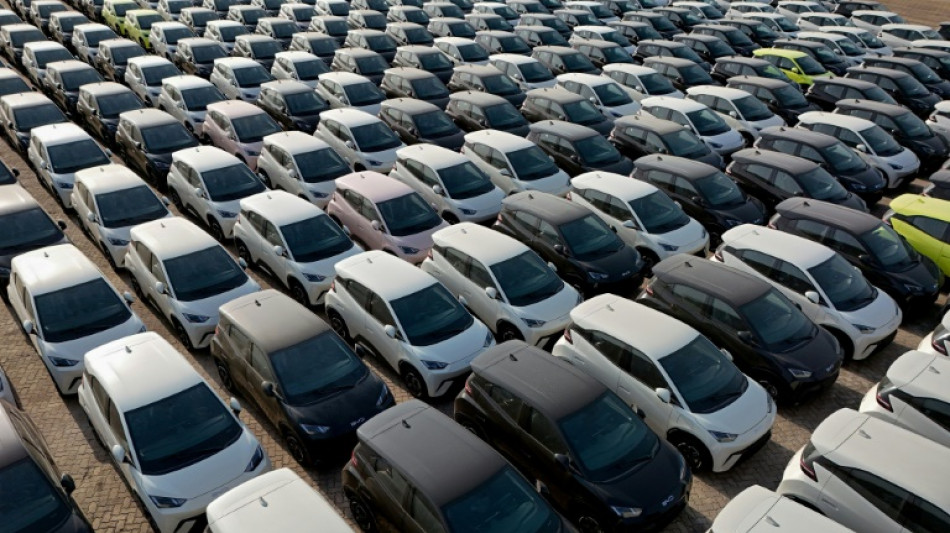
Tesla faces lower-rate EU tariffs on China-made EVs / Photo: STR - AFP/File
The European Commission announced plans Tuesday to impose an extra nine-percent tariff on Tesla's China-made electric cars, much lower than what Chinese firms face unless Beijing compromises in a trade row.
Brussels last month slapped EVs imported from China with hefty provisional tariffs -- on top of current duties of 10 percent -- after an anti-subsidy probe found they were unfairly undermining European rivals.
Beijing vociferously opposes the EU tariffs, and has filed an appeal with the World Trade Organization -- which Brussels has acknowledged while voicing confidence its measures are WTO-compatible.
On Tuesday the commission released a draft plan making the tariffs definitive, at slightly revised rates, subject to input from interested parties by end August, and to approval by EU member states by end October at the latest.
The rates faced by major Chinese manufacturers would be 17 percent for market leader BYD, tweaked downward from 17.4; 19.3 percent for Geely, down from 19.9; and 36.3 percent for SAIC, down from 37.6.
Other producers in China that cooperated with Brussels will face a tariff of 21.3 percent -- revised slightly upwards from 20.8 -- while those that did not would be subject to the maximum 36.3 percent duty.
Musk's Tesla -- which manufactures Model 3 and Model Y cars in China -- had asked Brussels for its own duty rate, set at nine percent after the commission deemed that it received lower Chinese subsidies than domestic manufacturers.
The bulk of the benefits taken into consideration involve batteries being supplied to Tesla for less than market value, as well as land use provided below market value and various Chinese grants for exporting producers.
The European Commission also decided to grant European manufacturers involved in joint ventures that export EVs from China the rate applying to their Chinese partner firm.
European firms affected include Germany's Volkswagen and BMW -- which have expressed fears the EU tariffs could damage trade ties with China, where they have significant business interests.
- Balancing act -
The Chinese Chamber of Commerce to the EU (CCCEU) slammed the commission's "protectionist approach" and "unfair use of trade tools" that would worsen trade tensions.
A European Commission official said the EU executive remained "open" to resolving the trade dispute without resorting to tariffs -- but that the ball was in China's camp.
"We consider that it's very much up to China to come up with alternatives," the official said.
Concerning the provisional duties companies have faced since July 5, provided in the form of bank guarantees, the commission said it had determined it did not have legal grounds to collect the funds, which will be released once definitive measures take effect.
China and the EU have butted heads in recent years on a range of issues relating to trade, technology and national security.
The EU has launched a raft of probes targeting Chinese subsidies for solar panels, wind turbines and trains, while Beijing has begun its own investigations into imported European brandy and pork.
But Brussels faces a delicate balancing act as it tries to defend Europe's crucial auto industry and pivot towards green growth while also averting a showdown with Beijing.
China's emergence as an EV powerhouse stems in part from a targeted industrial strategy, with Beijing pouring vast state funds into domestic firms as well as research and development.
The approach has given Chinese firms a critical edge in the race to provide cheaper, more efficient EVs over leading European automakers, which have not always enjoyed such state largesse.
According to the Atlantic Council, Chinese sales of EVs abroad rose 70 percent in 2023, reaching $34.1 billion.
Almost 40 percent went to the European Union, the largest recipient of Chinese EVs.
F.Chaudhary--DT



