
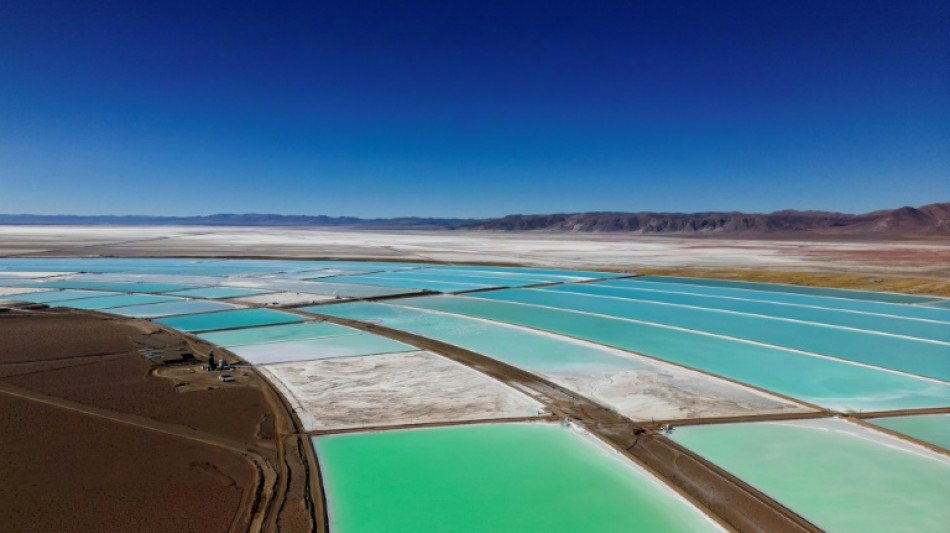
Argentine lithium a boon for some, doom for others / Photo: LUIS ROBAYO - AFP
Anahi Jorge, 23, works for a lithium extraction company in Argentina, earning four times the salary of a local government worker in her village of Susques.
And while she welcomes the income of about $1,700 per month -- a fortune for most in economic-crisis-riddled Argentina -- she laments the impact on critical water resources in her town and the wider Jujuy province.
"Lithium is good and bad at the same time," Jorge told AFP.
"The water issue is harmful to us, but it (lithium) is good for the people who are employed."
Lithium is a critical ingredient in electric car batteries and crucial for the global shift away from fossil fuels.
There are growing concerns, however, about the impact on groundwater sources in regions already prone to extended droughts, as lithium extraction requires millions of liters of water per plant per day.
Susques, with a population of fewer than 4,000 people, is one of the closest settlements to the Olaroz salt flat, which hosts two of Argentina's four lithium production plants.
With its neighbors Chile and Bolivia, Argentina forms Latin America's so-called "lithium triangle," where the metal nicknamed "white gold" is found in quantities larger than anywhere else on Earth.
About 56 percent of the world's 89 million tons of identified lithium resources are found in the region, according to the US Geological Survey (USGS).
Argentina is the world's fourth-biggest producer of the metal.
In a country where nearly half the population lives below the poverty line, environmental concerns can take a backseat to more immediate needs.
"It's very difficult to refuse" the lithium boon, said Jorge.
Before the arrival of the plant, she recounted, young women like herself had no option but to move to the provincial capital to work as domestic servants for a pittance.
- 'Nowhere to go' -
Between the mud houses of Susques, buildings of concrete and brick have started to appear as the local economy has seen some money trickle down from the lithium boom.
The community, though, still lacks adequate sewage systems or gas-pipe infrastructure.
Some residents, many of them Indigenous, have used their savings from years of work on lithium plants to start their own companies, running transport for workers or starting small hotels.
Susques town representative Benjamin Vazquez told AFP 60 percent of the population works in lithium.
But it is not a stable prospect.
The price of a ton of lithium dropped from nearly $70,000 in 2022 to just over $12,000 this year, the kind of dramatic fluctuation that brings mass job losses.
"Most of the guys here say: 'I'll finish high school and go work in mining'," said 19-year-old Camila Cruz, 19, who lives in Susques and studies medicine online.
"They don't realize that mining is not a job that's going to last forever. You will generate income but once it is over, if you have not studied, you will have nowhere to go," she told AFP.
- 'Major impacts' -
Unlike in Australia -- which extracts the metal from rock -- in South America it is derived from salars, or salt flats, where saltwater containing lithium is brought from underground briny lakes to the surface to evaporate.
At projects such as Olaroz, between one and two million liters of brine water evaporate for every ton of lithium, with another 140,000 liters of fresh water needed to clean the extracted metal, according to Argentina's CEMA Chamber of Environmental Entrepreneurs.
Susques resident Natividad Bautista Sarapura, 59, told AFP that in the countryside where she raises livestock as a subsistence farmer, "there is no water."
"Before, you could find water at two or three meters, now (you have to dig) deeper and deeper," he said.
In its 2024 World Water Development Report 2024, the UN said lithium extraction from salt flats "has major impacts on groundwater and the lives of local communities, as well as on the environment."
French mining group Eramet and China's Tsingshan recently inaugurated a new lithium production plant in Argentina.
They said it will use a less-damaging "direct extraction method" to produce up to 24,000 tons of battery-grade lithium carbonate per year at full capacity -- enough for 600,000 electric vehicle batteries.
H.Yousef--DT



