Dubai Telegraph - In Colombia, hungry beetle larvae combat trash buildup

EUR -
AED 4.210499
AFN 72.796213
ALL 94.461752
AMD 422.020011
ANG 2.052384
AOA 1052.326771
ARS 1679.881759
AUD 1.63659
AWG 2.066251
AZN 1.953303
BAM 1.955297
BBD 2.308106
BDT 140.663801
BGN 1.938299
BHD 0.432188
BIF 3421.780125
BMD 1.146325
BND 1.479519
BOB 7.918997
BRL 5.906215
BSD 1.146005
BTN 108.029372
BWP 15.573585
BYN 3.184181
BYR 22467.97
BZD 2.304717
CAD 1.624933
CDF 2613.621415
CHF 0.926076
CLF 0.026285
CLP 1034.512913
CNY 7.760166
CNH 7.776084
COP 3957.893401
CRC 519.866215
CUC 1.146325
CUP 30.377613
CVE 110.510194
CZK 24.17726
DJF 203.72533
DKK 7.470032
DOP 66.949832
DZD 152.856753
EGP 57.300762
ERN 17.194875
ETB 181.549268
FJD 2.562614
FKP 0.86629
GBP 0.867794
GEL 3.038209
GGP 0.86629
GHS 12.867544
GIP 0.86629
GMD 84.259302
GNF 10059.002282
GTQ 8.74175
GYD 239.719355
HKD 8.983611
HNL 30.589728
HRK 7.535022
HTG 149.691478
HUF 351.715881
IDR 20434.733348
ILS 3.402911
IMP 0.86629
INR 108.133415
IQD 1501.68575
IRR 1576196.875404
ISK 143.898619
JEP 0.86629
JMD 181.073402
JOD 0.81279
JPY 184.907999
KES 148.338813
KGS 100.246562
KHR 4596.763652
KMF 492.350937
KPW 1031.692901
KRW 1751.183826
KWD 0.352988
KYD 0.954929
KZT 559.241447
LAK 25282.198275
LBP 102653.40415
LKR 382.461576
LRD 208.803536
LSL 18.805507
LTL 3.3848
LVL 0.6934
LYD 7.307867
MAD 10.574893
MDL 20.237262
MGA 4814.565397
MKD 61.595297
MMK 2406.686258
MNT 4104.327632
MOP 9.251919
MRU 45.922214
MUR 54.852085
MVR 17.711155
MWK 1991.16692
MXN 19.883752
MYR 4.743383
MZN 73.262063
NAD 18.804002
NGN 1559.506815
NIO 41.96739
NOK 11.122344
NPR 172.851518
NZD 1.99898
OMR 0.441315
PAB 1.14601
PEN 3.879208
PGK 5.029788
PHP 69.600846
PKR 319.05095
PLN 4.257165
PYG 7037.250395
QAR 4.173201
RON 5.236532
RSD 117.120453
RUB 83.800079
RWF 1678.2198
SAR 4.296702
SBD 9.241012
SCR 15.685465
SDG 688.372376
SEK 10.992483
SGD 1.481515
SHP 0.855847
SLE 28.371969
SLL 24037.866288
SOS 655.128936
SRD 42.875425
STD 23726.613079
STN 24.531355
SVC 10.02742
SYP 126.705707
SZL 18.803912
THB 37.703052
TJS 10.628811
TMT 4.012138
TND 3.337812
TOP 2.760076
TRY 53.257148
TTD 7.771034
TWD 36.355741
TZS 3015.963923
UAH 51.481152
UGX 4170.926637
USD 1.146325
UYU 45.818209
UZS 13761.632008
VES 695.398184
VND 30159.81075
VUV 135.418733
WST 3.154451
XAF 655.788237
XAG 0.017686
XAU 0.000276
XCD 3.098001
XCG 2.065269
XDR 0.806666
XOF 647.674005
XPF 119.331742
YER 273.517259
ZAR 18.861706
ZMK 10318.306372
ZMW 20.541803
ZWL 369.116182
  • CMSC

    0.0500

    22.37

    +0.22%

  • CMSD

    0.0000

    22.29

    0%

  • NGG

    -1.2400

    79.44

    -1.56%

  • RBGPF

    -0.5300

    60.61

    -0.87%

  • BCE

    0.0000

    23.28

    0%

  • BTI

    -0.5800

    58.91

    -0.98%

  • BCC

    3.8500

    74.66

    +5.16%

  • RELX

    -0.8300

    31.18

    -2.66%

  • GSK

    -1.4800

    50.67

    -2.92%

  • JRI

    0.0500

    12.67

    +0.39%

  • VOD

    -0.2300

    14.3

    -1.61%

  • BP

    -1.0400

    39.1

    -2.66%

  • RYCEF

    -0.0300

    18.4

    -0.16%

  • RIO

    -2.5900

    100.08

    -2.59%

  • AZN

    -2.9600

    174.93

    -1.69%

In Colombia, hungry beetle larvae combat trash buildup
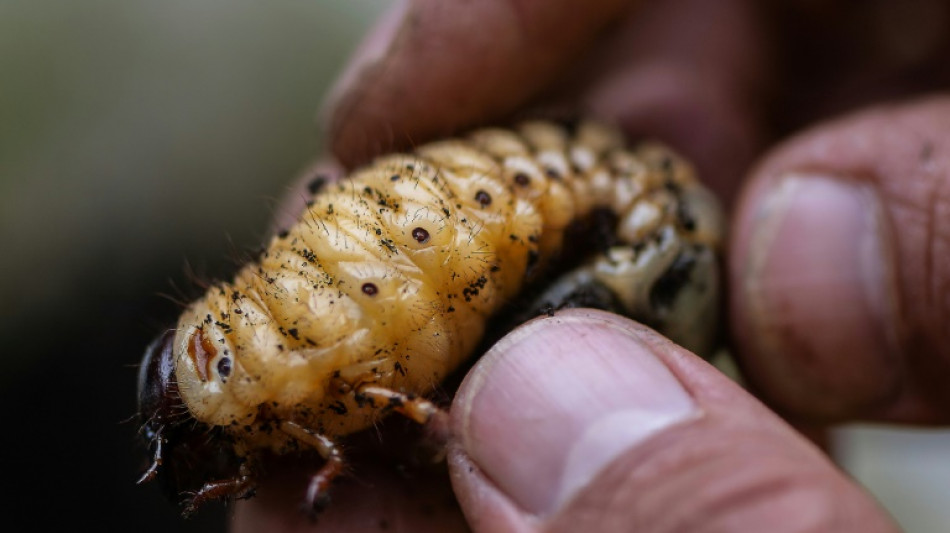
In Colombia, hungry beetle larvae combat trash buildup / Photo: Luis ACOSTA - AFP

In Colombia, hungry beetle larvae combat trash buildup

In the far-flung Colombian highlands, beetles are the secret weapon in an innovative project to combat the ever-growing problem of trash buildup.

Text size:

Here, larvae of the enormous rhinoceros beetle eat through piles of organic garbage that would otherwise end up in polluting landfills.

But that's not all. The larvae poop is gathered and sold as fertilizer, and when the beetles reach adulthood, they are sold as pets to clients as far afield as Japan.

"The beetles have the answer" to rubbish disposal, said environmental and health engineer German Viasus, who runs the project in Colombia's central Boyaca region.

The concept is simple, cheap and, Viasus believes, an example that would be easy to replicate elsewhere in the world.

Each week, his facility in the city of Tunja receives about 15 tons of waste generated by some 40,000 inhabitants of neighboring municipalities.

It is piled up as food for the voracious larvae, which can grow to the length of a human hand.

Other larvae are held in tanks where they consume leachate -- a fluid produced by organic waste decomposition that can be damaging to ecosystems.

- 'Cutting edge' -

Official Colombian estimates are that the South American country produces some 32,000 tons of garbage every day -- more than 2,600 school buses -- about half of it organic.

Worldwide, some 11.2 billion tons of trash are generated each year, according to the UN.

With the landfill in Tunja fast approaching its end date, Viasus's larvae offer an alternative solution to a major headache.

The engineer stumbled on the idea by chance when in 2000, after a similar project using earthworms had failed, he found scarab beetle larvae feasting on the contents of a garbage bag.

The ones he has today are all descendents of those first foundlings.

The larvae live for about four months before starting their metamorphosis and acquiring their characteristic hard shells. The beetles have a lifespan ranging from a few months to about three years.

At this point, Viasus sells them to clients in countries including Germany, Canada, France, the United States and Japan -- where they are a popular pet.

Some find homes in Colombia, where many see them as good luck charms.

To avoid the fees associated with payments in yen, euros and dollars, Viasus teamed up with crypto wiz Carmelo Campos to develop a digital currency called Kmushicoin after the Japanese name for a horned beetle.

Today in Tunja, but also cities such as Bogota and Medellin, a handful of businesses accept the currency as payment.

"The world is so polluted, we are suffocating with this junk," electronics vendor Jefferson Bastidas told AFP in Tunja, saying he joined the initiative to aid the environment and place his business at the "cutting edge of technology."

H.Hajar--DT



