
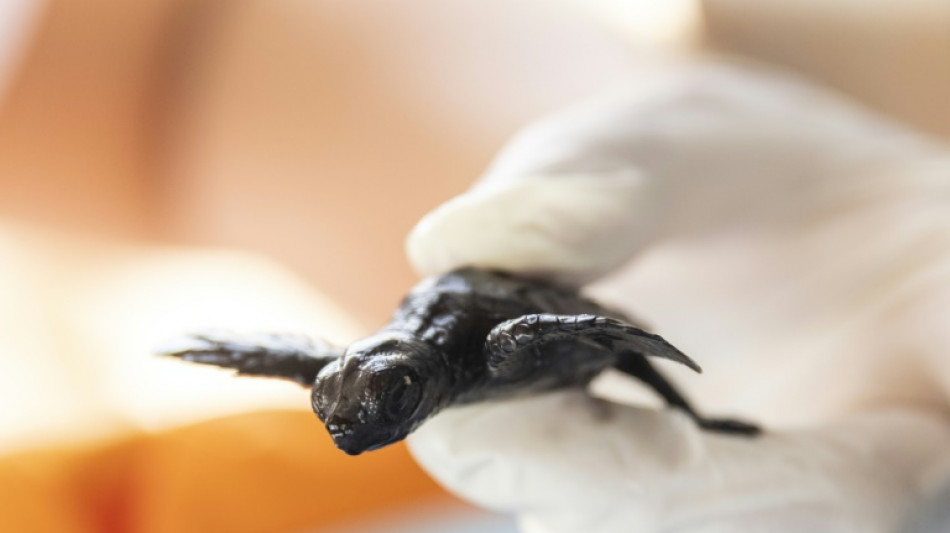
Moonlit scramble across the sand for Turkey's booming baby turtle population / Photo: KEMAL ASLAN - AFP
The baby loggerhead sea turtles emerged from their eggshells and began their first challenge in life: a wobbly dash across the sand to the moonlit waters of Turkey's Mediterranean coast -- sometimes with a helping hand from volunteers.
It is a perilous journey into the unknown for the sea turtles as only about one in 1,000 hatchlings will survive to adulthood.
Some 25 years later, the females will return to the beach where they were born to lay their own eggs.
Despite grave threats from humans and predators such as birds, crabs and ants, protection measures are bearing fruit on Turkey's southern coast.
In Manavgat, a tourist hotspot nestled in the foothills of mountains and prized for its golden sands and stunning waterfall, the number of nests has doubled from last year to 700.
A group of volunteers holds vigil around the clock along the 10-kilometre (six-mile) coastline, located east of the local tourism capital of Antalya.
It is a major breeding area for the globally endangered loggerheads -- also known as caretta caretta -- which are on the International Union for Conservation of Nature's (IUCN) red list of threatened species.
"Our average estimate this year is around 60,000 eggs; 30,000 of them will become babies; only 30 of them will come back years later" to breed, Seher Akyol, founding president of DEKAFOK marine conservation centre, told AFP.
- Red lights -
Turkey's southern coast is home to 21 official nesting areas -- eight of them in Antalya alone.
Protection measures have been put in place such as limiting the use of light and the speed of sea vessels.
Many beaches are declared protected areas and are off-limits from 8 pm to 8 am.
Manavgat, though, is not one of them, so volunteers have taken on the task of protecting the breeding nests.
Akyol's volunteers, including young students from all over Turkey and abroad, mark the nests, framing them with sticks and keeping the eggs protected from sunbathers.
At night, they patrol beaches, dig in nests with their bare hands and, donning white gloves, help baby turtles break from their shells and crawl to the sea.
Local officials also support volunteer initiatives.
Manavgat's mayor, Niyazi Nefi Kara, has placed red lights on roadsides along the coast. Signs that read "Attention! Caretta Nesting Area" dot the beach.
Under the environment law, anyone who damages sea turtles and their nests can be fined 387,141 liras ($11,700).
Kara said his office takes advice from "scientists and environmentalists" on protecting the turtles.
"After all, we need to learn how to live in harmony with nature," he said.
Akyol added that "people and caretta caretta can live together".
Songul Sert, 33, who was picnicking with her family around a wooden table near the beach, said "we do our best so as not to usurp their living space" with help from the signs.
Another local, Hasan Gulec, said that previously a lack of signs meant that "nobody knew where they were breeding, so anyone could walk on nests".
However, an AFP team saw some hotels along the beach still using the bright white lights that anger environmentalists.
-Climate change-
Loggerheads, whose overall numbers are unknown, can live for up to 80 years. Their weight ranges from 90-180 kilogrammes (200-400 pounds) and they can reach 1.2 metres (four feet) in length.
The small percentage of hatchlings that return to the beach to breed is why "they are endangered and need to be protected," Professor Mehmet Cengiz Deval of Akdeniz University's faculty of fisheries told AFP.
Loggerhead sea turtles are found primarily in subtropical and temperate regions of the Atlantic, Pacific and Indian Oceans, and in the Mediterranean Sea.
According to IUCN, the Mediterranean loggerhead is considered of "least concern", though the species remains vulnerable globally.
Climate change is also a factor that threatens the species.
The sex of hatchlings is determined by the temperature of the sand: cooler temperatures produce males and warmer ones produce females.
High temperatures from July onwards means that "most of the babies are females," Deval said.
"If this trend continues, in 30-40 years females will be the majority and there will be no male partners for them to breed. This is the biggest danger."
Akyol, who dreams of building a rehabilitation centre to treat injured turtles, cannot hide her excitement each time she sends them off to the water.
"I cannot forget their last look before meeting with the water," she said. "It's as if they show how grateful they are."
I.Mansoor--DT



