Dubai Telegraph - World's rarest whale washes up on New Zealand beach

EUR -
AED 4.21834
AFN 74.661225
ALL 91.432306
AMD 416.419413
ANG 2.056463
AOA 1054.440663
ARS 1739.601242
AUD 1.608272
AWG 2.06753
AZN 1.957227
BAM 1.955422
BBD 2.310453
BDT 140.872738
BGN 1.933647
BHD 0.432416
BIF 3448.932551
BMD 1.148628
BND 1.465916
BOB 11.270819
BRL 5.906291
BSD 1.147178
BTN 109.921728
BWP 15.556989
BYN 3.470128
BYR 22513.103189
BZD 2.307154
CAD 1.607907
CDF 2654.479062
CHF 0.944743
CLF 0.027911
CLP 1102.062801
CNY 7.693107
CNH 7.700293
COP 3628.597782
CRC 513.200684
CUC 1.148628
CUP 30.438634
CVE 110.243665
CZK 24.347696
DJF 204.280467
DKK 7.475389
DOP 67.706897
DZD 153.990199
EGP 60.011386
ERN 17.229416
ETB 187.378938
FJD 2.545249
FKP 0.85749
GBP 0.857921
GEL 2.990867
GGP 0.85749
GHS 13.215443
GIP 0.85749
GMD 84.42856
GNF 10085.048308
GTQ 8.754306
GYD 240.003554
HKD 9.011042
HNL 30.79504
HRK 7.534658
HTG 149.930985
HUF 364.287725
IDR 20459.4717
ILS 3.487958
IMP 0.85749
INR 110.194179
IQD 1502.809171
IRR 1578903.655694
ISK 139.202636
JEP 0.85749
JMD 181.144944
JOD 0.814422
JPY 180.197158
KES 148.551252
KGS 100.447935
KHR 4649.100291
KMF 491.613064
KPW 1033.765308
KRW 1592.044397
KWD 0.353962
KYD 0.956015
KZT 512.880746
LAK 25706.025284
LBP 102727.519827
LKR 379.706518
LRD 198.461593
LSL 18.650291
LTL 3.391599
LVL 0.694794
LYD 7.28659
MAD 10.868997
MDL 20.161098
MGA 4973.037601
MKD 61.513096
MMK 2411.927194
MNT 4131.777436
MOP 9.269406
MRU 46.150069
MUR 54.640655
MVR 17.746733
MWK 1989.21504
MXN 19.789482
MYR 4.690656
MZN 73.40923
NAD 18.650291
NGN 1529.662418
NIO 42.211831
NOK 10.809019
NPR 175.874964
NZD 1.993627
OMR 0.442634
PAB 1.147178
PEN 3.871151
PGK 5.106012
PHP 72.2606
PKR 317.962167
PLN 4.363465
PYG 6800.683909
QAR 4.193089
RON 5.263476
RSD 117.367287
RUB 96.581309
RWF 1685.17388
SAR 4.316112
SBD 9.18961
SCR 16.119885
SDG 690.903792
SEK 11.290555
SGD 1.465883
SHP 0.858627
SLE 28.314099
SLL 24086.139517
SOS 655.573131
SRD 43.585257
STD 23774.274604
STN 24.49526
SVC 10.038057
SYP 14934.457826
SZL 18.644392
THB 38.275765
TJS 10.582452
TMT 4.031683
TND 3.374547
TOP 2.76562
TRY 56.015171
TTD 7.787493
TWD 36.503811
TZS 3039.911706
UAH 51.253181
UGX 4525.124283
USD 1.148628
UYU 46.131073
UZS 13582.371494
VES 973.444877
VND 29889.590367
VUV 135.48724
WST 3.159056
XAF 655.957
XAG 0.01734
XAU 0.000262
XCD 3.104224
XCG 2.0675
XDR 0.812139
XOF 655.957
XPF 119.331742
YER 271.708303
ZAR 18.688024
ZMK 10339.031894
ZMW 22.547637
ZWL 369.857655
SSP 6560.977546
MXV 2.243573
  • RYCEF

    0.7100

    20

    +3.55%

  • RBGPF

    -1.6900

    68.3

    -2.47%

  • CMSC

    0.0400

    20.71

    +0.19%

  • GSK

    -0.8400

    50.22

    -1.67%

  • AZN

    -0.0600

    166.08

    -0.04%

  • BTI

    -0.1900

    55.83

    -0.34%

  • RIO

    -0.6700

    97.37

    -0.69%

  • NGG

    -0.8000

    76.8

    -1.04%

  • VOD

    -0.5700

    16.95

    -3.36%

  • RELX

    -0.9700

    33.41

    -2.9%

  • BP

    -0.8400

    44.58

    -1.88%

  • CMSD

    0.0000

    20.45

    0%

  • BCE

    -0.2200

    22.06

    -1%

  • JRI

    -0.0600

    11.55

    -0.52%

  • BCC

    0.1600

    75.69

    +0.21%

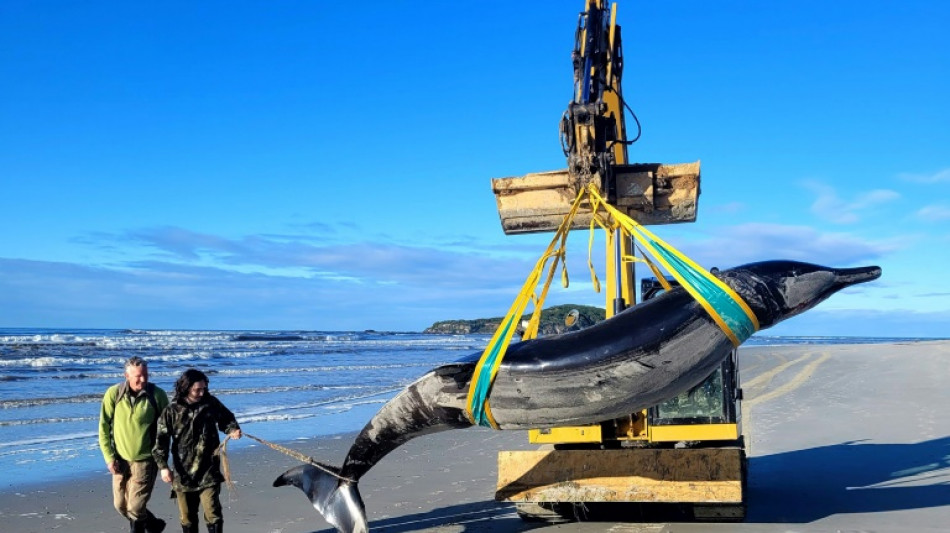
World's rarest whale washes up on New Zealand beach
World's rarest whale washes up on New Zealand beach / Photo: Handout - New Zealand Department of Conservation/AFP

World's rarest whale washes up on New Zealand beach

The body of a spade-toothed whale -- a species so rare it has never been seen alive -- appears to have washed up on a New Zealand beach, scientists say.

Text size:

The remains of the obscure, five-metre (16.4 foot) long, beaked creature were found near a river mouth in southern Otago province on July 4, government researchers said.

It was identified by marine-mammal experts from New Zealand's Department of Conservation and the national museum, Te Papa, as a male spade-toothed whale.

A DNA investigation has been launched to confirm its classification, the scientists said.

"Spade-toothed whales are one of the most poorly known large mammalian species of modern times," said the conservation department's coastal Otago operations manager, Gabe Davies.

"Since the 1800s, only six samples have ever been documented worldwide, and all but one of these was from New Zealand," Davies said in a statement Monday.

"From a scientific and conservation point of view, this is huge."

The find was fresh enough to offer the first opportunity for a spade-toothed whale to be dissected, the conservation department said.

The species is "so rare next to nothing is known about them", it said.

- 'International importance' -

The body of the whale has been placed in cold storage and genetic samples have been sent to the University of Auckland as curators of the New Zealand Cetacean Tissue Archive.

It may take several weeks or months for the DNA to be processed and a final identification confirmed.

"The rarity of the whale means conversations around what to do next will take more time because it is a conversation of international importance," the conservation department said.

The species was first described in 1874 from just a lower jaw and two teeth collected from the Chatham Islands off the east coast of New Zealand.

That sample, along with skeletal remains of two other specimens found in New Zealand and Chile, enabled scientists to confirm a new species.

Marine scientist Vanessa Pirotta said researchers would study the whale's stomach contents, genetics, and how this sample compared to previous ones.

This could shine light on the whales' behaviour, their population and why they are so rare, Pirotta told AFP, describing the discovery as "like hitting the jackpot".

Because so few specimens have been found and there have been no live sightings, little is known about the spade-toothed whale and it is classified as "data deficient" under New Zealand's Threat Classification System.

The first intact specimen was from a mother and calf stranding in Bay of Plenty in 2010, the New Zealand conservation department said.

A further stranding in 2017 in Gisborne added one more specimen to the collection.

A.Ansari--DT



