
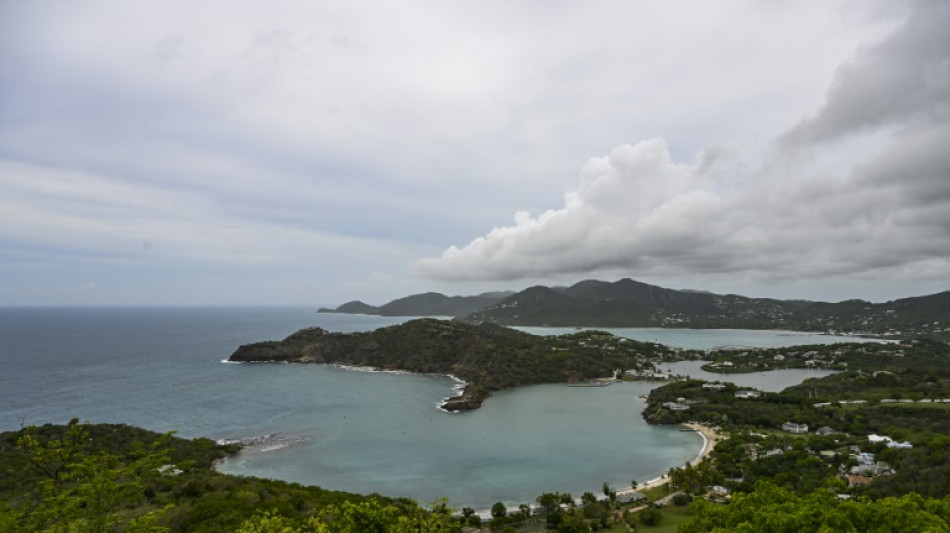
World's island states meet to confront climate, fiscal challenges / Photo: CHANDAN KHANNA - AFP
Extremely vulnerable to climate change, not rich enough to stop it on their own, and not poor enough to depend on aid and development financing: the world's small island countries are bracing for both fiscal and climate shocks.
Both will be high on the agenda this week as Small Island Developing States (SIDS), as they're formally known, meet Monday at their fourth UN Conference, in the Caribbean nation of Antigua and Barbuda.
Caught between rising debts and rising oceans, from the Caribbean to Africa to the Pacific, many SIDS share characteristics that make them especially vulnerable to external shocks: small landmasses home to scattered and isolated populations, with import dependent, non-diversified economies.
And climate change -- with its brutal droughts, powerful hurricanes and rising seas -- is threatening to erase some of them from the map altogether.
"The next ten years are critical for SIDS," reads the draft document set to be adopted at the UN conference, which will bring together countries ranging from Asian economic heavyweight Singapore to Cape Verde in Africa to the Bahamas.
High on the agenda for the 39 states, whose populations number roughly 65 million people: increasing climate financing, even as many criticize the slow pace of fulfilling previous UN aid pledges.
"The harsh truth is for these countries, climate change is already a reality," Achim Steiner, head of the UN Development Program (UNDP), told AFP. "Because of their smallness as economies... one extreme weather event can literally throw a country back 5-10 years in its development."
"One hurricane, one typhoon that crosses -- by sheer lottery of bad luck -- the terrain of a small island developing state can wipe out a third or more of the entire infrastructure of a country."
But most small island states are classified as middle-income countries or higher -- meaning that they're unable to access international aid and preferential financing available to the world's poorest countries.
Additionally, many already are also facing strained debt loads. As a whole, the UN estimates SIDS will spend 15.9 percent of government revenues in 2024 on interest alone.
"They are being trapped in a no man's land where financing from the international community that is often a kind of safety net is simply not available to them," Steiner said.
According to the UNDP, some $4.7-7.3 billion in financing is needed per year just for climate adaptation measures in SIDS countries.
"SIDS cannot be left to drown in crises not of their own making. This would have catastrophic consequences for the entire world," said Fatumanava-o-Upolu III Dr Pa'olelei Luteru, Samoa's ambassador to the UN.
- 'Blue economy' -
Beyond seeking outside aid, however, many are also turning toward reforming their own economies.
Priorities include developing renewable energy sectors and engaging in the so-called "blue economy" of sustainable fishing and ocean conservation -- a serious opportunity for SIDS countries, which account for 19 percent of the world's Exclusive Economic Zones.
Tourism, too, can be made more sustainable -- though the specter of climate change hangs over these countries' marine biodiversity and coral reefs, which draw scuba divers from across the world.
Even just getting there has increasingly come under scrutiny as airplane travel comes under fire for its heavy emissions -- a sort of "double punishment," said Steiner.
The effects of climate change also overlap with other issues many poor or otherwise marginalized people in small island countries face, which must be confronted domestically, said Nicole Leotaud, executive director of the Caribbean Natural Resources Institute.
"They are already marginalized because they are poor," she said. "They are already marginalized because of their gender or their race."
"And these climate impacts are another layer of injustice to these people."
Y.Rahma--DT



