
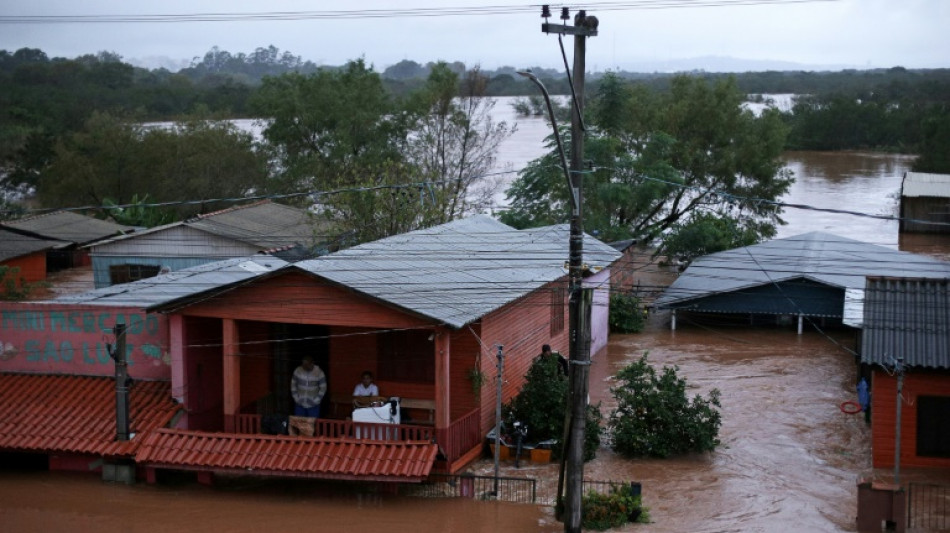
Dams strain as water, death toll, keep rising in south Brazil / Photo: Anselmo Cunha - AFP
The death toll from floods and mudslides triggered by torrential storms in southern Brazil climbed to 39 Friday, officials said, as they warned of worse to come.
As the rain kept beating down, rescuers in boats and planes searched for dozens of people reported missing among the ruins of collapsed homes, bridges and roads.
Rising water levels in the state of Rio Grande do Sul was putting strain on dams and threatening the metropolis of Porto Alegre with "unprecedented" flooding, authorities warned.
"Forget everything you've seen, it's going to be much worse in the metropolitan region," governor Eduardo Leite said Friday as streets of the state capital, with a population of some 1.5 million, started flooding after days of heavy downpours in the region.
The state's civil defense department said at least 265 municipalities have suffered storm damage in Rio Grande do Sul since Monday, injuring 74 people and displacing more than 24,000 -- a third of whom have been brought to shelters.
At least 68 people were missing, and more than 350,000 have experienced some form of damage, according to the latest data.
And there was no end in sight, with officials reporting an "emergency situation, presenting a risk of collapse" at four dams in the state.
- 'Disastrous cocktail' -
The level of the state's main Guiaba river, meanwhile, was estimated to have risen 4.2-4.6 meters (about 13.7-15 feet), but could not be measured as the gages have washed away, the mayor of Porto Alegre said.
As it kept rising, officials raced to reinforced flood protection.
Porto Alegre's worst recorded flood was in 1941, when the river reached a level of 4.71 meters.
Elsewhere in the state, several cities and towns have been completely cut off from the world in what governor Leite described as "the worst disaster in the history" of Rio Grande do Sul.
Many communities have been left without access to drinking water, telephone or internet services.
Tens of thousands had no electricity.
President Luiz Inacio Lula da Silva visited the region Thursday, vowing "there will be no lack of human or material resources" in responding to the disaster, which he blamed on climate change.
The central government has sent aircraft, boats and more than 600 soldiers to help clear roads, distribute food, water and mattresses, and set up shelters.
School classes have been suspended state-wide.
Climatologist Francisco Eliseu Aquino told AFP on Friday the devastating storms were the result of a "disastrous cocktail" of the El Nino weather phenomenon and global warming combined.
South America's largest country has recently experienced a string of extreme weather events, including a cyclone in September that claimed at least 31 lives.
Aquino said the region's particular geography meant it was often confronted by the effects of tropical and polar air masses colliding -- but these events have "intensified due to climate change."
And when they coincide with El Nino, a periodic weather system that warms the tropical Pacific, the atmosphere becomes more unstable "and conducive to storms in the Rio Grande do Sul," he said.
Extreme flood hit the state in the last two years at "a level of recurrence not seen in 10,000 years," said Aquino, who heads the Federal University of Rio Grande do Sul's geography department.
Brazil's north recently experienced an historic drought, and the number of forest fires reached a record in the first four months of this year.
"Rain in the south, fire in the north... These two tragedies bear the fingerprints of the climate crisis," the Climate Observatory NGO warned in a statement.
H.Nadeem--DT



