Dubai Telegraph - Norway women bring seaweed to culinary heights in Europe

EUR -
AED 4.31455
AFN 75.17582
ALL 95.497748
AMD 434.609215
ANG 2.102431
AOA 1078.299107
ARS 1629.799413
AUD 1.621782
AWG 2.115782
AZN 1.997833
BAM 1.949267
BBD 2.366459
BDT 144.435342
BGN 1.959384
BHD 0.443243
BIF 3494.490103
BMD 1.174619
BND 1.487509
BOB 8.118757
BRL 5.802377
BSD 1.174957
BTN 111.168968
BWP 15.722243
BYN 3.318066
BYR 23022.523033
BZD 2.363071
CAD 1.601181
CDF 2720.416217
CHF 0.914334
CLF 0.026757
CLP 1053.08021
CNY 8.00062
CNH 8.003075
COP 4377.638785
CRC 536.101092
CUC 1.174619
CUP 31.127391
CVE 110.355846
CZK 24.315545
DJF 208.753027
DKK 7.472242
DOP 69.948993
DZD 155.426683
EGP 61.927887
ERN 17.619278
ETB 184.530583
FJD 2.565308
FKP 0.86525
GBP 0.864046
GEL 3.147258
GGP 0.86525
GHS 13.214287
GIP 0.86525
GMD 86.334925
GNF 10313.150391
GTQ 8.968904
GYD 245.775292
HKD 9.203725
HNL 31.279893
HRK 7.533412
HTG 153.749219
HUF 358.757838
IDR 20341.69118
ILS 3.410628
IMP 0.86525
INR 111.038683
IQD 1538.750264
IRR 1542274.119942
ISK 143.785121
JEP 0.86525
JMD 185.131149
JOD 0.832823
JPY 183.603453
KES 151.737226
KGS 102.685737
KHR 4714.328613
KMF 492.164793
KPW 1057.160776
KRW 1697.429557
KWD 0.361712
KYD 0.979115
KZT 544.084304
LAK 25806.369524
LBP 104988.695268
LKR 376.137855
LRD 215.630544
LSL 19.422288
LTL 3.468343
LVL 0.710515
LYD 7.447119
MAD 10.804726
MDL 20.197227
MGA 4886.413132
MKD 61.626822
MMK 2466.169432
MNT 4204.722635
MOP 9.48288
MRU 46.860325
MUR 54.960077
MVR 18.153718
MWK 2046.185399
MXN 20.262636
MYR 4.610383
MZN 75.069563
NAD 19.422339
NGN 1600.253173
NIO 43.13183
NOK 10.911504
NPR 177.87015
NZD 1.969841
OMR 0.451696
PAB 1.174957
PEN 4.067112
PGK 5.095789
PHP 71.404705
PKR 327.454346
PLN 4.232021
PYG 7190.901262
QAR 4.280334
RON 5.265784
RSD 117.377293
RUB 87.795473
RWF 1714.943042
SAR 4.399208
SBD 9.419773
SCR 16.367148
SDG 705.356436
SEK 10.854181
SGD 1.4893
SHP 0.876971
SLE 28.954576
SLL 24631.158596
SOS 671.301108
SRD 43.943644
STD 24312.231862
STN 24.901913
SVC 10.280503
SYP 130.621923
SZL 19.428198
THB 37.834281
TJS 10.979956
TMT 4.117038
TND 3.374091
TOP 2.8282
TRY 53.113783
TTD 7.962282
TWD 36.868914
TZS 3044.826098
UAH 51.515534
UGX 4418.174644
USD 1.174619
UYU 47.21178
UZS 14183.51893
VES 579.670053
VND 30921.832595
VUV 138.899141
WST 3.197999
XAF 653.763272
XAG 0.015185
XAU 0.00025
XCD 3.174466
XCG 2.117594
XDR 0.818038
XOF 654.851416
XPF 119.331742
YER 280.293319
ZAR 19.256347
ZMK 10572.975752
ZMW 22.236385
ZWL 378.226685
  • CMSD

    0.1300

    23.42

    +0.56%

  • RBGPF

    0.0800

    63.18

    +0.13%

  • JRI

    0.1300

    13.17

    +0.99%

  • CMSC

    0.1300

    23.01

    +0.56%

  • BCC

    2.1100

    74.24

    +2.84%

  • BCE

    0.1300

    24.23

    +0.54%

  • RELX

    -0.4100

    35.75

    -1.15%

  • NGG

    0.2100

    87.85

    +0.24%

  • RYCEF

    1.0500

    17.5

    +6%

  • RIO

    5.0100

    105.51

    +4.75%

  • VOD

    0.3900

    16.13

    +2.42%

  • AZN

    3.6800

    184.92

    +1.99%

  • BTI

    0.1600

    59.56

    +0.27%

  • GSK

    0.1500

    50.53

    +0.3%

  • BP

    -1.8700

    44.63

    -4.19%

Norway women bring seaweed to culinary heights in Europe
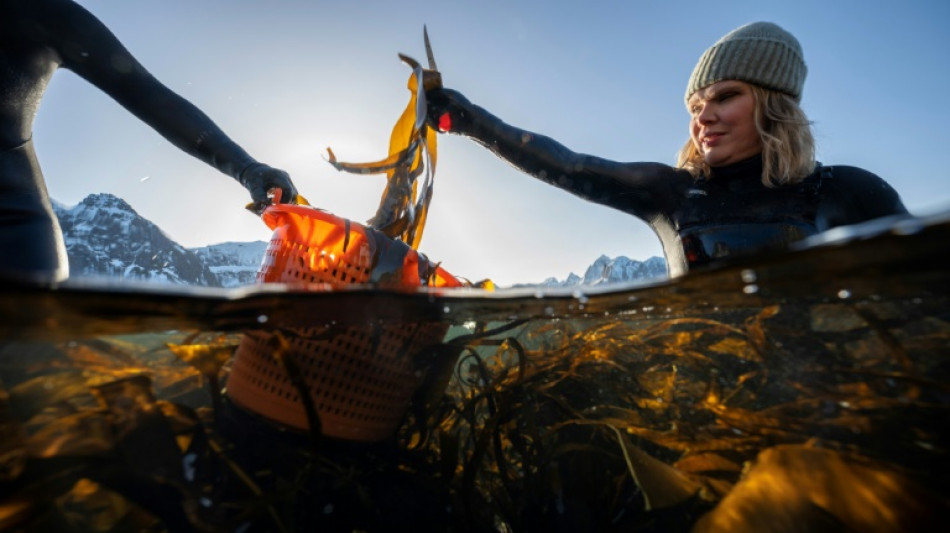
Norway women bring seaweed to culinary heights in Europe / Photo: Olivier MORIN - AFP

Norway women bring seaweed to culinary heights in Europe

In the glacial waters of the Lofoten archipelago in Norway's far north, Angelita Eriksen uses a knife to cut a handful of seaweed that will soon end up in a fancy European eatery.

Text size:

"We have the cleanest and clearest waters in the world. We're very lucky that we have this really important resource growing right outside our doorstep," Eriksen told AFP in a cabin on the shores of the northern Atlantic Ocean where the seaweed is laid out to dry.

"We want to show that to the world."

The daughter of a Norwegian fisherman, Eriksen joined forces with New Zealand-born Tamara Singer, whose Japanese mother served seaweed with almost every meal, to start the company Lofoten Seaweed -- specialising in harvesting and preparing seaweed for the food industry.

With the help of six others, they hand-pick 11 tonnes of seaweed a year, the snow-capped mountains plummeting into the sea behind them in a dramatic tableau.

It's a demanding and "physical job", said Eriksen.

The peak season runs from late April until June, but "we harvest the dulse, the nori and the sea truffle in the winter and fall".

"It can be quite cold, as we can stay out for about an hour along the shore", with lower legs and hands submerged in the chilly water.

By "late May, I'm actually sweating in my suit".

One time, she said, "I took my glove off and the steam was just rising up".

"It's physically hard but at the same time it's very meditative, or therapeutic in a way, to harvest," she says.

- 'Delicate' -

Truffle seaweed, winged kelp, nori, dulse, sugar kelp, oarweed kelp: the pair focus on about 10 types of seaweed, long eaten in Japan and increasingly popular in Europe for their nutritional qualities.

The seaweed is sold locally or shipped to gourmet restaurants in Norway and the rest of Europe.

The two women organise workshops to teach chefs about the different varieties and the qualities of each type.

"Seaweeds are like vegetables, they have their own texture, taste and colours," says Singer.

She said it was a "huge surprise" how many European chefs had little or no knowledge of the different flavours and ways of preparing seaweed.

The duo have worked with Japanese chefs "who know exactly what to do, you don't have to tell them anything".

"It's just so natural for them. It's like giving a piece of fish to a North Norwegian," says Singer.

Some 20 kilometres (12 miles) away, chef Josh Wing has been serving the pair's products in his high-end restaurant Hattvika Lodge for about five years.

He is well versed and does not need to take part in their workshops anymore.

Wing is particularly fond of the dulse, a "very delicate purple seaweed", which he serves with local fish dishes or bread.

It "can provide a physical texture in a dish that you can't get from other products", he tells AFP.

To ensure that their business is sustainable, Eriksen and Singer have mapped and dated their harvest sites, as well as the volumes of each species, for the past four years.

"Our results show that the regrowth in recently-harvested patches is actually faster than anticipated, almost as if a harvest actually stimulates growth," says Singer.

Z.W.Varughese--DT



