Dubai Telegraph - Global sea level jumped due to El Nino and climate change: NASA

EUR -
AED 4.236991
AFN 75.572023
ALL 93.392402
AMD 421.307604
AOA 1057.951276
ARS 1726.537236
AUD 1.637674
AWG 2.076675
AZN 1.941269
BAM 1.956764
BBD 2.320123
BDT 142.600268
BHD 0.43441
BIF 3442.49633
BMD 1.153709
BND 1.478128
BOB 13.990894
BRL 5.914602
BSD 1.151958
BTN 109.937173
BWP 15.664583
BYN 3.395144
BYR 22612.686665
BZD 2.316822
CAD 1.623025
CDF 2607.381253
CHF 0.934164
CLF 0.026742
CLP 1055.908837
CNY 7.791628
CNH 7.786275
COP 3698.83561
CRC 522.352868
CUC 1.153709
CUP 30.573275
CVE 110.319361
CZK 24.198812
DJF 205.129302
DKK 7.475111
DOP 67.182523
DZD 153.331351
EGP 57.42688
ERN 17.305628
ETB 184.737559
FJD 2.554253
FKP 0.857463
GBP 0.857119
GEL 3.01134
GGP 0.857463
GHS 13.49565
GIP 0.857463
GMD 85.374628
GNF 10116.985262
GTQ 8.78633
GYD 241.168839
HKD 9.049026
HNL 30.976643
HRK 7.535794
HTG 150.614217
HUF 362.341791
IDR 20674.456379
ILS 3.462354
IMP 0.857463
INR 109.795612
IQD 1511.934994
IRR 1586493.405669
ISK 141.786352
JEP 0.857463
JMD 182.138172
JOD 0.818017
JPY 182.115769
KES 149.266919
KGS 100.891772
KHR 4663.237235
KMF 493.786874
KRW 1644.438406
KWD 0.356934
KYD 0.959973
KZT 542.677411
LAK 26054.838825
LBP 103156.737553
LKR 386.770586
LRD 207.932461
LSL 18.672752
LTL 3.406601
LVL 0.697866
LYD 7.343352
MAD 10.733389
MDL 20.164937
MGA 4972.48339
MKD 61.555332
MMK 2421.982963
MNT 4151.271303
MOP 9.306807
MRU 46.251989
MUR 53.612641
MVR 17.836387
MWK 1997.466962
MXN 19.884743
MYR 4.723165
MZN 73.715631
NAD 18.990558
NGN 1572.066382
NIO 42.390889
NOK 10.988347
NPR 175.898151
NZD 1.967898
OMR 0.443607
PAB 1.151968
PEN 3.904721
PGK 5.102273
PHP 70.152972
PKR 320.55809
PLN 4.305929
PYG 6868.324915
QAR 4.199269
RON 5.249262
RSD 117.397979
RUB 93.162004
RWF 1692.490374
SAR 4.329325
SBD 9.312217
SCR 15.530153
SDG 692.787515
SEK 10.995661
SGD 1.479441
SLE 27.573691
SOS 658.318688
SRD 43.715183
STD 23879.43669
STN 24.511866
SVC 10.079967
SZL 18.972765
THB 38.320457
TJS 10.632539
TMT 4.049517
TND 3.384068
TRY 54.877415
TTD 7.820854
TWD 37.31206
TZS 3054.440924
UAH 51.509235
UGX 4314.125836
USD 1.153709
UYU 46.413072
UZS 13781.048421
VES 870.139933
VND 30284.271358
VUV 137.942013
WST 3.157414
XAF 656.274699
XAG 0.018723
XAU 0.000277
XCD 3.117955
XCG 2.07615
XDR 0.816195
XOF 656.274699
XPF 119.331742
YER 274.986839
ZAR 18.915511
ZMK 10384.756882
ZMW 21.800554
ZWL 371.493667
  • CMSC

    0.0300

    21.79

    +0.14%

  • RIO

    3.1100

    99.01

    +3.14%

  • NGG

    0.5600

    80.42

    +0.7%

  • RYCEF

    0.2000

    20.4

    +0.98%

  • BCE

    0.2100

    22

    +0.95%

  • GSK

    0.0200

    51.53

    +0.04%

  • BCC

    3.4600

    86.49

    +4%

  • BTI

    -0.4400

    59.12

    -0.74%

  • RBGPF

    -1.2500

    69.74

    -1.79%

  • CMSD

    0.0000

    22.02

    0%

  • JRI

    -0.1000

    12.72

    -0.79%

  • VOD

    0.0800

    15.69

    +0.51%

  • AZN

    -2.3500

    155.62

    -1.51%

  • RELX

    0.6400

    36.8

    +1.74%

  • BP

    -1.8200

    42.44

    -4.29%

Global sea level jumped due to El Nino and climate change: NASA
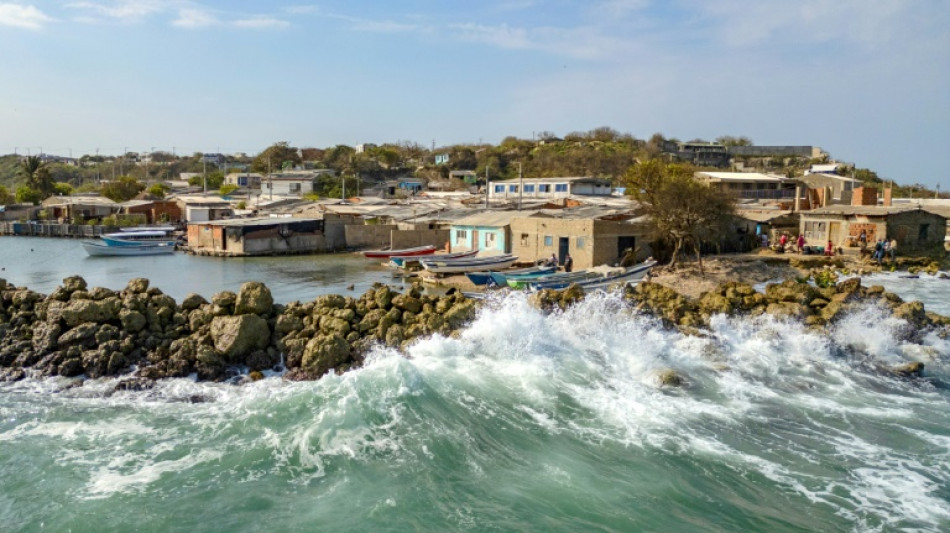
Global sea level jumped due to El Nino and climate change: NASA / Photo: Luis ACOSTA - AFP/File

Global sea level jumped due to El Nino and climate change: NASA

Global average sea level rose by about 0.3 inches (0.76 centimeters) from 2022 to 2023 -- nearly four times the increase of the previous year -- NASA said Thursday, attributing the "significant jump" to a strong El Nino and a warming climate.

Text size:

The NASA-led analysis is based on more than 30 years of satellite observations, with the initial satellite launching in 1992 and the latest in 2020.

Overall, sea levels have risen by around four inches since 1993. The rate of increase has also accelerated, more than doubling from 0.07 inches per year in 1993, to the current rate of 0.17 inches per year.

"Current rates of acceleration mean that we are on track to add another 20 centimeters of global mean sea level by 2050," said Nadya Vinogradova Shiffer, director for the NASA sea level change team and the ocean physics program in Washington.

That would be double the amount of change in the next three decades compared to the previous century, she said, creating a future where flooding is far more frequent and catastrophic than today.

The immediate cause of the spike is the El Nino weather effect, which replaced the La Nina from 2021 to 2022, when the sea level rose around 0.08 inches.

El Nino involves warmer-than-average ocean temperatures in the equatorial Pacific.

"In El Nino years, a lot of the rain that normally falls on land ends up in the ocean, which raises sea levels temporarily," said Josh Willis, a sea level researcher at NASA's Jet Propulsion Laboratory (JPL).

But there is also a clear human footprint evident in the underlying trend of acceleration.

"Long-term datasets like this 30-year satellite record allow us to differentiate between short-term effects on sea level, like El Nino, and trends that let us know where sea level is heading," said Ben Hamlington, lead for NASA's sea level change team at JPL.

Technological innovations have brought greater accuracy of measurements over the years. For example, radar altimeters bounce microwaves off the sea surface, then record the time the signal takes to travel back to the satellite, as well as the strength of the return signal.

They also cross-check their data with other sources like tide gauges and satellite measurements of atmospheric water vapor and Earth's gravity field.

T.Jamil--DT



