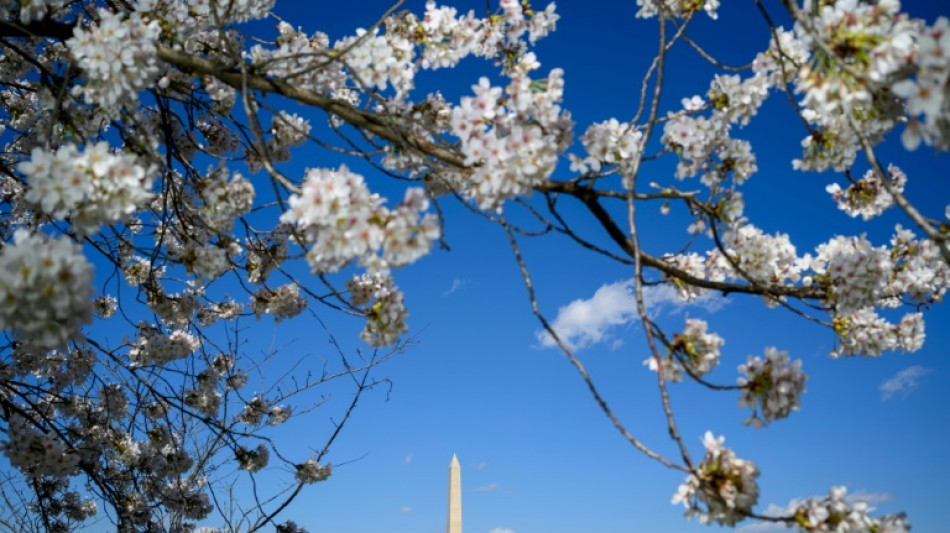
Climate change hits Washington's beloved cherry blossom festival / Photo: Mandel NGAN - AFP
It is one of the prettier fixtures of spring in Washington: thousands of cherry trees bloom amid the city's stately monuments in a spectacle that draws more than a million visitors every year.
But because of climate change, those eager to enjoy the clouds of pale pink petals and their almond-like scent have to get here earlier than they used to.
Warmer weather means the peak of this gigantic bloom starts around mid-March, on average six days earlier than a century ago.
This year, after the United States had its warmest winter on record, the cherry blossom pinnacle came on March 17. Only once before, in 1990, did the peak happen earlier.
"It is a real-world example of how climate change is affecting the nation's capital," said Mike Litterst, head of communications for the National Mall and Memorial Parks.
Another result of this greater warmth is that cherry trees lining the Tidal Basin -- a reservoir connected to the nearby Potomac River that is one of several spots where people can see the bloom -- are sometimes under several inches of water at their base because the inlet has overflowed.
This is due in part to higher sea levels, which also affect the flow in the Potomac.
The park service plans later this year to carry out major construction work to build up and improve an old, ineffective seawall meant to hold back the water, which will cause a disruption to the next two cherry blossom festivals.
Some 300 trees around the Tidal Basin, including 158 cherry trees, will be chopped down, to the dismay of some Washingtonians.
This decision was not taken lightly, said Litterst, adding that 455 trees, including 270 cherry trees, will eventually be planted once the seawall work is completed.
"Leaving things as they are is not an option because the end result of that eventually is no cherry trees" in this area, he told AFP.
- Serious consequences -
In 1912, the mayor of Tokyo gave the city of Washington roughly 3,000 cherry trees, as a gift of friendship. The National Mall, the vast green esplanade area in downtown Washington, now features around 3,700 of them.
They comprise about a dozen kinds of cherry trees, and along the Tidal Basin most are of a variety called Yoshino, with pale pink blossoms that people love to take selfies with.
This year the bloom cycle was also shorter than ever: it only took 15 days from when the first cherry buds appeared until the full bloom -- compared to the previous average of 26.
Last week temperatures in Washington surpassed 70 degrees Fahrenheit (20 degrees C) five days in a row, with winter not yet officially over.
This earlier and earlier peak of the bloom affects not just visitors' travel plans but could also have serious consequences for pollinating insects, said Litterst.
"What happens if we get to a point where we are reaching blossoms so early, that none of those pollinators are out," he mused.
- Goodbye to 'Stumpy' -
But Litterst said what most strikes him in his 10th cherry blossom season is the rising water levels from the Tidal Basin.
Ten years ago, say, some spots along the inlet would flood once a month at high tide but now they are covered with water every week or even every day, he said.
"It's been fascinating, if not a little bit scary to watch the effects of the water especially," he said.
"The water comes over the seawall here twice a day, every day during high tide. It's not a question of is it going to come over the wall? The question is how far inland is the water going to go?"
The current seawall was poorly constructed more than 100 years ago and has settled in some spots by five feet (1.5 meters) or so while water levels in the basin have gone up one foot(30 centimeters).
The work to build up the seawall will take three years and cost around $113 million. And crews will be able to add to the new structure and raise it if necessary to deal with even more water, Litterst said.
"I think it's so sad and hard, seeing how much climate change is really impacting us with this early bloom and with the ways that we can see the sea starting to take bites out of the city," said Caitlin Cotter Coillberg, a minister in suburban Washington.
"So I'm looking forward to seeing it again once they've repaired it," she added.
Besides the construction plans, and how they will disrupt the next two festivals, Washingtonians are also sad that one of the trees due to be cut down is Stumpy -- a short and oddly shaped ugly duckling star of the annual cherry blossom celebrations.
The other trees due to be felled will be turned into mulch -- but with Stumpy, cuttings will be taken to create new trees with its same DNA, if not the same unfortunate silhouette.
S.Saleem--DT