
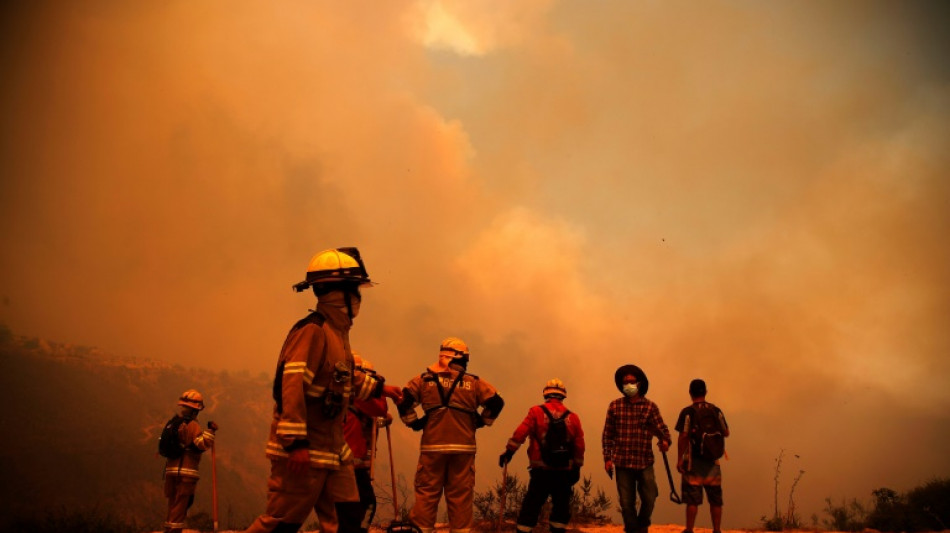
What to know about Chile's voracious wildfires / Photo: Javier TORRES - AFP
Coming in the middle of a fierce heatwave, Chile's forest fires engulfed communities with a destructive speed that has stunned the nation.
This is what you need to know about the country's deadliest wildfires in recent history:
- Why did fire spread so quickly? -
Summer is in full swing in Chile and a brutal heatwave has seen temperatures reach 40 degrees Celsius (104 degrees Fahrenheit) since last week.
On Friday, several fires broke out in the mountains that overlook the seaside town of Vina del Mar and other locations in the coastal Valparaiso region, some 120 kilometers (74 miles) from the capital Santiago.
Professor Miguel Castillo from the University of Chile's Faculty of Forestry Sciences said the ferocious heat and strong winds formed a "disastrous" combination.
He explained that when vegetation or garbage burns, light, hot air is generated which "lifts ignited particles or embers that travel hundreds of meters, causing satellite" fires.
On the hilly slopes of the coastal region, flames move faster downwind, exacerbating the danger.
On Sunday night some 40 fires remained active in the country.
- Why was the fire so deadly? -
At least 112 people have been killed, and almost one hundred are still missing. President Gabriel Boric has warned the toll could rise "significantly."
The fires engulfed densely populated hilltop communities, mainly in Vina Del Mar -- a popular tourism spot known for beaches and botanical gardens.
In one suburb alone, Villa Independencia, 19 people were killed and thousands of homes razed.
Here, families live crowded in homes built of light materials such as wood.
Flames tore through the narrow streets snaking through the hills, with cars exploding where they stood parked outside homes, according to survivors.
Authorities are investigating why residents did not flee, despite being urged to via messages sent to cellphones.
"Alarms were raised, but the evacuation apparently did not work," said Horacio Gilabert, from the Global Climate Change Center of the Catholic University of Chile.
- What started the fires? -
Boric said authorities were investigating "the possibility that the fires were deliberate."
According to the National Forestry Corporation (Conaf), 99.7 percent of fires in the country are started intentionally or through recklessness.
In the current crisis, "simultaneous outbreaks occurred, and that is totally abnormal," said the professor Castillo.
He said that the deliberate starting of fires was "steadily increasing" despite this drawing prison sentences of up to 20 years. Perpetrators are however rarely caught.
- Is climate change to blame? -
The effects of the El Nino weather phenomenon have become more intense in this part of the world, due to global warming caused by human activity, scientists say.
El Nino raises the temperature of the Pacific Ocean, causing flooding in some areas, and droughts in others.
"A change of just a few degrees in the Tropical Pacific can make the difference between a relatively mild forest fire season and a widespread catastrophe," climatologist Raul Cordero said in a study recently published by the Nature journal.
In the midst of a long drought, Chile experienced an unusual bout of rains last year which led to the growth of scrubland which serves as kindling during wildfires.
- How is Chile tackling the fires? -
Authorities have deployed some 1,400 firefighters and 1,300 soldiers and volunteers to fight the blazes.
They are backed by 31 helicopters and planes equipped to carry water.
Boric, who has increased the budget to fight and prevent fires by 47 percent in his almost two years in office, declared a state of emergency.
A curfew has been imposed in parts of Valparaiso to free up roads for emergency vehicles.
However, the emergency services lack important capabilities, including equipment to fight fires at night.
"As a result, the likelihood that all work done during the day will be lost at night is very high," Michel De L'Herbe, an expert in crisis management, told the radio station Cooperativa.
G.Gopinath--DT



