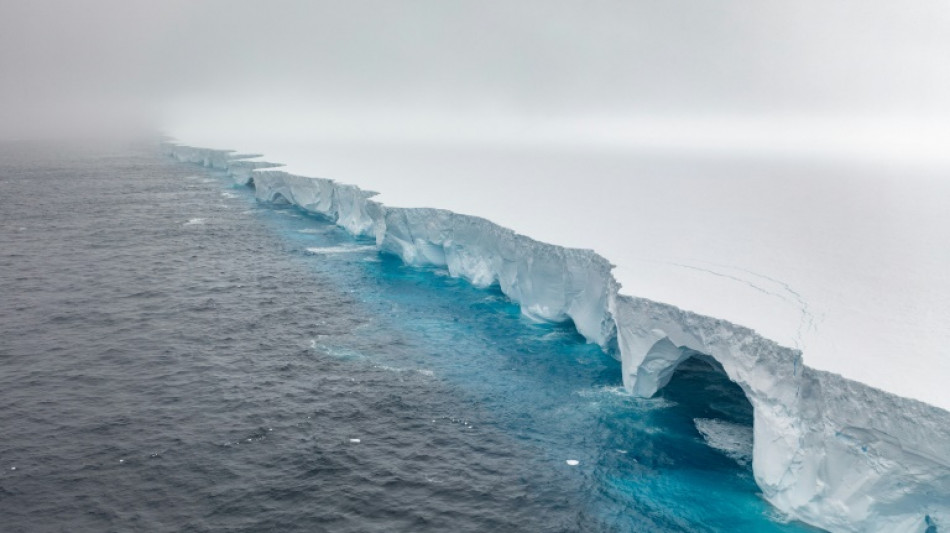
World's biggest iceberg 'battered' by waves as it heads north / Photo: IAN STRACHAN - EYOS Expeditions/AFP
It was impossible to see through the snow and fog on the Antarctic seas but expedition leader Ian Strachan knew his ship was approaching a true behemoth: the world's biggest iceberg lay somewhere ahead.
"Then the clouds lifted and we could see this expansive -- almost abstract -- white line that extended each way across the horizon," he told AFP.
As the ship got closer during its visit on Sunday, huge gaping crevasses and beautiful blue arches sculpted into the edge of the iceberg came into focus.
Waves up to four metres (13 feet) high "smashed" and "battered" its wall, breaking off small chunks and collapsing some arches, Strachan said.
He compared sailing along the endless jagged edge to looking at sheet music. "All the cracks and arches were different notes as the song played."
The tooth-shaped iceberg named A23a is nearly 4,000 square kilometres (1,550 square miles) across, making it more than twice the size of Greater London.
After three decades stuck to the Antarctic ocean floor, the iceberg is now heading north on what could be its final journey.
It contains an estimated one trillion tonnes of fresh water that is likely to melt off into the ocean along way.
The iceberg, which is up to 400 metres thick in places, is currently drifting between Elephant Island and the South Orkney islands.
- 'Magical' -
Strachan was speaking to AFP as his ship, run by the expeditions firm EYOS, was wrapping up a private tour of the Antarctic Peninsula.
It had been planning to go to South Georgia island but due to a bird flu outbreak there, it visited A23a instead.
It was not the first ship to witness the majesty of the iceberg.
The UK's RRS Sir David Attenborough was travelling to Antarctica on a scientific mission last month, when it found the A23a blocking its path.
Andrew Meijers, the chief scientist on board, said that when they approached the iceberg, the mist parted, the sun came out and a pod of orcas even swam past.
"It was really magical," Meijers told AFP.
"It took us six hours to steam past it," he added.
A23a first broke off the Antarctic coast back in 1986, making it the world's oldest iceberg, as well as its largest.
But it quickly became stuck to the ocean floor, where it languished for decades.
Andrew Fleming of the British Antarctic Survey told AFP that in 2020 he saw satellite images suggesting it was "wobbling".
Then late last year, A23a broke free from its icy shackles and started venturing north.
Whether or not this was caused by climate change -- winter Antarctic sea ice reached its lowest level on record last year -- remains an open question.
Fleming emphasised that these icebergs are a natural process, adding that one or two big ones break off every year.
"It's more likely that it's time had just come," he added.
But he emphasised that such icebergs are "part of a huge system that is changing dramatically".
- 'Lumbering beast' -
This "lumbering beast" moves slower than walking pace, Fleming said.
"The Titanic would've spotted this one coming."
Since breaking free, A23a has followed roughly the same path as previous massive icebergs A68 and A76, moving past the east side of the Antarctica Peninsula through the Weddell Sea along a route called "iceberg alley".
As the iceberg is "ejected out into the Southern Ocean", warmer waters and bigger waves will start to break it up, Fleming said.
If it follows the path of the two comparably huge previous icebergs, it will travel northeast towards the island of South Georgia, a haven for wildlife including penguins and seals.
There is a slight fear that if the iceberg parks itself near the island, it could block these animals from getting to where they normally forage, threatening their ability to feed themselves.
But this is not expected to happen.
A68 instead broke up into smaller chunks, causing a problem not for animals but humans, making it difficult for fishing ships to navigate the area, Meijers said.
A more likely path would be for A23a to move around the island and continue meandering northwards.
A rare few icebergs have made it so far that they have been spotted from the Brazilian coast.
But eventually A23a will meet the fate of all icebergs that journey north -- melting away in warmer waters.
"Ultimately, they're doomed," Fleming said.
G.Gopalakrishnan--DT