
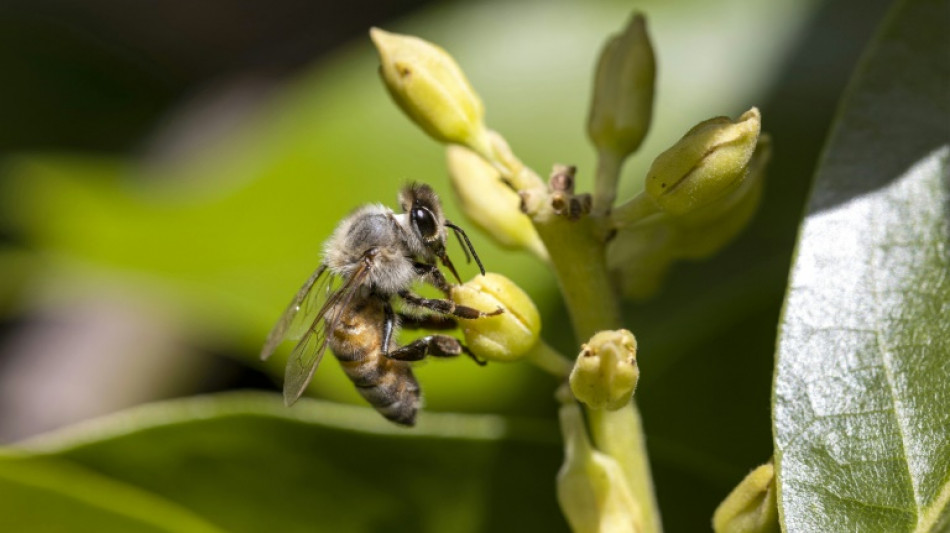
Insect compasses, fire-fighting vines: 2023's nature-inspired tech / Photo: MENAHEM KAHANA - AFP
Even as human-caused climate change threatens the environment, nature continues to inspire our technological advancement.
"The solutions that are provided by nature have evolved for billions of years and tested repeatedly every day since the beginning of time," said Evripidis Gkanias, a University of Edinburgh researcher.
Gkanias has a special interest in how nature can educate artificial intelligence.
"Human creativity might be fascinating, but it cannot reach nature's robustness -- and engineers know that," he told AFP.
From compasses mimicking insect eyes to forest fire-fighting robots that behave like vines, here's a selection of this year's nature-based technology.
- Insect compass -
Some insects -– such as ants and bees -– navigate visually based on the intensity and polarisation of sunlight, thus using the sun's position as a reference point.
Researchers replicated their eye structure to construct a compass capable of estimating the sun's location in the sky, even on cloudy days.
Common compasses rely on Earth's weak magnetic field to navigate, which is easily disturbed by noise from electronics.
A prototype of the light-detecting compass is "already working great", said Gkanias, who led the study published in Communications Engineering.
"With the appropriate funding, this could easily be transformed into a more compact and lightweight product" freely available, he added.
And with a little further tweaking, the insect compass could work on any planet where a big celestial light source is visible.
- Water-collecting webs -
Fabric inspired by the silky threads of a spider web and capable of collecting drinking water from morning mist could soon play an important role in regions suffering water scarcity.
The artificial threads draw from the feather-legged spider, whose intricate "spindle-knots" allow large water droplets to move and collect on its web.
Once the material can be mass produced, the water harvested could reach a "considerable scale for real application", Yongmei Zheng, a co-author of the study published in Advanced Functional Materials, told AFP.
- Fire-fighting vines -
Animals aren't the only source of inspiration from nature.
Scientists have created an inflatable robot that "grows" in the direction of light or heat, in the same way vines creep up a wall or across a forest floor.
The roughly two-metre-long tubular robot can steer itself using fluid-filled pouches rather than costly electronics.
In time, these robots could find hot spots and deliver fire suppression agents, say researchers at the University of California, Santa Barbara.
"These robots are slow, but that is OK for fighting smouldering fires, such as peat fires, which can be a major source of carbon emissions," co-author Charles Xiao told AFP.
But before the robots can climb the terrain, they need to be more heat-resistant and agile.
- Kombucha circuits -
Scientists at the Unconventional Computing Laboratory at the University of the West of England in Bristol have found a way to use slimy kombucha mats –- produced by yeast and bacteria during the fermenting of the popular tea-based drink -- to create "kombucha electronics".
The scientists printed electrical circuits onto dried mats that were capable of illuminating small LED lights.
Dry kombucha mats share properties of textiles or even leather. But they are sustainable and biodegradable, and can even be immersed in water for days without being destroyed, said the authors.
"Kombucha wearables could potentially incorporate sensors and electronics within the material itself, providing a seamless and unobtrusive integration of technology with the human body," such as for heart monitors or step-trackers, lead author Andrew Adamatzky and the laboratory's director, told AFP.
The mats are lighter, cheaper and more flexible than plastic, but the authors caution that durability and mass production remain significant obstacles.
- Scaly robots -
Pangolins resemble a cross between a pine cone and an anteater. The soft-bodied mammals, covered in reptilian scales, are known to curl up in a ball to protect themselves against predators.
Now, a tiny robot might adapt that same design for potentially life-saving work, according to a study published in Nature Communications.
It is intended to roll through our digestive tracts before unfurling and delivering medicine or stopping internal bleeding in hard-to-reach parts of the human body.
Lead author Ren Hao Soon of the Max Planck Institute for Intelligent Systems was watching a YouTube video when he "stumbled across the animal and saw it was a good fit".
Soon needed a soft material that wouldn't cause harm inside the human body, with the advantages of a hard material that could, for example, conduct electricity. The Pangolin's unique structure was perfect.
The tiny robots are still in their initial stages, but they could be made for as little as 10 euros each.
"Looking to nature to solve these kinds of problems is natural," said Soon.
"Every single design part of an animal serves a particular function. It’s very elegant."
D.Farook--DT



