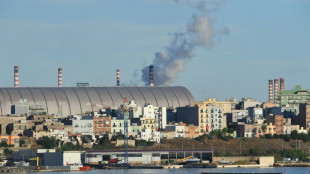
Current carbon dioxide levels last seen 14 million years ago / Photo: Giuseppe CACACE - AFP
The last time carbon dioxide in the atmosphere consistently matched today's human-driven levels was 14 million years ago, according to a large new study Thursday that paints a grim picture of where Earth's climate is headed.
Published in the journal Science, the paper covers the period from 66 million years ago until the present, analyzing biological and geochemical signatures from the deep past to reconstruct the historic CO2 record with greater precision than ever before.
"It really brings it home to us that what we are doing is very, very unusual in Earth's history," lead author Baerbel Hoenisch of the Columbia Climate School's Lamont-Doherty Earth Observatory told AFP.
Among other things, the new analysis finds the last time the air contained 420 parts per million (ppm) of carbon dioxide was between 14-16 million years ago, when there was no ice in Greenland and the ancestors of humans were just transitioning from forests to grasslands.
That is far further back in time than the 3-5 million years that prior analyses have indicated.
Until the late 1700s, atmospheric carbon dioxide was about 280 ppm, meaning humans have already caused an increase of about 50 percent of the greenhouse gas, which traps heat in the atmosphere and has warmed the planet by 1.2 degrees Celsius compared to before industrialization.
"What's important is that Homo, our species, has only evolved 3 million years ago," said Hoenisch.
"And so our civilization is tuned to sea level as it is today, to having warm tropics and cool poles and temperate regions that have a lot of rainfall."
If global CO2 emissions continue to rise we could reach between 600 - 800 ppm by the year 2100.
Those levels were last seen during the Eocene, 30-40 million years ago, before Antarctica was covered in ice and when the world's flora and fauna looked vastly different -- for example huge insects still roamed the Earth.
- Ancient plants -
The new study is the product of seven years of work by a consortium of 80 researchers across 16 countries and is now considered the updated consensus of the scientific community.
The team didn't collect new data -- rather, they synthesized, re-evaluated and validated published work based on updated science and categorized them according to confidence level, then combined the highest-rated into a new timeline.
Many people are familiar with the concept of drilling into ice sheets or glaciers to extract ice cores whose air bubbles reveal past atmospheric composition -- but these only go back so far, generally hundreds of thousands of years.
To look further into the past, paleoclimatologists use "proxies": by studying the chemical composition of ancient leaves, minerals and plankton, they can indirectly derive atmospheric carbon at a given point in time.
The researchers confirmed that the hottest period over the past 66 million years happened 50 million years ago, when CO2 spiked to as much as 1,600 ppm and temperatures were 12C hotter, before a long decline set in.
By 2.5 million years ago, carbon dioxide was 270-280 ppm, ushering in a series of ice ages.
That remained the level when modern humans arrived 400,000 years ago and persisted until our species began burning fossil fuels at large scales.
The team estimates that a doubling of CO2 is predicted to warm the planet by 5-8 degrees Celsius -- but over a long period, hundreds of thousands of years -- when increased temperatures have rippling effects through Earth systems.
For example, melting the polar ice caps would reduce the planet's ability to reflect solar radiation and become a reinforcing feedback loop.
But the new work remains directly relevant to policy makers, stressed Hoenisch.
The carbon record reveals that 56 million years ago, Earth underwent a similar rapid release of carbon dioxide, which caused massive changes to ecosystems and took some 150,000 years to dissipate.
"We are in this for a very long time, unless we sequester carbon dioxide, take it out of the atmosphere, and we stop our emissions sometime soon," she said.
A.Al-Mehrazi--DT