
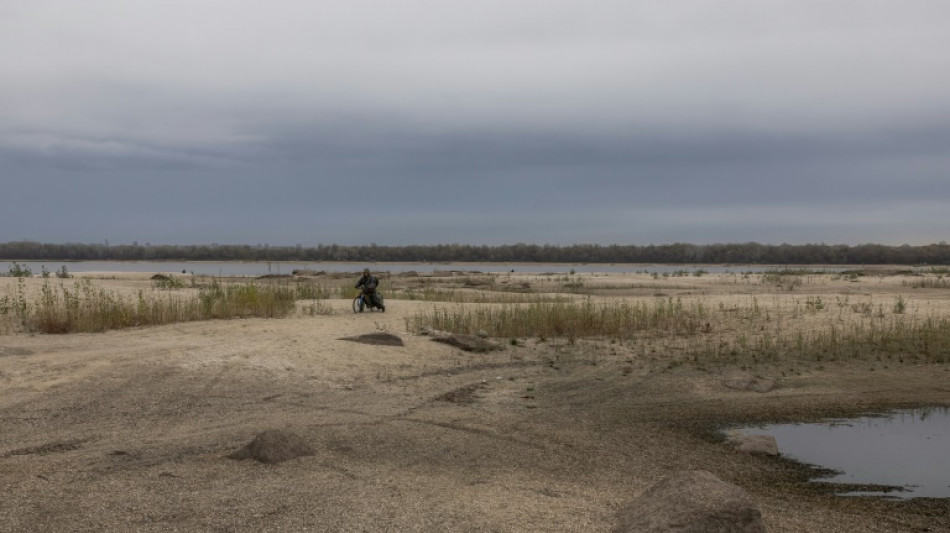
In flooded south, Ukraine builds landmark ecocide case against Russia / Photo: Roman PILIPEY - AFP
Stood in the cold air of a southern Ukrainian village, dozens of investigators were digging into the ground, collecting dirt, taking photos and planting small red flags in the soil.
Watching over the proceedings was Vladislav Ignatenko, a Ukrainian prosecutor conducting a world-first war crimes investigation into allegations of Russian ecocide.
The case, which Kyiv plans to take to the International Criminal Court (ICC) in some form, is the latest in a string of investigations and challenges that Ukraine hopes will hold Russia accountable -- and make it pay -- for its invasion.
The investigation in the southern Kherson region stems from the extensive flooding caused after the Kakhovka dam was partially destroyed on June 6 in a series of early morning blasts.
Dozens were killed as entire villages became submerged and the United Nations says there was $14 billion of destruction.
Ukraine says Russia blew up the dam and that the extent of the environmental damage constitutes a war crime.
To build its case, it has dispatched a hundreds-strong team of ecological investigators.
"We're going to use every possible method to gather evidence," Ignatenko, 32, told AFP.
Donning a military t-shirt and scrawling in a notebook, he called the hundreds working on the case "pioneers."
Russia has blamed Ukraine for the dam's destruction. Both sides have denied responsibility.
It was under Russia's control and the flooding complicated Ukraine's counteroffensive in the south.
The evidence collected in the village of Chornobaivka is just a small part of Kyiv's case.
"Our next point will be here, in this district of Kherson," Ignatenko said, pointing to a map.
"I'm not going there, it's too dangerous," one of his team protested.
The city has been under constant Russian shelling since Ukraine reclaimed it in November 2022.
- Polluted soil -
In Ukraine, ecocide -- deliberately destroying the natural environment -- is a specific criminal offence.
While the Rome Statute that underpins the ICC does not recognise "ecocide" as a crime in itself, its Article Eight states that large-scale environmental damage can be considered part of a war crimes case.
But the evidential barrier is high.
It must be proven that one side carried out an attack, that it knew it would cause "long-term and severe damage to the natural environment" and that the damage was "excessive" in relation to any perceived military advantage.
Ukraine is unperturbed.
Maksym Popov, a special adviser on environmental crimes to the Ukrainian Prosecutor General, has sent more than 400 prosecutors and investigators to gather evidence and Kyiv plans to prosecute Russia both at home and internationally.
Standing next to a row of houses, Ignatenko pointed to a mark on the wall above the ground.
"The water flooded this field... After conducting an analysis, we will be able to determine whether there are traces of pesticide or hydrocarbons -- polluted soil."
Flooding washed away petrol stations and farmhouses storing pesticides, raising concerns the land is now likely contaminated.
"When the water spilled out, it picked up pollutants and dumped them on land where farm animals were being kept," Ignatenko said.
For its case to succeed, Ukraine will first need to prove Russia blew up the dam.
"That's our conviction. Another investigation is underway to that end," the prosecutor said, as he packed a sample of earth into a plastic bag bearing the Ukrainian police logo.
On May 30 -- a week before the dam exploded -- Russia adopted a law banning the investigation of incidents concerning "hydraulic structures" in parts of Ukraine it claims to have annexed.
- 'Dynamic ecosystem' -
About 300 kilometres (185 miles) upstream, on the outskirts of Zaporizhzhia, biologist Vadym Maniuk walked across dry, crunchy ground.
Beneath his feet were millions of freshwater mussel shells, scattered across the old bed of the Kakhovka reservoir.
"There used to be four metres of water here," Maniuk, an associate professor at Dnipro's Oles Honchar University, told AFP.
"Billions of living organisms were killed suddenly, in a few days," when the reservoir emptied, Maniuk said.
To him, the charges of ecocide are undeniable given the scale of the disaster.
But almost six months later, life is returning, he said.
"We have regained a dynamic ecosystem in just a few months," he said.
The ground is strewn with shells and carp skeletons -- but goats have now taken to grazing on small shrubs.
Locals ride bicycles across the former waterway, weaving between boulders.
Biologists such as Maniuk are currently in a tussle with Ukraine's energy industry over whether to rebuild the dam.
"The scientists are against it, we're fighting against the energy lobby," he said.
It generated "negligible" power and a big reconstruction project would damage the local environment once more, Maniuk argued.
"The people here have already made the area their own. For shepherds and fishermen, the conditions are better."
Y.Al-Shehhi--DT



