
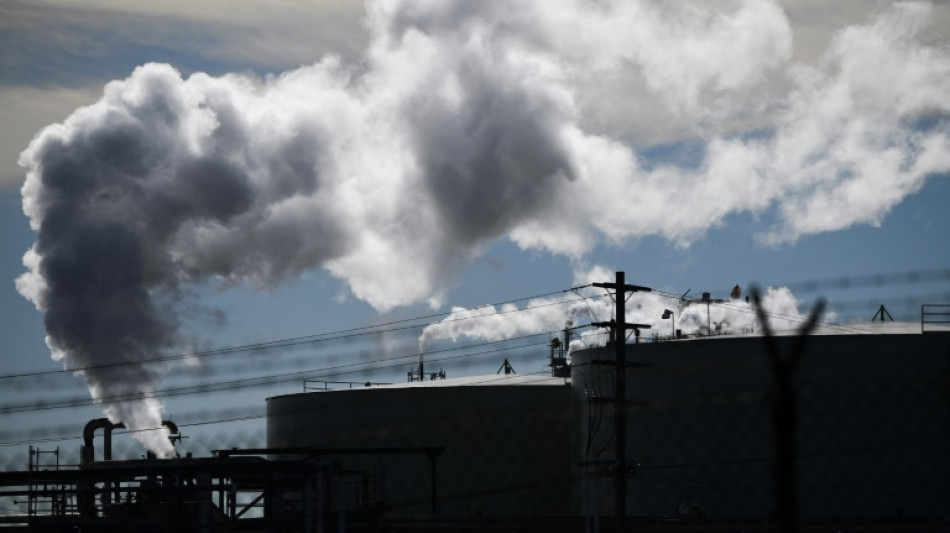
Fossil fuel plans by producing nations threaten global climate goals: UN / Photo: Patrick T. FALLON - AFP/File
Plans to expand oil, gas and coal production by major fossil fuel countries would push the world far beyond agreed global warming limits and are "throwing humanity's future into question", the UN warned Wednesday.
The future of fossil fuels will be a key flashpoint when world leaders meet at the COP28 climate conference later this month, tasked with salvaging the world's agreed temperature thresholds.
Most of the world's leading producers of fossil fuels have pledged to achieve "net-zero" emissions by midcentury -- a target that should align with the Paris Agreement's aims to limit global warming to well below two degrees Celsius (2.7 degrees Fahrenheit) since the pre-industrial era, and preferably a safer 1.5C.
But the annual United Nations Environment Programme (UNEP) Production Gap report makes it clear that the production plans of the top 20 producing countries -- including the United States, China, Russia, Australia, India and COP28 host United Arab Emirates -- are heading in the opposite direction.
It found that planned increases in production in these countries would produce 460 percent more coal, 82 percent more gas, and 29 percent more oil than would be consistent with limiting warming to 1.5C.
Overall it found that governments' plans would produce 110 percent more fossil fuels in 2030 than would be in line with 1.5C, and 69 percent more than would be consistent with 2C.
"Governments' plans to expand fossil fuel production are undermining the energy transition needed to achieve net-zero emissions, throwing humanity's future into question," said Inger Andersen, UNEP Executive Director.
"Starting at COP28, nations must unite behind a managed and equitable phase-out of coal, oil and gas -- to ease the turbulence ahead and benefit every person on this planet."
Burning fossil fuels is by far the main cause of climate change, accounting for most of the pollution driving global warming and the ensuing barrage of temperature records, devastating weather disasters and sea level rise.
But countries have been reluctant to officially acknowledge this in global climate negotiations.
A statement from UN Secretary-General Antonio Guterres said the report was a "startling indictment of runaway climate carelessness".
"COP28 must send a clear signal that the fossil fuel age is out of gas –- that its end is inevitable," he said.
- Big emitters -
The UNEP report covers 20 countries that account for 82 percent of production and 73 percent of consumption of the world's fossil fuel supply.
The report said the United States -- the top oil and gas producer globally -- has encouraged accelerated domestic production of oil and gas since Russia's invasion of Ukraine, even as it ramped up climate policies.
US authorities forecast oil production will reach and remain at "record high levels" from 2024 to 2050, with gas production continuously increasing, the report said.
Meanwhile, UNEP said the world's biggest emitter China produces just over half of the world's supply of coal, the most polluting of the fossil fuels, as well as being a world leader in renewables.
Its domestic coal production reached a record in 2022 of around 4.5 billion tonnes, the report said, adding that production was expected to peak this decade.
- 'Hypocrisy' -
Two years ago at the COP26 meeting in Glasgow countries agreed to "phase-down unabated coal power", the first time a fossil fuel had been explicitly mentioned in the negotiated agreement. Abated generally means to capture emissions before they go into the atmosphere.
UNEP hailed that pledge as a "significant milestone" but noted that since then production and use of fossil fuels have "reached record high levels".
The report "exposes the glaring hypocrisy at the heart of global climate action", said Harjeet Singh, head of global political strategy at Climate Action Network International, calling for wealthy polluters to lead by example.
Fossil fuels and the emissions they cause are expected to dominate climate talks in oil-rich UAE from November 30 to December 12.
The incoming COP28 president Sultan Al Jaber, who also leads the state-owned oil firm ADNOC, has said phasing down all fossil fuels is "inevitable and essential".
But the UAE has no concrete policies to support a "managed wind-down" of its own fossil fuels, the UNEP report found, noting plans by ADNOC to boost oil production capacity by 2027 as part of a $150 billion investment plan.
"World leaders can no longer look away from the undeniable truth: to meet the Paris temperature goal we need a managed and equitable phase-out of fossil fuel production," said Alex Rafalowicz, of the Fossil Fuel Non-Proliferation Treaty Initiative, which has been spearheaded by vulnerable island nations.
"People talk about a transition but it's not a transition if you're expanding the problem, and the UN is clear today -- the hole we're in is just getting bigger."
A.Al-Mehrazi--DT



