
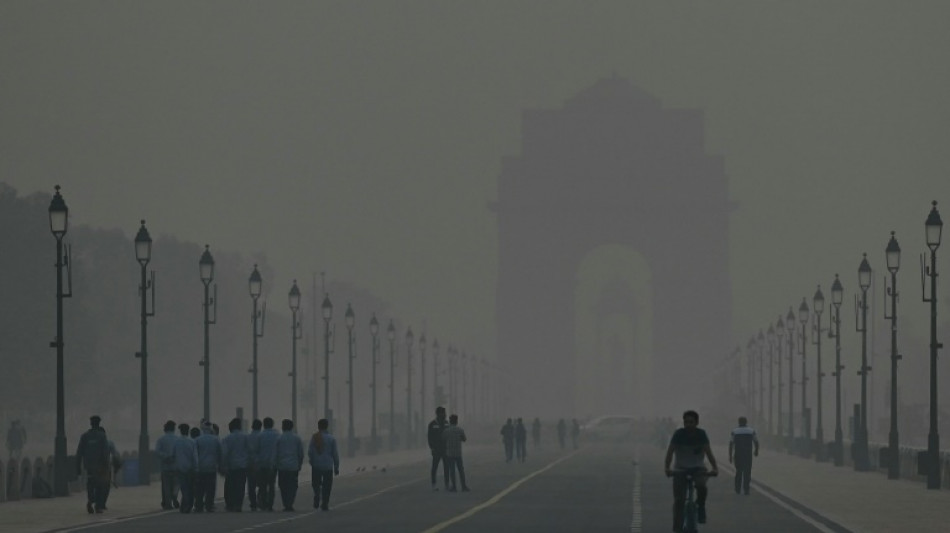
'Air-pocalypse': Indian capital launches 'Green War Room' / Photo: Arun SANKAR - AFP/File
The enemy is nearly invisible and there are no soldiers, but the Indian capital's new "Green War Room" is battling air pollution that is cutting lives of residents by over a decade.
"It's a pollution emergency", said Gopal Rai, environment minister for the rapidly expanding megacity of over 20 million people, consistently ranked the world's worst capital for air quality.
Rai dubs the problem an "air-pocalypse".
New Delhi's latest effort to combat a decades-old problem is a high-tech coordination centre, where 17 experts monitor giant screens livestreaming pollution hotspots, beaming in NASA satellite imagery and updating air quality index (AQI) sensors.
In Delhi, levels of PM2.5 pollutants -- cancer-causing microparticles that enter the bloodstream through the lungs -- often hit more than 30 times World Health Organization danger limits.
On Friday, schools were shut across the city as a noxious grey smog engulfed it, making life a misery for its 30 million inhabitants.
The average city resident could die nearly 12 years earlier due to air pollution, according to an August report by the University of Chicago's Energy Policy Institute.
Eye-stinging and lung-burning smog worsens during winter from October to February -- when colder air traps pollution -- and residents are advised to wear face masks outside at all times.
- Political roadblocks -
Last month, Delhi opened the pollution coordination hub connecting 28 government departments -- complete with "Green War Room" sign -- to zoom in on exact emission sites.
"As soon as the AQI worsens, we alert our teams on the ground and they take action immediately," said the war room's environmental engineer Anurag Pawar.
A problem factory can be served a notice, a garbage fire put out, vehicles belching black smoke stopped, illegal firework displays for festivals halted, or trucks spraying water sent to douse down dust.
But the key problem remains out of their hands -- the huge fires lit by farmers surrounding Delhi to clear rice fields after harvests for the sowing season.
Farm fires can cloak the city in a yellow-grey soupy smog that, according to one study in the Lancet medical journal, caused almost 17,500 premature deaths in 2019.
Air pollution is "one of the greatest environmental risks to health", the WHO warns, triggering strokes, heart disease, lung cancer and respiratory diseases.
To reduce that, Delhi authorities have begun using biochemical sprays that speed up decomposition of the crop stubble, to ready the soil for planting.
But as with so many environmental efforts, good intentions hit political roadblocks.
Rai said the source of more than two-thirds of air pollution plaguing the city comes from beyond its borders, where municipal authorities don't have the authority to act.
"We have introduced electric buses, but in the adjoining states buses are still being run on diesel," Rai told AFP.
"All that impacts Delhi. Pollution and winds can't be restricted by state boundaries."
Pollution has become a political flashpoint.
The capital and Punjab state are governed by the Aam Aadmi Party, but other neighbouring states are led by their rivals from Prime Minister Narendra Modi's Bharatiya Janata Party (BJP).
Farmers, a powerful bloc of voters, say stubble burning is easy and cheap, and city pollution doesn't impact them.
"Obviously, the politics has an impact," Rai said. "It creates hurdles when it comes to implementing policies."
- 'Win-win strategy' -
Tackling pollution aids both the wider climate change battle and moves to protect public health, experts say.
The WHO points out that "many drivers of air pollution are also sources of greenhouse gas emissions", and that policies to reduce air pollution "offer a win-win strategy for both climate and health".
War room officers say they are doing what they can -- like monitoring reports sent via a "Green Delhi" phone app, which allows residents to send geolocated photographs of pollution problems.
"Most of the complaints are about burning garbage dumps and dust from construction sites," Pawar said.
"Once we receive the complaint, we coordinate with various departments and make sure it is resolved quickly."
But Sunil Dahiya, an analyst with the Centre for Research on Energy and Clean Air, said bigger policy changes were needed.
India is heavily reliant on polluting coal for energy generation. It has seen its per capita coal emissions rise 29 percent in the last seven years and has shied away from policies to phase down the dirty fossil fuel.
"The Green War Room, if done the right way, will be effective in suppressing the pollution for some time," Dahiya told AFP.
"But it is not the solution to cut down emissions. When it comes to breathing clean air and reducing pollution levels, much more comprehensive and systematic changes are required."
I.Khan--DT



