
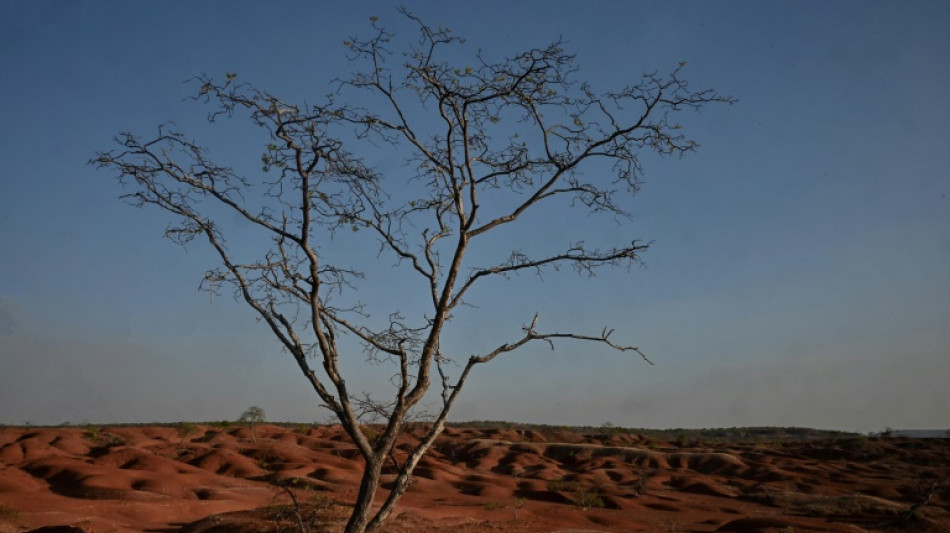
In Brazil town turning to desert, farmers fight to hang on / Photo: Nelson ALMEIDA - AFP
Standing amid a terrain of rugged red craters that looks like something from Mars, Brazilian farmer Ubiratan Lemos Abade extends his arms, pointing to two possible futures for this land fast turning to desert.
Abade, a 65-year-old cattle rancher, lives in Brazil's worst desertification hotspot: Gilbues, in the northeastern state of Piaui, where a parched, canyon-pocked landscape is swallowing up farms and residences, claiming an area bigger than New York City.
Experts say the phenomenon is caused by rampant erosion of the region's naturally fragile soil, exacerbated by deforestation, reckless development and probably climate change.
But several hundred determined farming families are hanging on in this desolate land, scraping by with hardscrabble ingenuity and sounding the alarm over the spreading problem.
"Things have gone haywire. It's not raining the way it used to. So we use irrigation. Without that, we wouldn't get by," says Abade.
To his right, he points to a barren field of withered grass that died before his cattle could eat it. To his left, he points to an exuberant patch of tall bluestem grass watered with a makeshift irrigation system, which he is counting on to keep his 15 cows -- and himself -- alive.
He installed the system a year ago, digging a well and jerry-rigging a network of hoses.
"Without irrigation, this whole place would look like that -- dying of thirst," he says.
"It takes technology to farm here. But when you're poor, technology is hard to come by."
- 'Fragile land' -
Seen from the sky, the "Gilbues desert" looks like a giant sheet of crumpled, brick-red sandpaper.
Its erosion problem isn't new. The name "Gilbues" likely comes from an Indigenous word meaning "fragile land," says environmental historian Dalton Macambira, of the Federal University of Piaui.
But humans have made the problem worse by razing and burning vegetation whose roots helped secure the silty soil, and by over-taxing the environment as Gilbues has grown to a town of 11,000 people, he says.
Gilbues was the scene of a diamond-mining rush in the mid-20th century, a sugarcane boom in the 1980s and is now one of the biggest soybean-producing counties in the state.
"Where there are people, there's demand for natural resources," Macambira says.
"That accelerates the problem, by demanding more of the environment than it can sustain."
Macambira published a study in January finding the area affected by desertification more than doubled from 387 square kilometers in 1976 to 805 (310 square miles) in 2019, hitting 15 counties and some 500 farming families.
Climate scientists say further studies are needed to pinpoint whether global warming is accelerating the phenomenon.
Farmers say the dry season has gotten drier, punctuated by a shorter, more-intense rainy season -- which exacerbates the problem, as heavy rains wash away more soil, deepening the gaping canyons known as "vocorocas."
Macambira says a hotter planet can only make things worse.
"Wherever you have environmental degradation, climate change tends to have a more perverse effect," he says.
- Turnaround -
The United Nations calls desertification a "silent crisis" that affects 500 million people worldwide, fueling poverty and conflicts.
But there is opportunity in the problem, says Fabriciano Corado, president of conservation group SOS Gilbues.
The 58-year-old agricultural engineer says although Gilbues's soil erodes easily, it is also a farmer's dream: rich in phosphorous and clay, it needs no fertilizer or other treatments.
Like Abade, he says farmers need technology to survive the encroaching desert -- but nothing too high-tech.
Local producers are getting extremely positive results with things like protecting native vegetation, drip irrigation, fish farming and the ancient anti-erosion technique of terrace farming, he says.
"We don't have to reinvent the wheel. The Aztecs, Incas and Mayas did it already," he says.
He condemns the closure six years ago of a government-run anti-desertification research center in Gilbues that helped local farmers implement just such techniques.
The state plans to reopen it -- but has not set a date.
The region meanwhile has huge potential as a solar energy producer, says Corado, citing the recent opening of a 2.2-million-panel solar park. Another is in the works.
Get the right mix of conservation and technology, and "there's no stopping us," he says.
H.Nadeem--DT



