
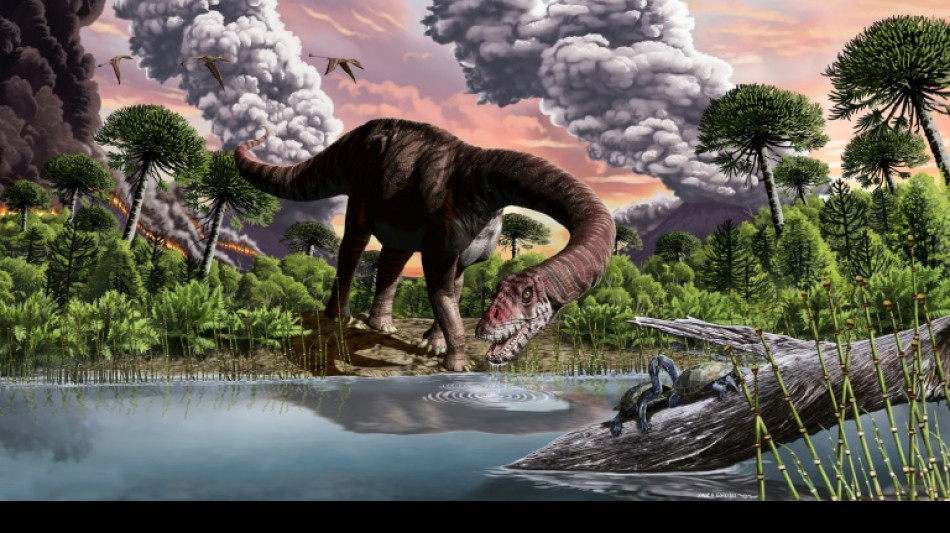
Asteroid dust caused 15-year winter that killed dinosaurs: study / Photo: Jorge GONZALEZ - MUSEO PALEONTOLOGICO EGIDIO FERUGLIO/AFP/File
Around 66 million years ago, an asteroid bigger than Mount Everest smashed into Earth, killing off three quarters of all life on the planet -- including the dinosaurs.
This much we know.
But exactly how the impact of the asteroid Chicxulub caused all those animals to go extinct has remained a matter of debate.
The leading theory recently has been that sulphur from the asteroid's impact -- or soot from global wildfires it sparked -- blocked out the sky and plunged the world into a long, dark winter, killing all but the lucky few.
However research published Monday based on particles found at a key fossil site reasserted an earlier hypothesis: that the impact winter was caused by dust kicked up by the asteroid.
Fine silicate dust from pulverised rock would have stayed in the atmosphere for 15 years, dropping global temperatures by up to 15 degrees Celsius, researchers said in a study in the journal Nature Geoscience.
Back in 1980, father-and-son scientists Luis and Walter Alvarez first proposed that the dinosaurs were killed off by an asteroid strike that shrouded the world in dust.
Their claim was initially met with some scepticism -- until a decade later when the massive crater of Chicxulub was found in what is now the Yucatan Peninsula on the Gulf of Mexico.
Now, scientists largely agree that Chicxulub was to blame.
But the idea that it was sulphur, rather than dust, that caused the impact winter has become "very popular" in recent years, Ozgur Karatekin, a researcher at the Royal Observatory of Belgium, told AFP.
Study co-author Karatekin said this was because the dust from the impact was thought to be the wrong size to stay in the atmosphere for long enough.
For the study, the international team of researchers was able to measure dust particles thought to be from right after the asteroid struck.
- 'Catastrophic collapse' -
The particles were found at the Tanis fossil site in the US state of North Dakota.
Though 3,000 kilometres (1,865 miles) away from the crater, the site has preserved a number of remarkable finds believed to be dated from directly after the asteroid impact in sediment layers of an ancient lake.
The dust particles were around 0.8 to 8.0 micrometres -- just the right size to stick around in the atmosphere for up to 15 years, the researchers said.
Entering this data into climate models similar to those used for current-day Earth, the researchers determined that dust likely played a far greater role in the mass extinction than had previously been thought.
Out of all the material that was shot into the atmosphere by the asteroid, they estimated that it was 75 percent dust, 24 percent sulphur and one percent soot.
The dust particles "totally shut down photosynthesis" in plants for at least a year, causing a "catastrophic collapse" of life, Karatekin said.
Sean Gulick, a geophysicist at the University of Texas at Austin and not involved in the research, told AFP that the study was another interesting effort to answer the "hot question" -- what drove the impact winter -- but did not provide the definitive answer.
He emphasised that discovering what happened during the world's last mass extinction event was important not just for understanding the past, but also the future.
"Maybe we can better predict our own mass extinction that we're probably in the middle of," Gulick said.
A.El-Sewedy--DT



