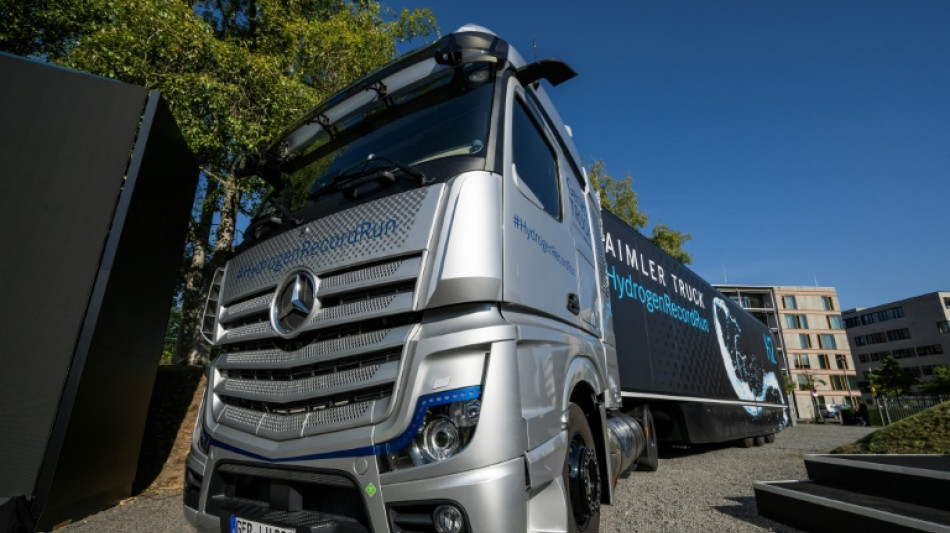
Germany bets on hydrogen to help cut trucking emissions / Photo: John MACDOUGALL - AFP
Applause rings out as Daimler Truck's hydrogen-powered, zero-emission lorry crosses the finish line in Berlin after completing a record-breaking 1,047-kilometre (650 mile) journey on a single tank.
But in the race to decarbonise long-haul trucking, the niche technology is still stuck in the slow lane.
The Mercedes-Benz GenH2 truck started its demonstration run at the group's factory in Woerth am Rhein on Monday afternoon, near the border with France, and arrived in the German capital on Tuesday morning.
The prototype truck made the trip fully loaded on only one fill of liquid hydrogen, similar to what a diesel-powered truck can do.
Unlike planet-warming diesel however, the hydrogen fuel cell technology used in the truck emits only water vapour.
"You're showing that a heavy load can be transported over a long distance in a sustainable manner," Petra Dick-Walther, state secretary for economic affairs in Germany's Rhineland-Palatinate region, said at the departure ceremony.
Germany's Daimler Truck, one of the world's biggest truckmakers, said the feat of cracking the 1000-kilometre range marked "another milestone" for hydrogen-powered driving.
But the technology has plenty of hurdles to overcome before going mainstream.
Hydrogen fuel is produced through water electrolysis but is only considered "green" if the electricity required for the process is obtained from renewables such as wind or solar power.
Hydrogen produced using coal or natural gas is more widely available but less environmentally friendly.
Technical challenges, high costs and a lack of infrastructure have all slowed the advance of clean hydrogen.
German firms such as Daimler Truck and engineering giant Bosch are nevertheless betting that hydrogen has a role to play in slashing road transport emissions, alongside battery-powered electric vehicles.
"To decarbonise transport, we need both," said Andreas Gorbach, head of technology at Daimler Truck who drove the GenH2 across the finish line himself.
The "sweet spot" for hydrogen trucks lies in particularly demanding long-distance haulage, he said, whereas battery-electric trucks do well on plannable routes with plenty of charging options.
Daimler Truck is aiming for series production of hydrogen trucks in "the second half of the decade", Gorbach added.
But he said the hydrogen breakthrough will depend on two major factors: the rollout of refuelling stations, and "the availability of green energy at a competitive cost".
- Lagging behind -
Under current European Union rules, truckmakers have to cut emissions of new trucks by 30 percent by 2030 compared with 2019 levels.
But European Commission said earlier this year it was eying tougher cuts of 45 percent by 2030 and 90 percent by 2040.
On top of the regulatory pressures, truck manufacturers face growing international competition as the battle to supply zero-emissions trucks heats up.
According to a recent study commissioned by campaign group Transport and Environment (T&E), European truckmakers "could lose 11 percent of the EU market to international electric rivals by 2035" if they don't go green faster, with the likes of Tesla and China's BYD snapping at their heels.
American company Nikola, a Bosch customer, has already begun mass production of its hydrogen-powered heavy-duty truck in the United States, benefiting from climate subsidies under President Joe Biden's Inflation Reduction Act.
In August, Nikola reported a total of 202 orders from 18 customers.
To share out the costs of a hydrogen rollout, Daimler Truck has partnerships with other truckmakers and energy companies such as Shell, Total and BP to install refuelling stations in Europe and the United States.
Bringing down the price tag of expensive hydrogen will be key to its success.
Rainer Mueller-Finkeldei, head of Mercedes-Benz Trucks product development, estimates that the infrastructure will be in place by 2030 and that the total cost of buying and operating hydrogen trucks will eventually be "similar" to diesel trucks.
But according to the campaign group T&E, it could take until 2040 for hydrogen trucks to reach cost parity with diesel.
Both will be more expensive than battery electric trucks by then, its calculations showed.
A.Al-Mehrazi--DT