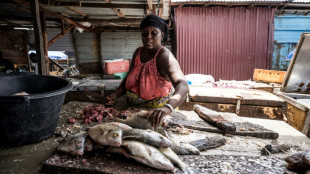
Tunisian brand turns sea plastic into green couture / Photo: FETHI BELAID - AFP
The two men in bright overalls rooting for plastic on a Tunisian beach do so to make a living, but also in the knowledge that they are helping the environment.
What they do not know is that the waste will become part of a synthetic plastic fibre used to make blue denim cloth to create a dress for the eco-friendly fashion label Outa.
The pair are among around 15 "barbeshas", or informal rubbish collectors, taking part in the Kerkennah Plastic Free programme, backed by the European Union.
This aims to recover the 7,000 tonnes of plastic waste each year that end up littering beaches on the Kerkennah Islands 20 kilometres (12 miles) off the port city of Sfax.
Jean-Paul Pelissier, of the International Centre for Advanced Mediterranean Agronomic Studies (CIHEAM), is coordinating the EU-funded project.
He told AFP that on the archipelago, "we have an exciting environment in terms of nature and tranquillity. It's ideal for green tourism".
Pelissier said the islands were a passage point for migratory birds, and that its waters were abundant in Posidonia oceanica seagrass, or Neptune grass.
"But there's one thing you never see in the pictures -- the plastic," he said. Marine currents carry the waste from Europe into the Gulf of Gabes, and there it washes up to be collected by the barbeshas.
They take their daily harvest to a sorter which passes it on to a collection company and then it is fed into a crusher to be baled.
A partnership has been established with Seaqual Initiative, an international consortium which buys the marine plastic "at a remunerative and stable price all year round", Pelissier said.
- New opportunities -
The initiative's website says it "works with ocean clean-ups around the world to bring value to the waste that they recover".
Omar Kcharem is the boss of Kerkennah Plast, which compacts and crushes plastic, and he said working with Seaqual has created new opportunities, since marine plastic "does not have much value and does not bring in any money".
The plastic granules recovered after grinding the waste are transformed into "Seaqual Yarn" nylon fibre in Portugal, in one of just four factories in the world equipped with the technology.
"This is innovative," said Pelissier. "Four or five years ago, you couldn't recycle marine plastic because of its lengthy exposure to salt water and the sun."
He said Seaqual Yarn comprises around 10 percent of recycled marine plastic, but the aim is to increase this.
Apart from the Portugal side of the operation, the rest is definitely "Made in Tunisia".
In the coastal town of Ksar Hellal southeast of Monastir, a huge machine in the ultra-modern Sitex plant makes an infernal racket as it transforms the Seaqual Yarn into denim.
Sitex is a denim specialist that has supplied brands such as Hugo Boss, Zara and Diesel. Now Anis Montacer, founder of the Tunisian fabric and fashion brand Outa, has entered into a partnership with it.
He chose Sitex "for its sensitivity to the environment, because in 2022, 70 percent of their manufacturing was based on recycled fibres".
"We worked together to determine the proper yarn strength and the right indigo dye," he told AFP, adding that their collaboration will continue to expand Outa's colour range to include natural dyes.
- Higher costs -
"The entire process takes place in Tunisia, from the denim transformed in Ksar Hellal to the Tunisian seamstresses who work on the tailoring" for Outa, Montacer said.
Production costs are 20 percent higher, though, than for denim without the marine plastic content.
Despite this, Montacer believes he can "bring together other entrepreneurs and inspire designers to produce eco-responsible collections".
He called on renowned French designer Maud Beneteau, formerly of Hedi Slimane, to design Outa's first haute couture collection.
"We chose a high value collection because the production cost is higher than with normal thread to create denim fabric," Montacer said.
Outa creations first graced the catwalk during Tunis Fashion Week in June.
Beneteau saw the first Outa collection as "a challenge, a human dimension in this wonderful project that aligns with the idea of saving the planet".
She does say there were some difficulties working with a fabric that was "a little thick and stiff, originally designed for sportswear and ready-to-wear, rather than haute couture".
More used to fine silks, linen and cotton, she admits having some qualms working with the new fibre, even though like her peers in the fashion industry she tries to recycle and buy back unsold stocks in the fight against overconsumption.
But "when you think that this is recycled and ecological, that jobs have been created, people who pick up the plastic... it's a whole interesting chain," Beneteau said.
It's also a great yarn. Plastic fantastic: from sea waste to see waist, you might say...
S.Mohideen--DT