Dubai Telegraph - Discarded plastic blights Honduran mangrove island

EUR -
AED 4.313234
AFN 75.750435
ALL 95.578696
AMD 433.594907
ANG 2.102159
AOA 1078.160336
ARS 1638.971773
AUD 1.625109
AWG 2.11404
AZN 1.999672
BAM 1.958437
BBD 2.373175
BDT 144.574668
BGN 1.95913
BHD 0.444976
BIF 3506.83234
BMD 1.174466
BND 1.49167
BOB 8.141894
BRL 5.790702
BSD 1.178287
BTN 111.063856
BWP 15.776243
BYN 3.329855
BYR 23019.541599
BZD 2.369771
CAD 1.603364
CDF 2720.064631
CHF 0.915033
CLF 0.026588
CLP 1046.41439
CNY 7.992303
CNH 7.987329
COP 4391.212453
CRC 540.500166
CUC 1.174466
CUP 31.12336
CVE 110.414612
CZK 24.310747
DJF 209.820735
DKK 7.472819
DOP 70.07077
DZD 155.423039
EGP 61.917074
ERN 17.616996
ETB 183.972419
FJD 2.568381
FKP 0.863023
GBP 0.864883
GEL 3.147732
GGP 0.863023
GHS 13.255849
GIP 0.863023
GMD 85.736074
GNF 10340.659465
GTQ 8.997345
GYD 246.52194
HKD 9.192848
HNL 31.323911
HRK 7.539253
HTG 154.323854
HUF 355.902081
IDR 20401.597252
ILS 3.418737
IMP 0.863023
INR 110.912846
IQD 1543.578414
IRR 1541956.947453
ISK 143.801193
JEP 0.863023
JMD 185.589895
JOD 0.832657
JPY 184.144002
KES 151.682245
KGS 102.672444
KHR 4726.162529
KMF 492.10156
KPW 1056.962147
KRW 1724.486599
KWD 0.361498
KYD 0.981922
KZT 545.674746
LAK 25857.596849
LBP 105154.351013
LKR 379.417652
LRD 216.227592
LSL 19.224422
LTL 3.467894
LVL 0.710423
LYD 7.452972
MAD 10.799449
MDL 20.272124
MGA 4892.316697
MKD 61.676845
MMK 2465.917641
MNT 4203.300853
MOP 9.503997
MRU 47.141268
MUR 54.988565
MVR 18.15135
MWK 2043.037861
MXN 20.275107
MYR 4.603321
MZN 75.050158
NAD 19.224586
NGN 1599.599736
NIO 43.357827
NOK 10.917372
NPR 177.688178
NZD 1.973409
OMR 0.451583
PAB 1.178287
PEN 4.081295
PGK 5.127664
PHP 71.115081
PKR 328.303558
PLN 4.229206
PYG 7211.649015
QAR 4.294993
RON 5.262191
RSD 117.382025
RUB 87.677284
RWF 1727.425963
SAR 4.439687
SBD 9.433617
SCR 16.55833
SDG 705.267211
SEK 10.875383
SGD 1.489822
SHP 0.876858
SLE 28.892668
SLL 24627.968842
SOS 673.406736
SRD 43.961469
STD 24309.083409
STN 24.531883
SVC 10.309882
SYP 129.83015
SZL 19.218878
THB 37.847764
TJS 11.011555
TMT 4.122377
TND 3.417889
TOP 2.827833
TRY 53.276327
TTD 7.970733
TWD 36.867679
TZS 3063.471122
UAH 51.592714
UGX 4406.933896
USD 1.174466
UYU 47.115446
UZS 14278.225498
VES 582.780873
VND 30901.385664
VUV 138.617742
WST 3.175865
XAF 656.805031
XAG 0.014574
XAU 0.000249
XCD 3.174054
XCG 2.123559
XDR 0.816855
XOF 656.841431
XPF 119.331742
YER 280.225528
ZAR 19.270765
ZMK 10571.61339
ZMW 22.446032
ZWL 378.177704
  • RBGPF

    0.0000

    63.18

    0%

  • CMSD

    0.0000

    23.42

    0%

  • CMSC

    -0.0400

    22.97

    -0.17%

  • BCC

    -1.4800

    72.76

    -2.03%

  • BCE

    0.3400

    24.57

    +1.38%

  • JRI

    -0.0200

    13.15

    -0.15%

  • BTI

    -1.4800

    58.08

    -2.55%

  • RIO

    -2.4000

    103.11

    -2.33%

  • NGG

    -1.9400

    85.91

    -2.26%

  • GSK

    -0.0300

    50.5

    -0.06%

  • RELX

    -1.5900

    34.16

    -4.65%

  • RYCEF

    -0.0500

    17.45

    -0.29%

  • AZN

    -2.4000

    182.52

    -1.31%

  • VOD

    -0.4400

    15.69

    -2.8%

  • BP

    -0.8200

    43.81

    -1.87%

Discarded plastic blights Honduran mangrove island
Discarded plastic blights Honduran mangrove island / Photo: Orlando SIERRA - AFP

Discarded plastic blights Honduran mangrove island

A heron chick flutters clumsily after hatching in a nest on a mangrove island littered with plastic waste in the Gulf of Fonseca, along the Pacific Coast of Central America.

Text size:

The air fills with shrieks of other seabirds also nesting on Los Pajaros Island, in the San Lorenzo Wildlife Reserve, set amid turquoise waters shared by Honduras, El Salvador and Nicaragua.

Thousands of herons, gulls, pelicans, frigate birds, roseate spoonbills and other seabirds dwell in the tangle of branches on this 6.2 acre (2.5 hectare) island.

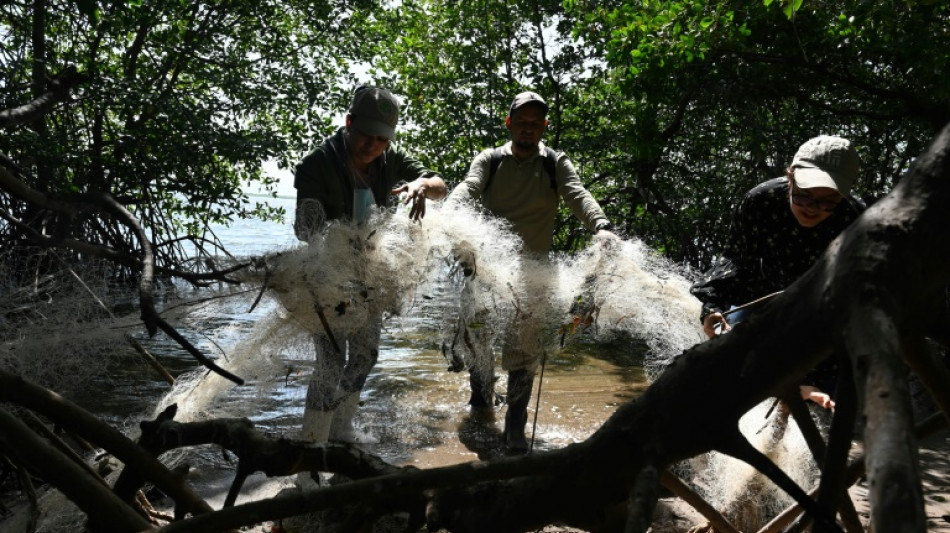
But they share it these days with unwanted mounds of plastic bottles, tangles of fish netting and other discarded trash washed up on its shores.

Residents in inland cities often throw their plastic waste into rivers that empty into the Gulf of Fonseca, despoiling the once-pristine habitat.

A dozen or so islands and keys dot the gulf, a 1,200 square mile (3,100 square kilometer) area that is fed by five major rivers from the three neighboring countries. Border disputes over rights to the gulf and its islands once roiled the countries but those disputes have quieted down.

- Cleanup time arrives -

Instead, efforts to clean up the gulf's islands and keys are now underway.

An activist group, the Committee for the Defense and Development of the Flora and Fauna of the Gulf of Fonseca, has joined forces with the Forest Conservation Institute of Honduras (ICF) and municipalities along the coast to conduct cleanups.

One recent day, a mission takes some 20 volunteers and government workers to Los Pajaros Island, where they plunge into the thickets of mangroves, filling sacks with endless plastic waste and discarded bottles.

"These solid wastes... take years to decompose," Helen Castillo of ICF tells AFP.

The gulf hosts "five of the seven species of mangrove that exist worldwide, so that is a target of our conservation," environmentalist Carlos Zorto of the activist group tells AFP.

The Gulf of Fonseca provides key nesting sites for migrating birds as well as habitat for crabs, mollusks, iguanas and fish, such as snook and snapper.

- 'The ones hit hardest' -

Much of the garbage comes from cities and towns in central and southern Honduras, carried down river to the gulf, Castillo explains.

"We have seen sea turtles with nostrils blocked by plastic forks and plastic spoons, which can cause their death," she says.

The head of the cleanup effort for the activist group, Adan Rivas, says participants try to get those living along the coastline to help.

"We are the ones hit hardest" by environmental degradation, Rivas told AFP. "In the case of Honduras, we are seeing droughts, flooding... and the disappearance of some species."

G.Rehman--DT



