Dubai Telegraph - Bangladesh major hub for tiger poaching: study

EUR -
AED 4.233412
AFN 75.493281
ALL 93.476873
AMD 423.012424
AOA 1058.078854
ARS 1724.84304
AUD 1.637146
AWG 2.074665
AZN 1.9613
BAM 1.957195
BBD 2.320614
BDT 142.631679
BHD 0.434585
BIF 3450.283135
BMD 1.152592
BND 1.478454
BOB 13.993612
BRL 5.923142
BSD 1.152201
BTN 109.959957
BWP 15.66817
BYN 3.395921
BYR 22590.796538
BZD 2.317352
CAD 1.62202
CDF 2604.856784
CHF 0.933478
CLF 0.026717
CLP 1054.90939
CNY 7.784085
CNH 7.778005
COP 3695.289544
CRC 522.463388
CUC 1.152592
CUP 30.543679
CVE 110.821967
CZK 24.174802
DJF 204.839013
DKK 7.475214
DOP 67.309719
DZD 153.225447
EGP 57.834277
ERN 17.288875
ETB 184.242088
FJD 2.549475
FKP 0.857957
GBP 0.857355
GEL 3.014012
GGP 0.857957
GHS 13.502625
GIP 0.857957
GMD 85.292198
GNF 10125.518143
GTQ 8.788265
GYD 241.218821
HKD 9.04041
HNL 30.958679
HRK 7.534952
HTG 150.646086
HUF 361.27813
IDR 20702.851399
ILS 3.471399
IMP 0.857957
INR 109.608412
IQD 1509.895075
IRR 1584957.60632
ISK 141.80319
JEP 0.857957
JMD 182.179872
JOD 0.817187
JPY 181.67259
KES 149.141517
KGS 100.79462
KHR 4667.996734
KMF 493.309394
KRW 1646.00506
KWD 0.356499
KYD 0.960164
KZT 542.785168
LAK 26048.57164
LBP 103214.582979
LKR 386.855782
LRD 208.936033
LSL 19.052185
LTL 3.403304
LVL 0.697191
LYD 7.33626
MAD 10.744475
MDL 20.168941
MGA 4950.381183
MKD 61.573895
MMK 2420.05814
MNT 4131.233505
MOP 9.308534
MRU 46.230476
MUR 53.594212
MVR 17.818945
MWK 2002.051424
MXN 19.906036
MYR 4.721703
MZN 73.650705
NAD 19.051931
NGN 1571.305274
NIO 42.400226
NOK 11.00657
NPR 175.938423
NZD 1.956749
OMR 0.443186
PAB 1.152221
PEN 3.912473
PGK 5.09395
PHP 70.316161
PKR 320.218844
PLN 4.297288
PYG 6869.927239
QAR 4.202061
RON 5.250283
RSD 117.347682
RUB 92.924497
RWF 1692.004557
SAR 4.315567
SBD 9.302748
SCR 15.433387
SDG 692.133809
SEK 10.981069
SGD 1.477876
SLE 28.181113
SOS 658.46941
SRD 43.67285
STD 23856.320291
STN 24.89598
SVC 10.082187
SZL 19.052529
THB 38.341538
TJS 10.634743
TMT 4.034071
TND 3.389771
TRY 54.80355
TTD 7.822577
TWD 37.357224
TZS 3060.128502
UAH 51.521028
UGX 4315.001205
USD 1.152592
UYU 46.423296
UZS 13847.236438
VES 848.482424
VND 30271.091065
VUV 137.324159
WST 3.149129
XAF 656.424953
XAG 0.019291
XAU 0.000282
XCD 3.114936
XCG 2.07658
XDR 0.817312
XOF 654.099666
XPF 119.331742
YER 274.773117
ZAR 18.891666
ZMK 10374.708657
ZMW 21.802137
ZWL 371.134044
  • CMSC

    0.0150

    21.775

    +0.07%

  • CMSD

    0.0350

    22.055

    +0.16%

  • BCC

    4.8350

    87.865

    +5.5%

  • RIO

    3.0600

    98.96

    +3.09%

  • JRI

    -0.0450

    12.775

    -0.35%

  • NGG

    0.3410

    80.201

    +0.43%

  • BCE

    0.0950

    21.885

    +0.43%

  • GSK

    0.1450

    51.655

    +0.28%

  • RBGPF

    3.9500

    69.95

    +5.65%

  • BP

    -1.7050

    42.555

    -4.01%

  • RELX

    0.5850

    36.745

    +1.59%

  • VOD

    0.0550

    15.665

    +0.35%

  • RYCEF

    0.1500

    20.35

    +0.74%

  • AZN

    -2.2800

    155.69

    -1.46%

  • BTI

    -0.4600

    59.1

    -0.78%

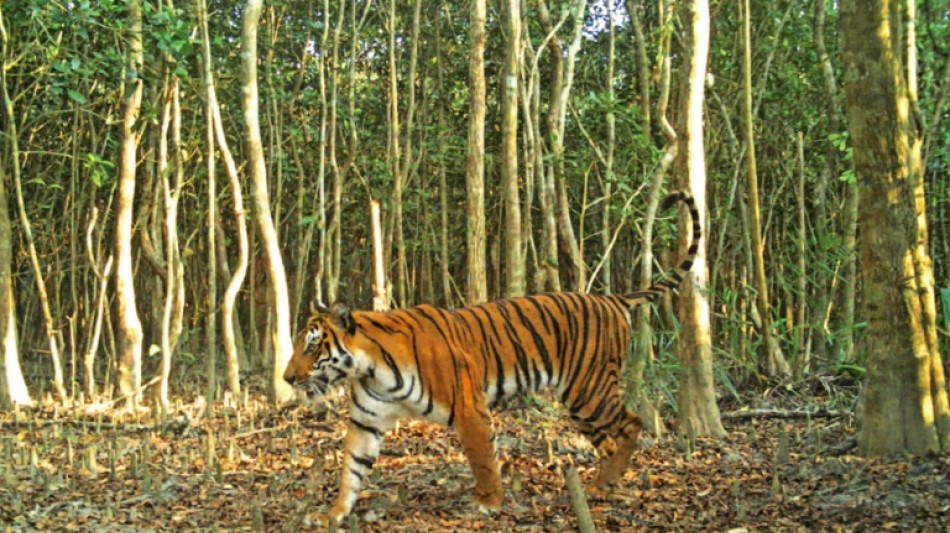
Bangladesh major hub for tiger poaching: study
Bangladesh major hub for tiger poaching: study / Photo: Handout - BANGLADESH FOREST DEPARTMENT/AFP/File

Bangladesh major hub for tiger poaching: study

Bangladesh remains a major hub for the poaching of endangered tigers despite government claims of a successful crackdown on pirate groups involved in the trade, according to research published Friday.

Text size:

The vast Sundarbans mangrove forest straddling India and Bangladesh hosts one of the world's largest populations of Bengal tigers.

Their pelts, bones and flesh are bought by black marketeers as part of a broader illegal wildlife trade valued at an estimated $20 billion globally each year.

Research from big cat conservation group Panthera and the Chinese Academy of Sciences said tiger parts harvested in the Sundarbans have been exported to 15 countries, with India and China being the most common destinations.

"Bangladesh plays a much more significant role in the illicit tiger trade than we previously realized," study co-author Rob Pickles said in a statement.

Pirate groups operating in the Sundarbans found a lucrative trade in tiger poaching before a government crackdown starting in 2016.

At least 117 pirates were shot dead and hundreds more were detained, according to official figures, while many others surrendered as part of a government amnesty.

But Panthera's research, published in the Conservation Science and Practice journal, said that the vacuum created by the crackdown had been filled by more than 30 specialist tiger poaching syndicates and opportunistic poachers.

Traders operated through their own logistics companies and in some cases concealed their activities through licenses for legal wildlife trade, the study added.

The research, based partly on interviews with those involved in the wildlife trade, also found that domestic consumption of tiger parts had increased since the crackdown, owing to Bangladesh's burgeoning economy.

Wealthy local buyers were purchasing medicines using tiger parts "as well as large ornamental items for display such as skulls and skins", the study said.

The findings were disputed by Bangladesh's official Sundarbans conservator Abu Naser Mohsin Hossain, who said the crackdown had brought the illicit trade to a standstill.

"We have taken measures to conserve the Bengal tiger population in the Sundarbans," he told AFP.

"No tiger has died from... tiger-human conflict in the past five years. Tiger sightings have increased."

Just 114 Bengal tigers live in Bangladesh's portion of the Sundarbans, according to an official census published in 2019 -- up slightly since a record low four years prior.

An updated population count is due to be published next year.

Poaching is the number one threat to tigers globally, and China is the biggest overall driver of demand, largely for use of their body parts in traditional medicine, according to Panthera.

G.Mukherjee--DT



