
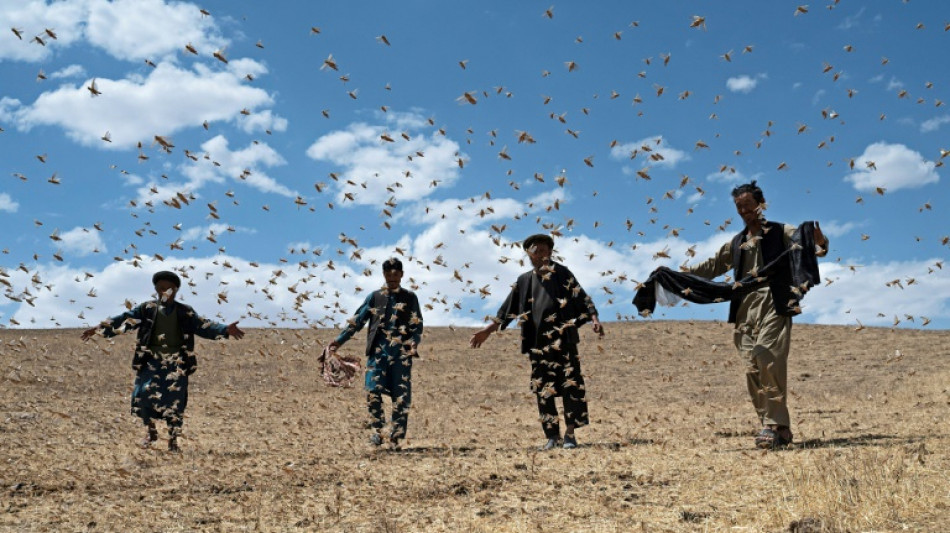
Afghan farmers despair as locusts plague precious crops / Photo: Wakil KOHSAR - AFP
Hundreds of thousands of locusts have descended on crops in northern Afghanistan, under the helpless gaze of farmers and their families already stalked by famine.
In the village of Kandali in northern Balkh, one of eight affected provinces in the country's breadbasket, a staggering swarm of grey insects has amassed on a fallow wheat field.
After feasting on the harvest they laid eggs to hatch anew next spring, continuing a cycle of destruction in a nation where nine in 10 families already struggle to afford food, according to the UN.
"They eat everything that is green: wheat, peas, sesame," Baz Mohammad, the representative of Kandali village, told AFP.
Desperate farmers used nets to sweep up the plague of Moroccan Locusts -- one of the world's most voracious pests -- before burying them in trenches, but their numbers are still multiplying.
"We walk with hungry stomachs to kill the locusts. If we don't kill them, our agriculture will be ruined," Mohammad said.
This year's outbreak could destroy 1.2 million tonnes of wheat, a quarter of the annual harvest, at a loss of up to $480 million, according to the UN's Food and Agriculture Organization (FAO).
Afghanistan is facing its third consecutive year of drought, with farmers in Kandali reporting no rains since March, which could have helped wash away the bugs.
"Harvest forecasts this year are the best we have seen for the last three years," FAO Afghanistan representative Richard Trenchard said last month.
"But this outbreak threatens to destroy all these recent gains and dramatically worsen the food insecurity situation later this year and into next year."
The agency said conditions were "perfect" for locusts with "overgrazing, drought and very limited control measures".
The last two major infestations, which took place 20 and 40 years ago, cost the country an estimated eight percent and 25 percent of production, respectively.
- Worse to come -
The head of locust control at the provincial agricultural ministry, Sifatullah Azizi, said 7,000 hectares (17,000 acres) of land has been treated chemically and manually, but it is not enough.
"We have acted within our means. To eradicate them you need a budget, to hire workers, pay for fuel, products," he told AFP.
Afghanistan's economy, already battered by decades of war, has been mired in crisis after billions of dollars in international aid were cut following the Taliban goverment's takeover in August 2021.
Economic output has collapsed and nearly 85 percent of the country lives in poverty, according to the latest report from the United Nations Development Programme.
"Afghanistan used to have a very strong locust control system in place. But this has been heavily eroded in the last two years," Trenchard said.
If left untreated, the population of Moroccan locusts could increase 100-fold next year, the FAO has warned.
Farmer Abdul Raqib Kazimi, who provides for sixteen family members, said 60 to 70 percent of his land has been destroyed, including fodder for cattle.
"We need to feed ourselves. If there is no wheat, there is no flour," the 38-year-old said.
"I am very worried as these locusts are laying eggs in this area so next year again it will be out of my control and out of the control of my villagers."
B.Krishnan--DT



