Dubai Telegraph - Syrians turn plastic waste into rugs to make a living

EUR -
AED 4.229821
AFN 74.864237
ALL 93.228828
AMD 421.085566
AOA 1056.160267
ARS 1720.733086
AUD 1.637784
AWG 2.076039
AZN 1.954916
BAM 1.955775
BBD 2.318931
BDT 142.528208
BHD 0.434189
BIF 3440.726871
BMD 1.151756
BND 1.477381
BOB 13.98346
BRL 5.846768
BSD 1.151366
BTN 109.880188
BWP 15.656803
BYN 3.393457
BYR 22574.408206
BZD 2.315671
CAD 1.619057
CDF 2605.270629
CHF 0.931862
CLF 0.026904
CLP 1062.322075
CNY 7.777342
CNH 7.775035
COP 3736.43312
CRC 522.084371
CUC 1.151756
CUP 30.521521
CVE 110.263614
CZK 24.202703
DJF 205.024752
DKK 7.475452
DOP 67.149156
DZD 153.146465
EGP 57.871799
ERN 17.276333
ETB 185.837664
FJD 2.548778
FKP 0.857335
GBP 0.856578
GEL 3.006302
GGP 0.857335
GHS 13.488479
GIP 0.857335
GMD 85.229454
GNF 10111.872879
GTQ 8.78189
GYD 241.04383
HKD 9.033562
HNL 30.861746
HRK 7.534208
HTG 150.536801
HUF 362.376716
IDR 20712.019529
ILS 3.484118
IMP 0.857335
INR 109.655937
IQD 1508.281039
IRR 1583951.78019
ISK 141.999677
JEP 0.857335
JMD 182.047711
JOD 0.816595
JPY 181.232211
KES 149.014032
KGS 100.721368
KHR 4660.900938
KMF 492.951678
KRW 1642.904407
KWD 0.356388
KYD 0.959467
KZT 542.391408
LAK 26041.672617
LBP 103089.392874
LKR 386.57514
LRD 207.822876
LSL 18.980961
LTL 3.400835
LVL 0.696685
LYD 7.334908
MAD 10.727965
MDL 20.154309
MGA 4902.938363
MKD 61.529226
MMK 2418.302526
MNT 4128.236531
MOP 9.301781
MRU 46.030421
MUR 54.17888
MVR 17.794357
MWK 1996.448901
MXN 19.912067
MYR 4.713674
MZN 73.578865
NAD 18.981044
NGN 1570.371947
NIO 42.369467
NOK 10.994201
NPR 175.81079
NZD 1.956723
OMR 0.442841
PAB 1.151386
PEN 3.895551
PGK 5.083936
PHP 70.025536
PKR 319.707481
PLN 4.306816
PYG 6864.943499
QAR 4.197165
RON 5.250796
RSD 117.352727
RUB 93.295072
RWF 1695.341888
SAR 4.314394
SBD 9.295999
SCR 15.438728
SDG 691.053528
SEK 10.992758
SGD 1.476953
SLE 28.160726
SOS 657.991728
SRD 43.543221
STD 23839.013893
STN 24.499267
SVC 10.074873
SZL 18.977597
THB 38.375353
TJS 10.627028
TMT 4.031144
TND 3.382357
TRY 54.772537
TTD 7.816902
TWD 37.32091
TZS 3055.023466
UAH 51.483653
UGX 4311.870919
USD 1.151756
UYU 46.389618
UZS 13747.827169
VES 861.341978
VND 30249.131118
VUV 137.224539
WST 3.146845
XAF 655.948754
XAG 0.019431
XAU 0.000283
XCD 3.112677
XCG 2.075074
XDR 0.816719
XOF 655.948754
XPF 119.331742
YER 274.582072
ZAR 18.940458
ZMK 10367.187916
ZMW 21.786321
ZWL 370.864808
  • BTI

    0.5350

    60.095

    +0.89%

  • GSK

    -0.1900

    51.32

    -0.37%

  • RYCEF

    0.5000

    20.7

    +2.42%

  • VOD

    0.1100

    15.72

    +0.7%

  • RIO

    2.8300

    98.73

    +2.87%

  • RELX

    0.0800

    36.24

    +0.22%

  • BP

    -1.7200

    42.54

    -4.04%

  • BCC

    0.1700

    83.2

    +0.2%

  • BCE

    -0.1250

    21.665

    -0.58%

  • AZN

    -0.5700

    157.4

    -0.36%

  • CMSC

    0.0000

    21.76

    0%

  • JRI

    0.0000

    12.82

    0%

  • RBGPF

    3.9500

    69.95

    +5.65%

  • NGG

    -0.2900

    79.57

    -0.36%

  • CMSD

    -0.0100

    22.01

    -0.05%

Syrians turn plastic waste into rugs to make a living
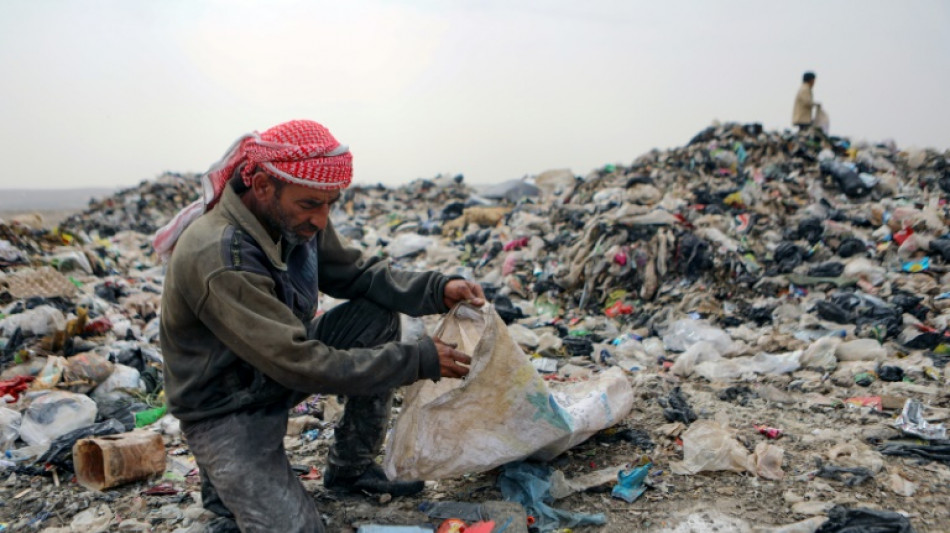
Syrians turn plastic waste into rugs to make a living / Photo: Aaref WATAD - AFP

Syrians turn plastic waste into rugs to make a living

At a rubbish dump in northwest Syria, Mohammed Behlal rummages for plastic to be sold to recyclers and transformed into floor rugs and other items in the impoverished rebel enclave.

Text size:

In rebel-held Syria, recycling is rarely an environmental impulse but rather a grim lifeline for needy residents looking for work or items they otherwise could not afford.

Braving the stench, insects and risk of disease, 39-year-old Behlal hacks through the rubbish pile with a scythe and his bare hands.

He and two of his six children earn a living sifting through the refuse in Idlib province's village of Hezreh, earning $7 to $10 a week each.

"It's tiring... but what can we do, we have to put up with this hard labour," said Behlal, who was displaced from neighbouring Aleppo province during Syria's civil war.

"Thank God, at least we have work with the trash," he added.

Behlal was shot in the leg during fighting and has had trouble finding employment.

Hunched over to collect pieces of plastic or metal, he throws everything into a bag to sell to a nearby scrap facility.

Syria's conflict has killed more than 500,000 people, and around half of the country's pre-war population has been forced from their homes since fighting broke out in 2011.

More than four million people, most of them dependent on aid, live in areas controlled by jihadists and Turkish-backed groups in Syria's north and northwest.

In a large scrapyard next to agricultural fields, workers sort plastic junk loosely into piles according to colour.

They then cut it up and crush it into small pieces that are washed and melted into plastic pellets.

- Plastic thread -

Farhan Sleiman, 29, is among those who handle the material brought in from the landfill.

"We buy plastic from roaming trash-picker trucks and children," said Sleiman, originally from Homs province.

He expressed fear of the risk of contracting "cholera or chronic illnesses" from working with the rubbish.

Elsewhere in northern Idlib province, workers at a factory making mats and rugs churn out brightly coloured plastic thread while large weaving machines click and clack.

Factory owner Khaled Rashu, 34, says rug-making is a family tradition.

"We have more than 30 employees" at the factory, he boasted as a significant feat in a region where many are jobless.

Large mats featuring geometric designs, some made with striking red or purple plastic thread, emerge from the weaving machines and are stacked into piles.

Shop owner Mohammed al-Qassem, 30, is among those selling the mats, which he says are a hit in an area where many people are displaced and live in basic tents or makeshift dwellings.

The mats made from recycled plastic cost between $5 and $15, while traditional Persian-style rugs are around $100.

"In summer, demand for plastic mats increases" because they retain less heat, Qassem said from his shop in Maaret Masrin, a town in Idlib province.

But "they can also be used in winter and are less costly", he added.

R.El-Zarouni--DT