Dubai Telegraph - Global warming made Horn of Africa drought possible: report

EUR -
AED 4.244814
AFN 72.802804
ALL 95.914677
AMD 436.246704
ANG 2.068623
AOA 1059.686486
ARS 1612.008363
AUD 1.638291
AWG 2.082972
AZN 1.962345
BAM 1.969574
BBD 2.328475
BDT 141.855734
BGN 1.97528
BHD 0.436297
BIF 3432.136637
BMD 1.155602
BND 1.483243
BOB 7.989252
BRL 6.063493
BSD 1.156105
BTN 107.709447
BWP 15.776079
BYN 3.574902
BYR 22649.790599
BZD 2.325171
CAD 1.587086
CDF 2628.993471
CHF 0.913988
CLF 0.026713
CLP 1054.763637
CNY 7.97417
CNH 7.960725
COP 4269.832208
CRC 540.913237
CUC 1.155602
CUP 30.623441
CVE 112.151229
CZK 24.481386
DJF 205.373253
DKK 7.47086
DOP 67.978235
DZD 152.576569
EGP 60.372554
ERN 17.334023
ETB 181.657116
FJD 2.588804
FKP 0.867479
GBP 0.862477
GEL 3.13749
GGP 0.867479
GHS 12.593607
GIP 0.867479
GMD 85.514573
GNF 10143.290905
GTQ 8.843733
GYD 241.874076
HKD 9.052001
HNL 30.704397
HRK 7.533481
HTG 151.647087
HUF 392.943851
IDR 19565.490032
ILS 3.613959
IMP 0.867479
INR 107.442864
IQD 1513.838045
IRR 1519760.503236
ISK 143.791825
JEP 0.867479
JMD 181.624669
JOD 0.819309
JPY 182.423841
KES 149.763421
KGS 101.054924
KHR 4633.962204
KMF 494.597345
KPW 1040.027513
KRW 1724.007673
KWD 0.353926
KYD 0.963484
KZT 555.984674
LAK 24816.543481
LBP 103484.119913
LKR 360.370478
LRD 211.937779
LSL 19.449397
LTL 3.412191
LVL 0.699012
LYD 7.372499
MAD 10.814987
MDL 20.260655
MGA 4813.080507
MKD 61.61802
MMK 2426.462186
MNT 4143.804949
MOP 9.328119
MRU 46.350722
MUR 53.741226
MVR 17.853738
MWK 2007.279745
MXN 20.551813
MYR 4.551849
MZN 73.838926
NAD 19.44871
NGN 1568.150995
NIO 42.433955
NOK 10.997704
NPR 172.329658
NZD 1.976252
OMR 0.444335
PAB 1.156145
PEN 3.992022
PGK 4.971446
PHP 69.284099
PKR 322.586743
PLN 4.27635
PYG 7512.308906
QAR 4.211707
RON 5.093891
RSD 117.455653
RUB 99.556773
RWF 1686.022678
SAR 4.338713
SBD 9.300955
SCR 17.161078
SDG 694.516441
SEK 10.775205
SGD 1.478315
SHP 0.867
SLE 28.485234
SLL 24232.399446
SOS 660.428353
SRD 43.337431
STD 23918.619165
STN 24.845434
SVC 10.116052
SYP 127.727213
SZL 19.448949
THB 37.709593
TJS 11.069987
TMT 4.044605
TND 3.364245
TOP 2.782411
TRY 51.186048
TTD 7.836174
TWD 36.808226
TZS 3001.680884
UAH 50.840265
UGX 4369.74838
USD 1.155602
UYU 46.828911
UZS 14092.560843
VES 525.435424
VND 30380.765043
VUV 137.988555
WST 3.157358
XAF 660.611205
XAG 0.01622
XAU 0.000251
XCD 3.123071
XCG 2.083589
XDR 0.821585
XOF 660.428833
XPF 119.331742
YER 275.668443
ZAR 19.4876
ZMK 10401.796193
ZMW 22.631445
ZWL 372.103231
  • RBGPF

    -13.5000

    69

    -19.57%

  • RYCEF

    -0.5900

    16.01

    -3.69%

  • CMSC

    0.0200

    22.85

    +0.09%

  • NGG

    -1.8700

    85.53

    -2.19%

  • RIO

    -2.0700

    85.65

    -2.42%

  • GSK

    0.3100

    52.37

    +0.59%

  • RELX

    -0.0400

    33.82

    -0.12%

  • CMSD

    0.0100

    22.9

    +0.04%

  • VOD

    0.0500

    14.42

    +0.35%

  • BCE

    -0.0200

    25.73

    -0.08%

  • AZN

    0.5100

    188.93

    +0.27%

  • BCC

    -1.9800

    69.86

    -2.83%

  • JRI

    -0.1630

    12.16

    -1.34%

  • BTI

    0.6300

    58.72

    +1.07%

  • BP

    1.2500

    45.86

    +2.73%

Global warming made Horn of Africa drought possible: report
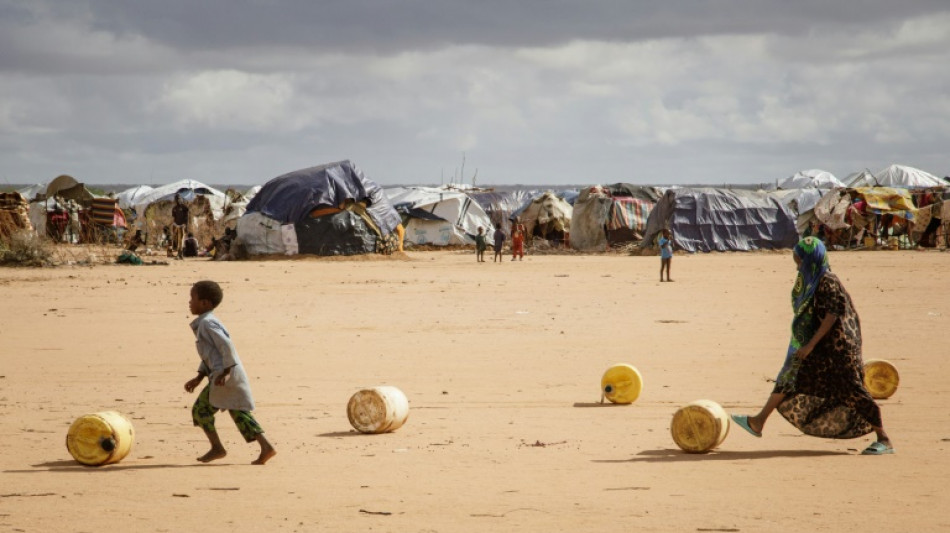
Global warming made Horn of Africa drought possible: report / Photo: Bobb Muriithi - AFP

Global warming made Horn of Africa drought possible: report

A devastating drought that has struck the Horn of Africa could not have occurred without global warming, according to a new report released Thursday from an international team of climate scientists.

Text size:

"Human-caused climate change has made agricultural drought in the Horn of Africa about 100 times more likely," said a summary of the report by the World Weather Attribution (WWA) group.

"The ongoing devastating drought would not have happened at all without the effect of greenhouse gas emissions," it added.

Since late 2020, countries on the Horn of Africa -- Djibouti, Ethiopia, Eritrea, Kenya, Somalia, South Sudan and Sudan -- have been suffering the worst drought in 40 years. The extended drought has led to the deaths of millions of heads of cattle and wiped out crops.

The WWA study concentrated on the three areas worst hit by the drought: southern Ethiopia, Somalia and eastern Kenya.

While climate change had little effect on total annual rainfall in the region, "higher temperatures have significantly increased evaporation from soil and plants, which has made dry soils much more likely", according to the 19 scientists who contributed to the WWA report.

"Without this effect, the region would not have experienced agricultural drought -- when crops and pastures are affected by dry conditions -- over the last two years," the summary added.

"Instead, widespread crop failures and livestock deaths have left more than 20 million people at risk of acute food insecurity."

The WWA said that, for its rapid analysis, "scientists looked at changes in rainfall in 2021 and 2022 in the affected region, covering southern Ethiopia, southern Somalia and eastern Kenya".

"They found that climate change is affecting the rainfall periods in opposite ways. The long rains are becoming drier, with low rainfall now about twice as likely, while the short rains are becoming wetter due to climate change," it added.

"This wettening trend in the short rains has been masked recently by the La Nina weather pattern, which reduces rainfall in the short rains."

Joyce Kimutai, a Kenyan climatologist who contributed to the report, told AFP: "It is time we act and engage differently. Central to this process is to transform and enhance resilience of our systems.

"We need to innovate across and throughout food systems, improve collaboration, involve vulnerable groups, make the best use of data and information, as well as incorporating new technologies and traditional knowledge."

The WWA network, set up by leading climate scientists, has built a reputation in recent years for its capacity to evaluate the extent to which climate change has contributed to extreme weather events.

Its results are published as a matter of urgency, without passing through the long peer-review process required by scientific journals, but employ approved methodological approaches.

G.Gopalakrishnan--DT