Dubai Telegraph - Water, water everywhere: Wet winter boosts California's reservoirs

EUR -
AED 4.218957
AFN 74.661225
ALL 91.582971
AMD 417.457719
ANG 2.056463
AOA 1054.440663
ARS 1743.614232
AUD 1.610725
AWG 2.06753
AZN 1.957227
BAM 1.958584
BBD 2.314189
BDT 141.100567
BGN 1.933647
BHD 0.43308
BIF 3445.883141
BMD 1.148628
BND 1.468274
BOB 11.289342
BRL 5.906291
BSD 1.149053
BTN 110.098541
BWP 15.582625
BYN 3.475741
BYR 22513.103189
BZD 2.310945
CAD 1.607792
CDF 2654.479062
CHF 0.944284
CLF 0.027911
CLP 1102.062801
CNY 7.693107
CNH 7.700293
COP 3657.609688
CRC 514.039631
CUC 1.148628
CUP 30.438634
CVE 110.55587
CZK 24.347696
DJF 204.134569
DKK 7.475389
DOP 67.81758
DZD 153.643935
EGP 60.011386
ERN 17.229416
ETB 187.686889
FJD 2.545249
FKP 0.859109
GBP 0.857505
GEL 2.990867
GGP 0.859109
GHS 13.237162
GIP 0.859109
GMD 84.42856
GNF 10101.666796
GTQ 8.768617
GYD 240.39904
HKD 9.011042
HNL 30.845651
HRK 7.534658
HTG 150.176082
HUF 364.287725
IDR 20459.4717
ILS 3.487958
IMP 0.859109
INR 110.252582
IQD 1505.265866
IRR 1578903.655694
ISK 139.202636
JEP 0.859109
JMD 181.437904
JOD 0.814422
JPY 180.197158
KES 148.759217
KGS 100.447935
KHR 4656.761237
KMF 491.613064
KPW 1033.765308
KRW 1592.044397
KWD 0.353962
KYD 0.95759
KZT 513.710212
LAK 25757.976881
LBP 102859.612165
LKR 380.330553
LRD 198.788625
LSL 18.680779
LTL 3.391599
LVL 0.694794
LYD 7.294223
MAD 10.886907
MDL 20.194321
MGA 4981.210628
MKD 61.619198
MMK 2411.949927
MNT 4132.823691
MOP 9.2846
MRU 46.225512
MUR 54.640655
MVR 17.746733
MWK 1992.492937
MXN 19.78965
MYR 4.690656
MZN 73.40923
NAD 18.680942
NGN 1529.662418
NIO 42.280099
NOK 10.809019
NPR 176.162473
NZD 2.008793
OMR 0.442789
PAB 1.149063
PEN 3.877412
PGK 5.114426
PHP 72.2606
PKR 318.484727
PLN 4.363465
PYG 6811.860614
QAR 4.19998
RON 5.263476
RSD 117.119869
RUB 96.935341
RWF 1687.950767
SAR 4.280492
SBD 9.18961
SCR 16.157873
SDG 690.903792
SEK 11.290555
SGD 1.465768
SHP 0.858627
SLE 28.314099
SLL 24086.139517
SOS 656.64482
SRD 43.585257
STD 23774.274604
STN 24.535303
SVC 10.054598
SYP 14934.457826
SZL 18.674871
THB 38.295672
TJS 10.59989
TMT 4.031683
TND 3.380004
TOP 2.76562
TRY 56.015171
TTD 7.800223
TWD 36.503811
TZS 3043.85889
UAH 51.337638
UGX 4532.442628
USD 1.148628
UYU 46.207089
UZS 13604.57507
VES 973.444877
VND 29889.590367
VUV 135.812798
WST 3.158992
XAF 655.957
XAG 0.01734
XAU 0.000262
XCD 3.104224
XCG 2.070844
XDR 0.812139
XOF 655.957
XPF 119.331742
YER 271.708303
ZAR 18.687948
ZMK 10339.031894
ZMW 22.584693
ZWL 369.857655
SSP 6551.981415
MXV 2.243593
  • RYCEF

    0.7100

    20

    +3.55%

  • RBGPF

    -1.6900

    68.3

    -2.47%

  • CMSC

    0.0400

    20.71

    +0.19%

  • GSK

    -0.8400

    50.22

    -1.67%

  • RIO

    -0.6700

    97.37

    -0.69%

  • RELX

    -0.9700

    33.41

    -2.9%

  • BCC

    0.1600

    75.69

    +0.21%

  • BTI

    -0.1900

    55.83

    -0.34%

  • NGG

    -0.8000

    76.8

    -1.04%

  • BCE

    -0.2200

    22.06

    -1%

  • AZN

    -0.0600

    166.08

    -0.04%

  • VOD

    -0.5700

    16.95

    -3.36%

  • CMSD

    0.0000

    20.45

    0%

  • BP

    -0.8400

    44.58

    -1.88%

  • JRI

    -0.0600

    11.55

    -0.52%

Water, water everywhere: Wet winter boosts California's reservoirs
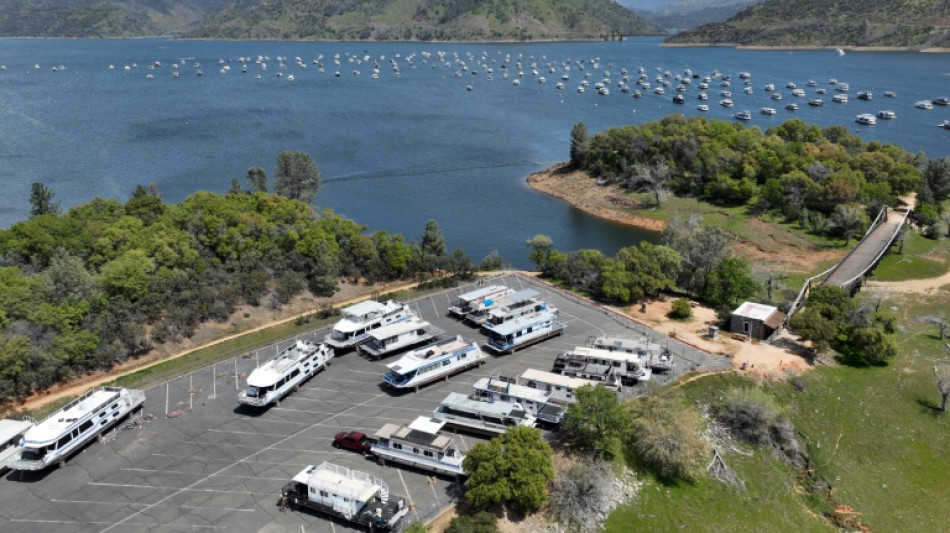
Water, water everywhere: Wet winter boosts California's reservoirs / Photo: JOSH EDELSON - AFP

Water, water everywhere: Wet winter boosts California's reservoirs

A very wet winter has left California's reservoirs looking healthier than they have for years, as near-record rainfall put a big dent in a lengthy drought.

Text size:

A series of atmospheric rivers -- high altitude ribbons of moisture -- chugged into the western United States, dousing a landscape that had been baked dry by years of below-average rain.

The state's 40 million residents had chafed under repeated warnings to save water, with restrictions on irrigating gardens that left lawns dead or dying.

Vegetation dried up, with hillsides a parched brown, and ripe for wildfires.

Reservoirs held just a fraction of their capacity, with shorelines retreating to reveal dust, rocks and the remains of sunken boats.

But then the winter of 2022-23 roared into action, and trillions of gallons of water fell from the skies.

Rivers and creeks that had slowed to a trickle or even vanished entirely sprang to life.

Lake Tulare, in the Central Valley, which had dried up 80 years earlier, began to re-emerge, as all that rain had to find somewhere to go.

Mountains were buried under hundreds of inches (many meters) of snow, and the state's ski resorts began talking about a bumper season that could last all the way into July.

Official statistics from the US Drought Monitor released last week show around two-thirds of California is completely out of the drought.

Less than 10 percent of the state is still technically in a drought, with the remainder classed as "abnormally dry."

A year ago the entire state was in a drought.

California's Department of Water Resources says major reservoirs are overtopping their average capacity.

Lake Oroville, one of the most important bodies of water in the state, is now around 88 percent full, storing almost twice the amount of water as it did a year ago.

AFP photographs show the once shriveled reservoir looking much closer to its original shoreline.

Pictures taken almost exactly a year apart show a marked contrast -- in April 2022, a puny stream trickles through a valley, but this year the valley is full of water.

A photograph taken in September last year shows a boat ramp hanging uselessly, high above the water line, while the same boat ramp seen in a picture taken Sunday has water lapping half way up.

The Enterprise Bridge now spans a body of water, where last year its footings stood starkly in the dusty bank, with just a small creek passing underneath.

Wet winters are not new in California, but scientists say human-cause climate change is exacerbating the so-called "weather whiplash" that sees very hot and dry periods give way to extremely soggy months.

And water managers caution that while there is a lot of wet around at the moment, Californians cannot afford to waste water.

Adel Hagekhalil of the Metropolitan Water District that serves Southern California told Spectrum News 1 that people should still conserve their supplies.

"We need to save and build the savings... so when we have another dry year, and hot days and dry days, we can respond," he said.

J.Chacko--DT



