
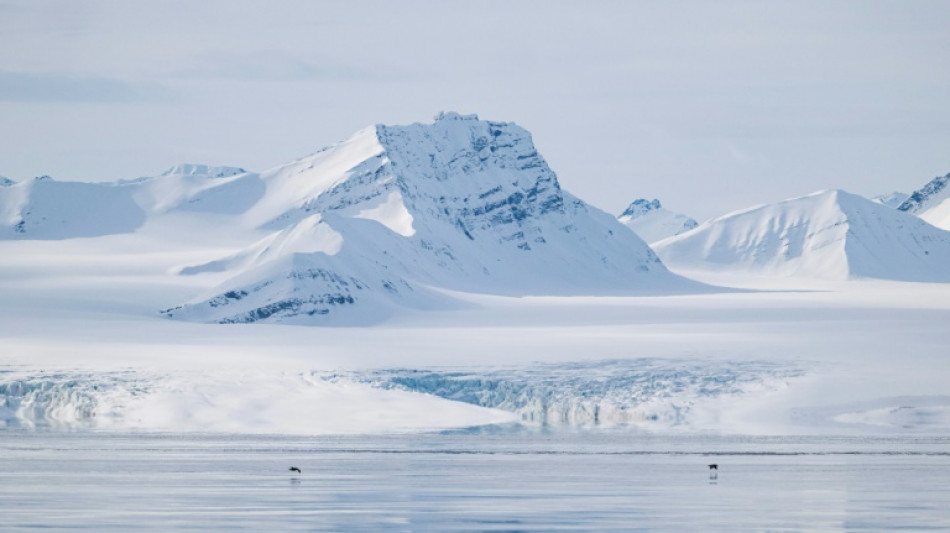
Scientists in Arctic race to preserve 'ice memory' / Photo: Jonathan NACKSTRAND - AFP/File
Scientists camped in the Arctic are set to start drilling to save samples of ancient ice for analysis before the frozen layers melt away due to climate change, mission organisers said on Monday.
Italian, French and Norwegian researchers are in Norway's Svalbard archipelago in what they called a race against time to preserve crucial ice records for analysing past environmental conditions -- planning to ship them all the way to the Antarctic for storage.
"Glaciers at high latitudes, such as those in the Arctic, have begun to melt at a high rate," said paleoclimatologist Carlo Barbante, vice-chairman of the Ice Memory Foundation that is running the mission.
"We want to recover and preserve, for future generations of scientists, these extraordinary archives of our Planet's climate before all the information they contain is completely lost."
The eight specialists on the mission have set up camp at an altitude of 1,100 metres on the crevasse-ridden Holtedahlfonna ice field and plan to start drilling on Tuesday, Ice Memory said.
They will extract ice in a series of tubes from as far as 125 metres (137 yards) below the surface, containing frozen geochemical traces dating back three centuries.
Analysis of chemicals in deep "ice cores" provides scientists with valuable data about past environmental conditions.
But experts warn that meltwater is leaking down and altering the geochemical records preserved in ancient ice beneath.
Ice scientists "are seeing their primary material disappear forever from the surface of the planet", Jerome Chapellaz, president of the foundation, told AFP.
"It is our responsibility as glaciologists of this generation to make sure a bit of it is preserved."
Human-caused carbon emissions have warmed the planet by 1.1 degrees Celsius since the 19th century. Studies indicate that the Arctic is warming between two and four times faster than the global average.
- Antarctic 'ice sanctuary' -
One set of the ice tubes extracted will be used for immediate analysis while a second set will be sent to Antarctica for storage in an "ice memory sanctuary" under the snow, where the samples will be preserved for future generations of scientists.
From their remote source, the ice cores will be transported by sea to Europe and later to the other end of the globe, for storage at a Franco-Italian Antarctic research station.
There, on territory protected by the Antarctic Treaty, they will be stored under the snow at minus 50C, where no power is needed to keep them cool.
"In coming decades, researchers will have new ideas and techniques to give voice to these archives," the researchers said in a statement.
"For instance, they may be able to isolate other information contained in the ice of which we are not aware today."
The team in Svalbard will work for three weeks in temperatures as low as minus 25C (-13 Farenheit), cutting and pulling out a series of cylinders of ice 10cm (four inches) wide.
The 700,000-euro ($760,000) mission, partly funded by the Italian research ministry, follows a series of earlier ice core extractions by the foundation, including operations in the Alps and the Andes.
Further core-drilling missions are planned in the coming years in Tajikistan and the Himalayas.
A study published in the journal Science in January said that half of the Earth's 215,000 mountain glaciers are expected to disappear by the end of this century due to climate change caused by humans -- even if the target of limiting global warming to 1.5 degrees Celsius is reached.
I.Mansoor--DT



