Dubai Telegraph - Scientists find water inside glass beads on the Moon

EUR -
AED 4.316068
AFN 75.78368
ALL 95.590345
AMD 433.921011
ANG 2.103199
AOA 1078.693153
ARS 1639.785212
AUD 1.624081
AWG 2.115085
AZN 1.998447
BAM 1.953692
BBD 2.367425
BDT 144.224377
BGN 1.960098
BHD 0.443342
BIF 3496.940129
BMD 1.175047
BND 1.48805
BOB 8.122098
BRL 5.804148
BSD 1.175422
BTN 110.788156
BWP 15.737751
BYN 3.321717
BYR 23030.922895
BZD 2.364009
CAD 1.602171
CDF 2720.234209
CHF 0.915114
CLF 0.026583
CLP 1046.250228
CNY 7.992494
CNH 7.994215
COP 4395.921653
CRC 539.208999
CUC 1.175047
CUP 31.138748
CVE 110.718804
CZK 24.309497
DJF 208.829292
DKK 7.472536
DOP 69.974145
DZD 155.20245
EGP 61.946583
ERN 17.625706
ETB 184.837228
FJD 2.569065
FKP 0.864214
GBP 0.865099
GEL 3.14908
GGP 0.864214
GHS 13.242649
GIP 0.864214
GMD 85.778323
GNF 10313.979512
GTQ 8.975086
GYD 245.920458
HKD 9.203498
HNL 31.268177
HRK 7.538985
HTG 153.949298
HUF 356.459886
IDR 20367.502417
ILS 3.409229
IMP 0.864214
INR 110.911284
IQD 1539.311683
IRR 1542719.319578
ISK 143.802053
JEP 0.864214
JMD 185.140228
JOD 0.833171
JPY 184.059961
KES 151.757262
KGS 102.723202
KHR 4714.873056
KMF 492.344575
KPW 1057.555194
KRW 1710.72734
KWD 0.361773
KYD 0.979526
KZT 544.33643
LAK 25792.283247
LBP 105225.46686
LKR 378.490323
LRD 215.562468
LSL 19.235691
LTL 3.469608
LVL 0.710774
LYD 7.437674
MAD 10.742863
MDL 20.222835
MGA 4894.071095
MKD 61.679754
MMK 2467.412574
MNT 4207.19177
MOP 9.480809
MRU 46.925498
MUR 54.88696
MVR 18.1603
MWK 2046.931705
MXN 20.277164
MYR 4.59457
MZN 75.083217
NAD 19.235747
NGN 1598.816408
NIO 43.130063
NOK 10.920412
NPR 177.26371
NZD 1.972799
OMR 0.451806
PAB 1.175412
PEN 4.062727
PGK 5.099342
PHP 71.029227
PKR 327.365667
PLN 4.227866
PYG 7194.237187
QAR 4.280702
RON 5.263274
RSD 117.383642
RUB 87.720656
RWF 1716.15627
SAR 4.436151
SBD 9.438281
SCR 16.52231
SDG 705.619296
SEK 10.86037
SGD 1.48966
SHP 0.877291
SLE 28.907303
SLL 24640.145375
SOS 671.539675
SRD 43.983217
STD 24321.10228
STN 24.999127
SVC 10.284902
SYP 129.899463
SZL 19.235297
THB 37.88334
TJS 10.984361
TMT 4.124415
TND 3.371797
TOP 2.829232
TRY 53.167497
TTD 7.951285
TWD 36.887663
TZS 3052.181577
UAH 51.470562
UGX 4396.218926
USD 1.175047
UYU 46.999286
UZS 14247.445607
VES 583.06901
VND 30915.488845
VUV 138.765659
WST 3.186155
XAF 655.238824
XAG 0.014727
XAU 0.000249
XCD 3.175623
XCG 2.118351
XDR 0.815968
XOF 653.912644
XPF 119.331742
YER 280.367229
ZAR 19.270304
ZMK 10576.837589
ZMW 22.391458
ZWL 378.364682
  • BCC

    -1.4800

    72.76

    -2.03%

  • RBGPF

    0.0000

    63.18

    0%

  • CMSC

    -0.0400

    22.97

    -0.17%

  • RYCEF

    -0.0500

    17.45

    -0.29%

  • NGG

    -1.9400

    85.91

    -2.26%

  • RIO

    -2.4000

    103.11

    -2.33%

  • GSK

    -0.0300

    50.5

    -0.06%

  • CMSD

    0.0000

    23.42

    0%

  • BCE

    0.3400

    24.57

    +1.38%

  • AZN

    -2.4000

    182.52

    -1.31%

  • JRI

    -0.0200

    13.15

    -0.15%

  • RELX

    -1.5900

    34.16

    -4.65%

  • VOD

    -0.4400

    15.69

    -2.8%

  • BP

    -0.8200

    43.81

    -1.87%

  • BTI

    -1.4800

    58.08

    -2.55%

Scientists find water inside glass beads on the Moon
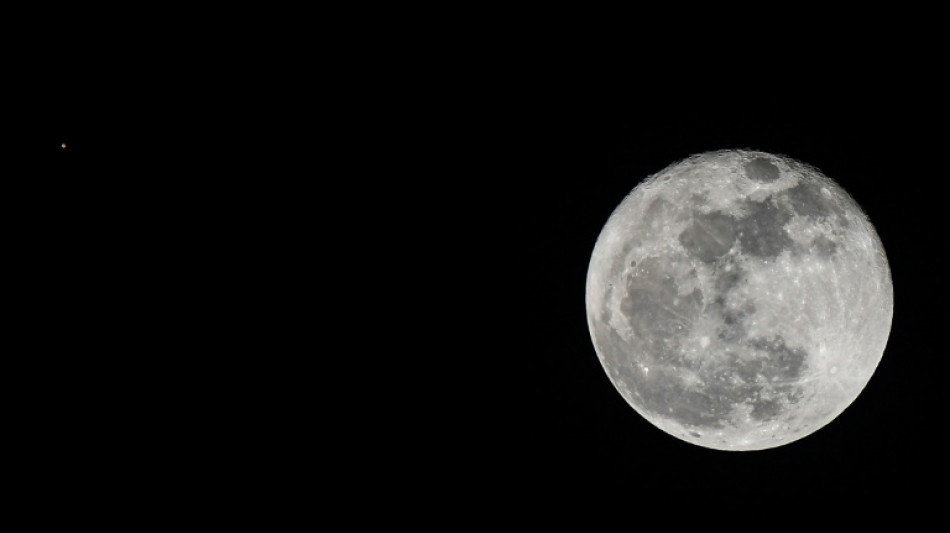
Scientists find water inside glass beads on the Moon / Photo: Luis Acosta - AFP/File

Scientists find water inside glass beads on the Moon

Scientists said Monday they have discovered water inside tiny beads of glass scattered across the Moon, suggesting that one day it could be extracted and used by the "explorers of tomorrow".

Text size:

The Moon was long believed to be dry, but over the last few decades several missions have shown there is water both on the surface and trapped inside minerals.

Mahesh Anand, a professor of planetary science and exploration at the UK's Open University, told AFP that water molecules could be seen "hopping over the lunar surface" when it was sunny.

"But we didn't know where exactly it was coming from," said Anand, a co-author of a new study published in the journal Nature Geoscience.

The study, carried out by a team led by the Chinese Academy of Sciences, said that the glass beads are "probably the dominant reservoir involved in the lunar surface water cycle".

The team polished and analysed 117 glass beads which were scooped up by China's Chang'e-5 spacecraft in December 2020 and brought back to Earth.

The beads are formed by tiny meteorites that bombard the surface of the Moon, which lacks the protection of an atmosphere.

The heat of the impact melts the surface material, which cools into round glass beads around the width of a strand of hair.

As well as finding water in the beads, the scientists detected "a telltale signature of the Sun," Anand said.

Investigating further, they determined that the hydrogen necessary to make up the water was coming from solar wind, which sweeps charged particles across the Solar System.

- 'Sustainable' source of water? -

The other ingredient for water, oxygen, makes up nearly half of the Moon, though it is trapped in rocks and minerals.

This means that solar wind could be equally contributing to water on other bodies in the Solar System lacking an atmosphere, such as Mercury or asteroids, Anand said.

The glass beads may make up around three to five percent of lunar soil, according to the study.

A "back of the envelope" calculation suggested that there could be around a third of a trillion tonnes of water inside all the Moon's glass beads, he added.

And it only takes mild heat of around 100 degrees Celsius (210 Fahrenheit) to liberate the water from the beads, Anand said.

While much more research is needed, he said that heating and processing these materials could supply the "explorers of tomorrow" with water -- or even oxygen -- to help them search "other worlds in a sustainable, responsible manner".

The European Space Agency's robotic drill PROSPECT, scheduled to launch for the Moon in 2025, could be the first to be able to collect and extract water in such a way, Anand said.

NASA's VIPER mission, planned to launch late next year, will head to the Moon's South Pole aiming to analyse water ice.

And in the coming years NASA's Artemis mission plans to return humans to the lunar surface for the first time since 1972.

C.Akbar--DT



