
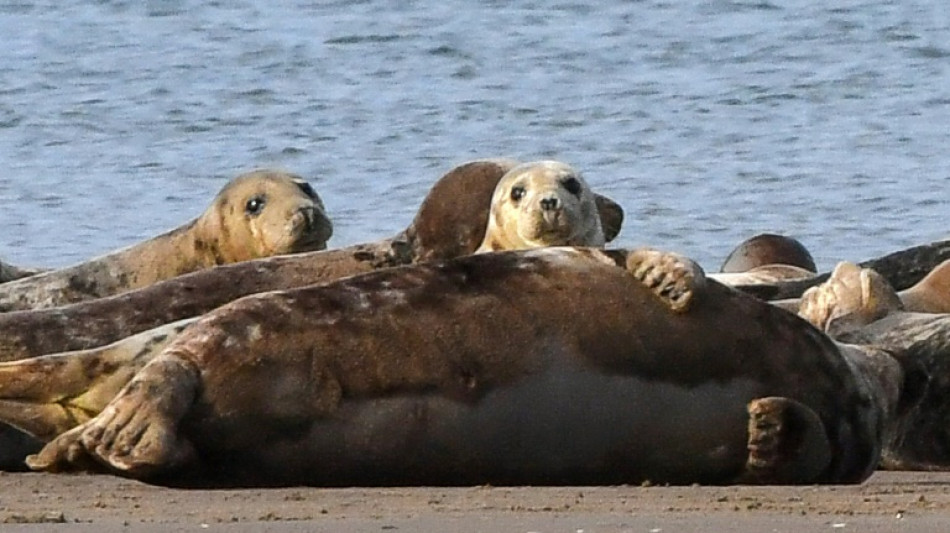
Shetland sanctuary fights to save seals as pollution takes toll / Photo: Denis Charlet - AFP
On the edge of a coastal pool on one of Scotland's Shetland Islands, Pixie, a plump grey seal grunts and rolls towards the water to retrieve a fish that's been left for its lunch.
Pixie is one of hundreds of rescued seals, many of which were sick and emaciated from ingesting food and sea water contaminated by micro plastics and chemicals when they arrived at a sanctuary on the north coast of the main island.
Others had severe neck wounds from getting entangled by plastic straps or fishing nets.
Pete and Jan Bevington -- who run the sanctuary at Hillswick, a village north of Shetland's main town, Lerwick -- say pollution is taking its toll on seal populations on the archipelago, known for its rugged coastlines, dramatic cliffs and diverse wildlife.
"It used to be a lot easier to look after seals," Pete Bevington, 70, told AFP.
"They came in bigger, they came in stronger, they came in more resilient. Now it's much harder work to keep them alive. We're losing more than we used to."
According to a report by the UK government's Environment Agency, published in January, climate change impacts have been linked to the increased release of hazardous chemicals washed in from water bodies and sewers.
Those chemicals can include polychlorinated biphenyls (PCBs), which although banned in the mid-1980s still find their way into the marine environment through the destruction and disposal of industrial plants and old equipment.
PCBs accumulate in shellfish and fish, which are ingested by seals, causing their immune systems to weaken and making them more susceptible to infections and diseases.
An increasingly common problem seen by the sanctuary is entanglement wounds.
"They get stuck with plastic straps around their neck and they can't free themselves from it," Pete Bevington said.
"The seal grows, but the plastic doesn't. You see more and more seals with neck wounds here."
- Fattest seal' -
Pods of orcas, most likely from Iceland, that have been hunting Shetland's shores in increasing numbers in search of new feeding grounds, were also hitting seal populations.
"Killer whales are turning up more than they used to," he said.
"We assume that's because they are not getting the food supply that they were getting elsewhere before.
"Everybody loves to see Orcas but it does put an added pressure on the seal population."
The sanctuary has rehabilitated hundreds of animals since is was founded by Jan Bevington, 76, in 1987 when she came across a sickly seal washed up on a nearby beach.
"I didn't know what to do with it so I rang around England and Scotland and found out what to do and that's what started the whole thing off," she said.
Covering Shetland's vast 1,500-mile coastline is challenging, but the Bevingtons have established a network of trained volunteers around the archipelago to help them rescue seals and otters.
"We rehydrate them, we keep them warm, we let them rest and then we feed them up," Pete Bevington said.
The couple admit to becoming attached to some of their rescues, all of which are christened with a new name, but they remain mindful of not interfering with nature.
Their job is to undo the harm done by man.
So returning animals like Pixie -- now at over 60 kg (132 pounds) officially the sanctuary's fattest seal -- to their natural environment is a joyful experience.
"When they're about 40 kilos, 50 kilos we let them go out into the wild," Pete Bevington said with a shrug.
"After that, they're on their own."
F.Saeed--DT



