
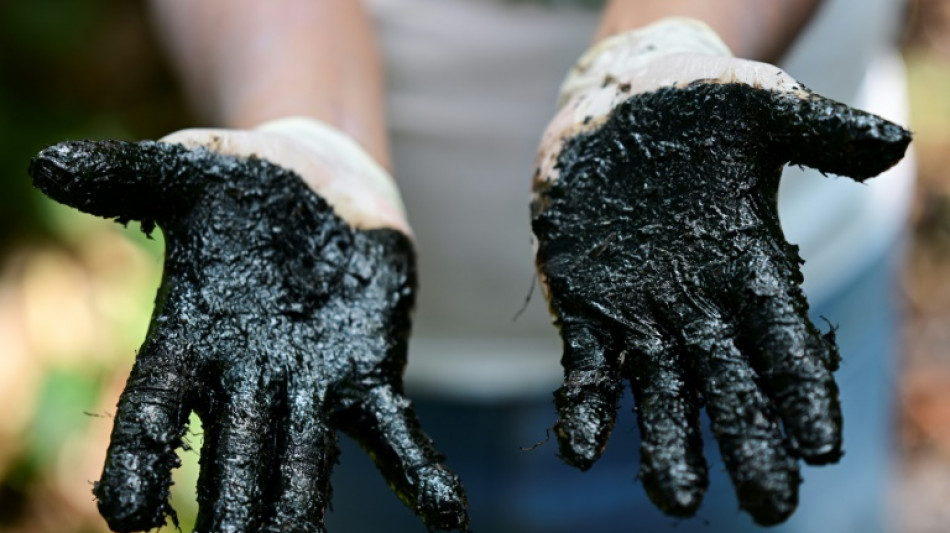
Amazon pollution: the stain on Ecuador's oil boom / Photo: Pedro PARDO - AFP
Lago Agrio is where it began in February 1967: Ecuador's first oil well drilled by the US Texaco-Gulf consortium to ring in an era of black gold for the Ecuadoran Amazon.
"On that day, ministers and officials bathed in oil. Then they threw it in the river... a good start," Donald Moncayo, coordinator of the Union of People Affected by Chevron-Texaco (Udapt), told AFP, ironically.
Fifty-six years later, the oil continues to flow, some 500,000 barrels per day that President Guillermo Lasso has vowed to double.
Oil is the South American country's top export -- generating some $13 billion per year.
That first well at Lago Agrio in Ecuador's northeast closed in 2006 after generating nearly 10 million barrels.
But millions of hectares have been transformed -- for better or worse -- into Ecuador's oil capital.
The region's forests are receding as pollution spreads, activists claim -- the landscape increasingly dominated by wells, pipelines, tanker trucks, oil flares and processing plants.
The government says oil income is essential for the country's development, and that of its people.
But for Moncayo, who says he was born "200 meters from an oil well" 49 years ago, it is an industry synonymous with poverty and large-scale pollution.
He has led a long and difficult legal fight against Texaco since the 1990s.
- The losing side -
In 30 years of operation, the company dug 356 wells around Lago Agrio, each with retention ponds -- 880 of them in total -- holding a toxic sludge of oil waste and contaminated water.
Some 60 million liters of this liquid were discharged into the environment, according to Udapt, contaminating water used for fishing, bathing and drinking.
The open pits remain scattered throughout the forest today.
In 1993, some 30,000 residents of the Lago Agrio region sued Texaco, since bought by Chevron, in a New York Court.
The case was dismissed over misplaced jurisdiction, and the plaintiffs turned to the courts closer to home.
In 2011, Ecuador's Supreme Court found in favor of the community and ordered the company to pay $9.5 billion in compensation for pollution of native lands.
But seven years later, the Permanent Court of Arbitration in The Hague ruled in favor of Chevron and Texaco.
It found the Ecuador court's judgment was in part "corruptly 'ghostwritten'" by plaintiffs' representatives who had promised a judge a bribe.
The residents have also failed in other court bids.
Chevron has said that Texaco spent $40 million on environmental cleanup in the area in the 1990, before selling its operations to state company Petroecuador.
And it argues that Petroecuador and the government are responsible for any remaining cleanup under the terms of the agreement of sale.
- 'Mere crumbs' -
Abandoned in 1994, the well "Agua-Rico 4" lies at the end of a narrow path through the jungle.
Nearby, a retention pond is covered in a thick layer of organic material which yields readily to a stick wielded by Moncayo to reveal a thick, black liquid.
A stream running past the pond is visibly soiled, and cows graze in places where black sludge oozes from the ground.
"It is like this everywhere," said Moncayo, wearing stained surgical gloves.
Leaks also come from crude oil from pipelines -- some 10 to 15 per month, according to a recent University of Quito study.
Petroecuador did not respond to requests from AFP for comment.
Lago Agrio residents complain of the noise and heat emitted from oil wells erected near their homes -- they say without consultation or compensation -- and the black smoke from oil flares that shoot several meters into the sky.
An Ecuador court recently ordered the closure of all 447 flare pits in the area by March, though few have been dismantled so far.
Conflicts between residents and Petroecuador are mainly resolved by ad hoc compensation payments or government undertakings to build infrastructure or expand services.
It is not always enough.
At the tiny settlement of Rio Doche 2, home to some 133 families, residents erected a metal barrier and dug holes in the road to block oil trucks from the well there.
"My chickens and ducks began to die. The well water darkened: it was impossible to drink or to use even for laundry. The girls had skin problems," said Francesca Woodman, the owner of a small farm she said she was forced to leave with her eight children due to oil pollution.
"We, here, suffer the pollution, the leaks, the smoke of the chimneys, we inhale the dust of the (tanker) trucks, while they collect the dollars in Quito!" lamented another resident, Patricia Quinaloa.
But Rio Doche 2 also stands as a testament to the inherent rivalry between oil windfalls on the one hand, and pollution on the other.
"While we have a bit of work and money, even if it's mere crumbs... people accept" the conditions, said Wilmer Pacheco, a driver for a local NGO.
Official data show that poverty rates in Ecuador's three Amazonian petrol-producing provinces range from 44 percent to 68 percent -- above the national average of 25 percent.
A.El-Nayady--DT



