
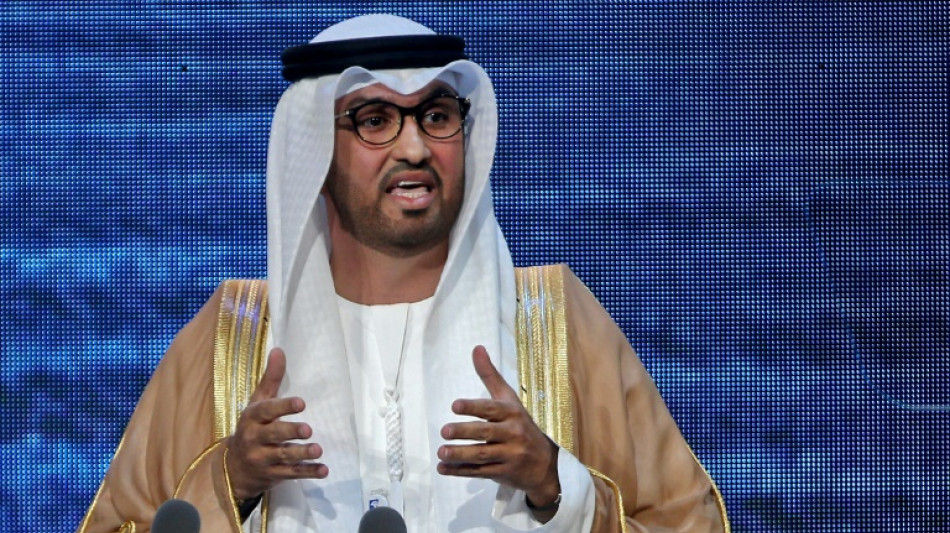
Oil boss as climate talks host: what's behind UAE's choice? / Photo: - - AFP/File
The United Arab Emirates has picked the head of its national oil company as president of this year's COP28 climate talks, prompting criticism from environmental activists.
Here we examine the UAE's reasons for choosing Sultan Al Jaber and what message it is sending ahead of the UN climate talks later this year.
- Who is Sultan Al Jaber? -
Al Jaber is the chief executive of the UAE's Abu Dhabi National Oil Company (ADNOC), which is one of the world's biggest oil firms.
The 49-year-old, who was educated in the United States and Britain, is also the UAE's Minister of Industry and Advanced Technology.
He was named the UAE's special climate envoy in 2020, a post he also previously held from 2010-2016.
He is also the founder of Masdar -- a multibillion-dollar, state-backed company that invests in renewable energy, backing projects in more than 40 countries since it was founded in 2006, according to UAE state media.
Al Jaber, who has taken part in more than 10 COP meetings, headed the UAE's delegation to the last UN climate summit in Egypt. It was by far the biggest delegation to attend the talks, and one of the largest in COP history.
In 2009, he was appointed to the UN's Advisory Group on Energy and Climate Change by Ban Ki-Moon, the then secretary general.
"Sultan Al Jaber has been spearheading the UAE's climate action well before and during his tenure at ADNOC," said climate expert Karim Elgendy, Associate Fellow at Britain's Chatham House think tank.
- Why the controversy? -
Holding COP28 in a major oil-producing country has provoked concern from activists urging a shift away from oil, which produces the greenhouse gases that heat the planet.
Those worries were only stoked by the choice of a fossil fuel executive as the face of the talks.
Tasneem Essop, executive director of Climate Action Network International said it was a "conflict of interest" to choose a figure "heading an industry that is responsible for the crisis itself".
Jaber's nomination also heightened concerns that lobbyists looking to delay the phasing-out of fossil fuels will be given more sway.
Already, the COP26 in Scotland had 500 fossil fuel lobbyists in attendance -- a figure that only increased with COP27 in Egypt, with the UAE sending the highest number.
"COP28 needs to conclude with an uncompromised commitment to a just phase out all fossil fuels: coal, oil and gas," said Tracy Carty from Greenpeace International.
"There is no place for the fossil fuel industry in the global climate negotiations."
- What's the message? -
The UAE -- one of the world's biggest crude producers -- "sees no contradiction" in the selection of Al-Jaber, Elgendy said.
The Gulf nation has repeatedly maintained that oil and gas will be needed for decades to power the world economy, while generating revenues that could be invested in renewable energy sources.
"The choice of Dr Sultan is absolutely representative of the UAE's approach to climate action, which pledges to decarbonise its economy... but advocates for its moral right to export every molecule of fossil fuel," Elgendy said.
"It argues that the world will still need some fossil fuel supplies by 2050 and that these should come from the lowest cost and lowest carbon producers," namely Gulf Arab countries, Elgendy added.
The UAE is also a strong advocate for including oil executives in the climate conversation, arguing that their experience in the energy industry is helpful in tackling climate change.
"For Gulf countries, where oil wealth contributes significantly to the economy, a great deal of climate action will need to come from this exact sector," said Aisha Al-Sarihi, a research fellow at the National University of Singapore's Middle East Institute.
"Excluding the oil industry from the negotiating table might not serve the region," the Omani expert told AFP.
S.Al-Balushi--DT



