Dubai Telegraph - Hard to bear: UK's only panda pair to return to China

EUR -
AED 4.228054
AFN 74.833174
ALL 93.364555
AMD 421.565177
AOA 1055.720532
ARS 1720.29465
AUD 1.644322
AWG 2.075175
AZN 1.93458
BAM 1.956524
BBD 2.321559
BDT 142.332678
BHD 0.434661
BIF 3410.162114
BMD 1.151276
BND 1.478247
BOB 14.033194
BRL 5.876107
BSD 1.152627
BTN 109.836651
BWP 15.676802
BYN 3.369447
BYR 22565.011394
BZD 2.318258
CAD 1.616823
CDF 2604.186139
CHF 0.932539
CLF 0.026975
CLP 1065.114926
CNY 7.774106
CNH 7.779345
COP 3734.601488
CRC 523.593784
CUC 1.151276
CUP 30.508816
CVE 110.305825
CZK 24.210243
DJF 205.255966
DKK 7.476495
DOP 66.864747
DZD 153.095548
EGP 57.700579
ERN 17.269141
ETB 186.044056
FJD 2.553418
FKP 0.853954
GBP 0.857338
GEL 3.004992
GGP 0.853954
GHS 13.468985
GIP 0.853954
GMD 85.19465
GNF 10121.746096
GTQ 8.794446
GYD 241.529391
HKD 9.028595
HNL 30.895435
HRK 7.537984
HTG 150.705777
HUF 364.154961
IDR 20689.697769
ILS 3.504064
IMP 0.853954
INR 109.753395
IQD 1509.958841
IRR 1583292.445177
ISK 142.021308
JEP 0.853954
JMD 182.587576
JOD 0.816268
JPY 181.256644
KES 148.940984
KGS 100.678981
KHR 4657.723841
KMF 492.746197
KRW 1648.419913
KWD 0.356389
KYD 0.960556
KZT 546.772362
LAK 26069.648473
LBP 103224.003586
LKR 387.003231
LRD 208.057003
LSL 19.009736
LTL 3.399419
LVL 0.696395
LYD 7.346719
MAD 10.747378
MDL 20.125449
MGA 4909.817141
MKD 61.547779
MMK 2417.315001
MNT 4137.143512
MOP 9.310646
MRU 46.164085
MUR 54.040305
MVR 17.787481
MWK 1998.739741
MXN 19.945516
MYR 4.71906
MZN 73.567165
NAD 19.009736
NGN 1570.190972
NIO 42.415698
NOK 10.977766
NPR 175.739042
NZD 1.961976
OMR 0.442682
PAB 1.152627
PEN 3.893041
PGK 5.086883
PHP 70.146828
PKR 320.062556
PLN 4.312772
PYG 6875.544665
QAR 4.201955
RON 5.246941
RSD 117.390701
RUB 92.562984
RWF 1690.325596
SAR 4.309375
SBD 9.292129
SCR 15.452692
SDG 690.765342
SEK 11.010401
SGD 1.476615
SLE 28.148317
SOS 658.743804
SRD 43.525146
STD 23829.090678
STN 24.509071
SVC 10.085733
SZL 19.013037
THB 38.463672
TJS 10.64474
TMT 4.029466
TND 3.382425
TRY 54.748357
TTD 7.815893
TWD 37.313999
TZS 3049.72806
UAH 51.703936
UGX 4313.596478
USD 1.151276
UYU 46.358164
UZS 13820.114876
VES 860.983443
VND 30263.594618
VUV 137.059598
WST 3.148154
XAF 656.199862
XAG 0.019721
XAU 0.000283
XCD 3.111381
XCG 2.077369
XDR 0.816102
XOF 656.199862
XPF 119.331742
YER 274.461274
ZAR 19.019311
ZMK 10362.854282
ZMW 21.662017
ZWL 370.710432
  • CMSC

    -0.0800

    21.76

    -0.37%

  • RBGPF

    1.7800

    70.99

    +2.51%

  • RELX

    0.7400

    36.16

    +2.05%

  • CMSD

    -0.0900

    22.02

    -0.41%

  • RIO

    -0.9500

    95.9

    -0.99%

  • BCE

    0.1100

    21.79

    +0.5%

  • BCC

    6.6500

    83.03

    +8.01%

  • RYCEF

    0.6500

    20.2

    +3.22%

  • GSK

    -0.1800

    51.51

    -0.35%

  • NGG

    -0.1100

    79.86

    -0.14%

  • VOD

    -0.1700

    15.61

    -1.09%

  • AZN

    -11.6700

    157.97

    -7.39%

  • JRI

    -0.1400

    12.82

    -1.09%

  • BTI

    -1.0900

    59.56

    -1.83%

  • BP

    -0.9600

    44.26

    -2.17%

Hard to bear: UK's only panda pair to return to China
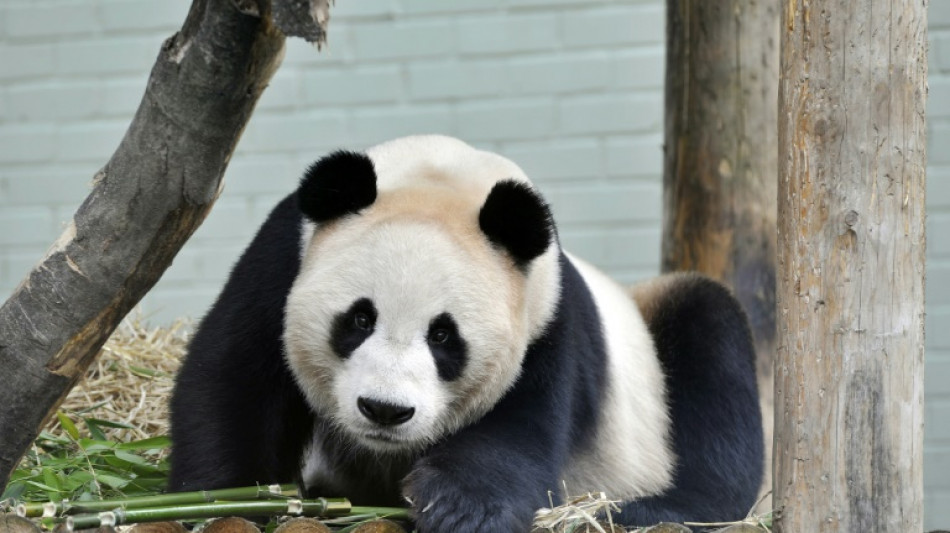
Hard to bear: UK's only panda pair to return to China / Photo: Andy Buchanan - AFP

Hard to bear: UK's only panda pair to return to China

It was supposed to be a match made in heaven that would produce a cub but after years of trying, Edinburgh Zoo said on Wednesday it is now sending its breeding pair of giant pandas back to China.

Text size:

The Royal Zoological Society of Scotland (RZSS) said it plans to give Yang Guang ("Sunshine") and Tian Tian ("Sweetie") a "giant farewell" at the zoo before their departure later this year.

"As the UK's only giant pandas, they have been incredibly popular with visitors, which has helped to connect millions of people to nature as well as raising vital funds for wildlife conservation," said RZSS chief executive David Field.

"We will be providing as many opportunities as possible for people to say goodbye and to celebrate the tremendous impact these two charismatic bears have had on our communities, helping to create a world where nature is protected, valued and loved."

Yang Guang and Tian Tian arrived in Edinburgh in December 2011 as part of a 10-year arrangement with the China Wildlife Conservation Association.

The popular pair even had a special tartan created in their honour, in black, white and grey representing their fur, and red to symbolise China.

But it was soon clear the two were not eager to breed. Officials at the zoo failed in an attempt to artificially inseminate Tian Tian in 2013.

Yang Guang was later castrated after being treated for testicular cancer.

- Eats shoots and leaving -

Giant pandas are notoriously difficult to breed in captivity, with bears losing interest in mating the natural way -- or simply not knowing how.

A female panda has a single oestrous cycle in the spring in which she is fertile for only 24 to 36 hours, according to the Pandas International conservation organisation.

Attempts to breed pandas in captivity first began in China in 1955. In 1963, Ming Ming, the first ever captive-bred giant panda was born at the Beijing zoo.

Pandas are found in the wild in southwest China, along the Tibetan Plateau.

Their population has been cut by poachers, who hunted them for their pelts and also illegal logging, which harms the growth of bamboo, its main food source.

Pandas International estimates the population of wild Giant Pandas is currently at 1,864.

There are approximately 600 in captivity in panda centres, zoos and wildlife parks around the world.

Edinburgh Zoo said the Yang Guang and Tian Tian could leave the Scottish capital as early as the end of October 2023, two years after their loan was extended.

"By collaborating with partners in China and welcoming Yang Guang and Tian Tian to Scotland, we have had many successes for... the past 11 years in terms of technique exchanges, scientific research and public engagement," Field said.

"We are also very proud of the contribution we have made to giant panda breeding research alongside our partners at the University of Edinburgh and our findings have been of real benefit to international efforts to protect the species."

S.Mohideen--DT