
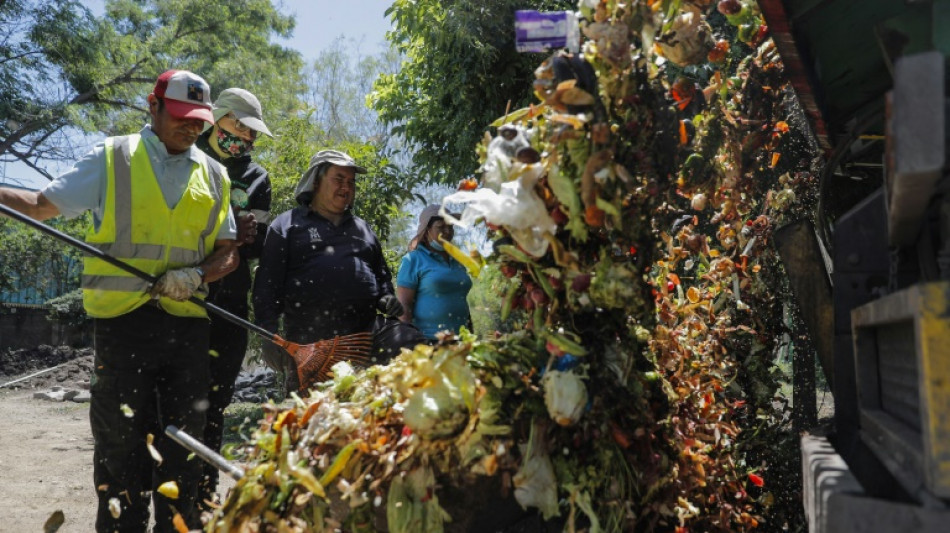
Waste not want not: Santiago's poorest district plants recycling seed / Photo: JAVIER TORRES - AFP
Every morning, trucks collect potato and avocado skins, orange peels and other food scraps that residents of Santiago's poorest neighborhood leave hanging in bags on their front doors or in tree branches or place in special bins.
For nearly two decades, the residents of La Pintana have been pioneers of recycling in Chile -- South America's largest garbage generator.
Under a project started in 2005, the commune of 190,000 people enthusiastically gather their plant-based food waste, which is then turned into compost to help green their community.
In La Pintana, where 15 percent of people live in poverty, 50 percent of the community's organic waste is collected for recycling -- a figure that puts to shame the 0.8 percent achieved by Chile as a whole, according to environment ministry data.
"They do a lot with it (the waste): they produce compost and it is used for the community itself, for the squares and gardens," La Pintana resident Jose Vera told AFP as he left two large cardboard boxes filled with scraps on the sidewalk, proud of his contribution.
"It is also a saving (for the municipality) because they no longer have to buy" fertilizer or pay landfill fees, he said.
Chile generates some 1.13 kilograms (about 2.5 pounds) of waste per person per day -- the highest output in South America, according to World Bank data.
And in terms of recycling, it is far from achieving even Latin America's low average of four percent of solid municipal waste processed.
But La Pintana, one of the first neighborhoods of Chile's deeply socially unequal capital to adopt such a project, now collects some 20 tons of organic waste every day.
It is delivered to a local plant that turns the scraps into natural fertilizer for the town's own municipal nursery, and others.
- 'A change in people' -
The municipality estimates to be saving some $100,000 per year -- money that can go to other community projects.
"There has been a change in people," since the project started, resident Vera said.
"They are now concerned about recycling and no longer put the vegetables with the garbage."
La Pintana's nursery, built on what used to be an unsightly landfill, yields some 100,000 plants of 400 different species every year.
These are planted back in La Pintana, one of the areas of Santiago with the fewest green spaces per inhabitant.
The nursery uses about a ton of humus -- a dark organic matter created when plant material decomposes -- every year, according to project member Cintia Ortiz.
All of it is obtained from La Pintana's plant waste.
"This humus, the benefit it gives us, is that it is organic... thanks to the community and the workers," Ortiz told AFP.
In addition, "as we can keep the plants well-nourished, we do not have to use chemicals."
Planting flowers outside a municipal sports center, municipal worker Jeanette Gonzalez told AFP the project "brings us... joy. The town is improving."
"When we took over... it was a town where every 200 meters there was a landfill," Claudia Pizarro, mayor of La Pintana since 2016, said of the trailblazing project, which has received several international awards.
"It is a virtuous circle: people see that where there used to be a landfill there is now greenery and everything is flourishing, and they stop throwing garbage there," she added.
There have been spillover benefits too: more than half of the municipal nursery's 15 staff are former inmates doing community work in lieu of serving prison time.
Chile's Environment Minister Maisa Rojas recently proposed a bill to reproduce the project in the rest of Chile.
F.Chaudhary--DT



