
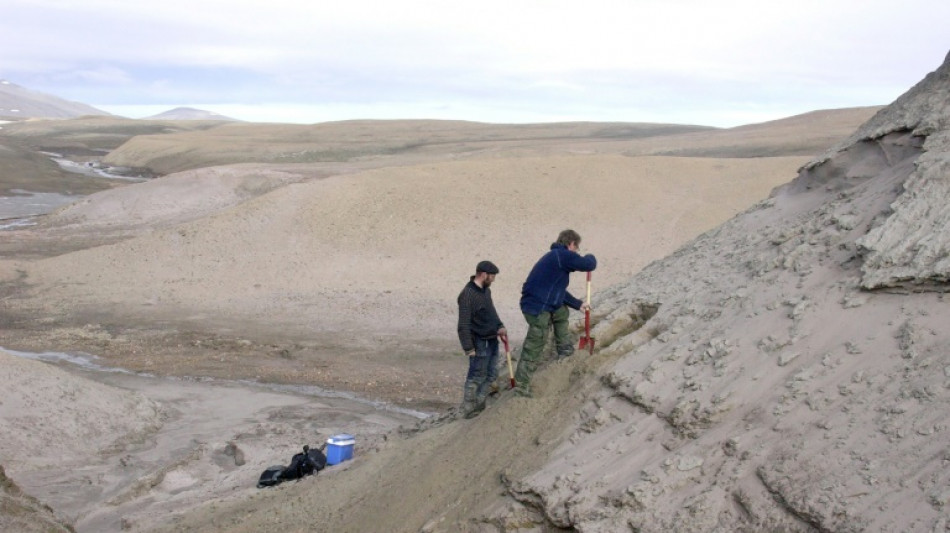
Scientists find 2-million year-old DNA in Greenland / Photo: Handout - SVEND FUNDER/AFP
Scientists in Greenland announced Wednesday they had found DNA dating back two million years -- the oldest ever extracted -- in sediment from the Ice Age, opening a new chapter in paleogenetics.
"We are breaking the barrier of what we thought we could reach in terms of genetic studies," said Mikkel Winther Pedersen, co-author of a new study published in science journal Nature.
"It was long thought that one million years was the boundary of DNA survival, but now we are twice as old" as that, told AFP.
They found the DNA fragments in sediment from the northernmost part of Greenland known as Kap Copenhagen, said the University of Copenhagen lecturer.
The fragments "come from an environment that we do not see anywhere on Earth today," he added. Frozen in a remote unpopulated area, the DNA had been very well preserved.
New technology enabled the scientists to determine that the 41 fragments were more than a million years older than the oldest known DNA, from a Siberian mammoth.
They had to first determine whether there was DNA hidden in the clay and quartz, then see whether it could be removed from the sediment to examine it.
The method used "provides a fundamental understanding of why minerals, or sediments, can preserve DNA", said Karina Sand, who heads the geobiology team at the University of Copenhagen and who took part in the study.
"It's a Pandora's box we're just about to open up", she added.
- Species adaptability -
The "rivers running through the environment transported minerals and organic material into the marine environment and this was where these terrestrial sediments were deposited", said Winther Pedersen.
Then, at some point around two million years ago, "this land mass beneath the water was raised up and became a part of North Greenland", he explained.
Today, Kap Copenhagen is an Arctic desert, where different types of deposits, including plant and insect fossils preserved in excellent condition, have already been discovered.
But scientists hadn't tried to establish the fossils' DNA, and very little was known about the presence of animals at the time.
The research team, which began its work in 2006, has now made it possible to paint a picture of what the region looked like two million years ago.
"We had this forested environment with mastodons and reindeer and hares running around in the landscape together with a lot of different plant species", he said, they had found 102 different kinds of plant.
The presence of mastodons was particularly noteworthy, he added, never having been found so far north before. The discovery has also given researchers more information about the adaptability of species.
Two million years ago, Greenland had temperatures 11 to 17 degrees warmer than today, but at its latitude, the sun doesn't set in summer nor rise in winter.
"We don't see this environment anywhere, this mix of species anywhere on Earth today", said Winther Pedersen.
"The plasticity in species, how species are actually able to adapt to different types of climate, might be different than what we previously thought.
"And obviously, it makes us look for newer and older sites.
"There are several different sites across the world that actually have geological deposits that go this far back. And even further back," ha added.
I.El-Hammady--DT



