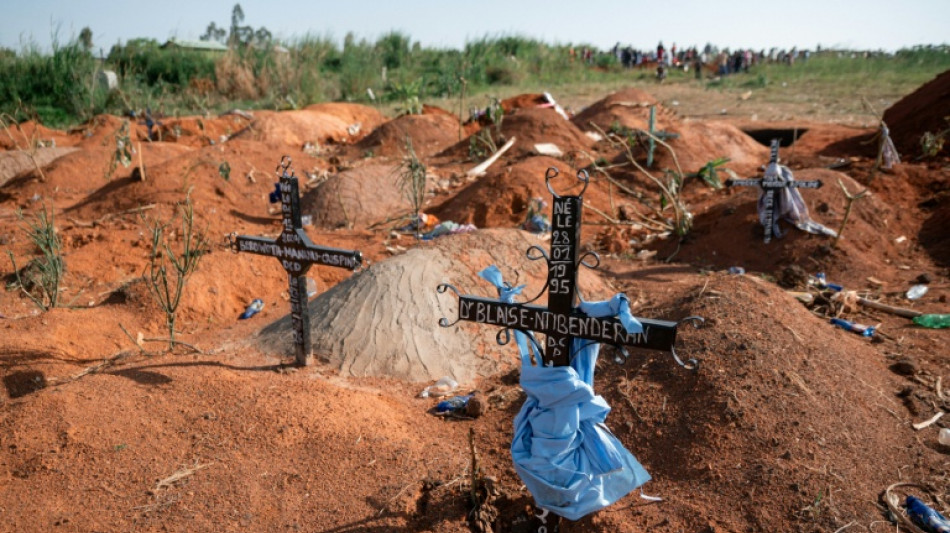
MSF warns of 'dangerous gaps' in Ebola response in DR Congo / Photo: Jospin Mwisha - AFP
"Dangerous gaps" remain in efforts to rein in an Ebola outbreak that has killed more than 180 people in the Democratic Republic of Congo, Doctors Without Borders warned Monday.
Despite a massive scale-up in the response to the deadly outbreak declared in the vast central African country on May 15, the medical charity, which goes by its French acronym MSF, said the true scale of the crisis remained unclear.
"One month on, the Ebola disease outbreak is outpacing the response effort," Kate White, MSF's emergency medical coordinator in the DRC, said in a statement.
"No-one knows the true scale or exactly where the disease is spreading," she said.
"What we do know is that most treatment centres in Ituri province are overwhelmed; many of our patients arrive at a late stage of the disease, and the majority were never identified or monitored as contacts before seeking care."
So far, 782 Ebola cases, including 181 deaths, have been confirmed in the DRC, according to the latest figures from the World Health Organization. Another 19 cases, including two deaths, have been confirmed in neighbouring Uganda.
MSF warned the true numbers were likely significantly higher.
No approved vaccines or treatments exist for the Bundibugyo strain of the virus responsible for the current outbreak, which is centred on the DRC's northeastern Ituri province, with cases also detected in North Kivu and South Kivu provinces.
The virus, which spreads through close contact and bodily fluids and can cause a fatal haemorrhagic fever, is believed to have been spreading under the radar for weeks before the outbreak was declared.
- 'Significant delays' -
Insecurity in the areas where the disease is spreading has made it difficult to reach some of the affected communities, MSF said, adding that "even in more stable areas, efforts to detect cases, test patients, identify contacts, and monitor transmission are insufficient".
White warned that "testing remains one of the most significant weaknesses in the response".
Even though laboratory capacity had been ramped up and mobile test kits designed specifically for the Bundibugyo virus had begun arriving in the eastern DRC, "many communities... still have limited access to those kits," she said.
At the same time, treatment centres were continuing to face "significant delays" in receiving laboratory results.
In North Kivu, meanwhile, there is only one laboratory able to test blood samples, MSF said.
"Without faster and more widely available testing, we will struggle to detect cases early enough to contain the outbreak," White warned.
Ebola has killed more than 15,000 people in Africa over the past 50 years.
The deadliest outbreak in the DRC claimed nearly 2,300 lives out of 3,500 cases between 2018 and 2020.
Experts have cautioned that without urgent action, the current outbreak could eventually risk rivalling the scale of the 2014 west Africa epidemic, which saw over 28,000 cases and more than 11,000 deaths.
F.Damodaran--DT