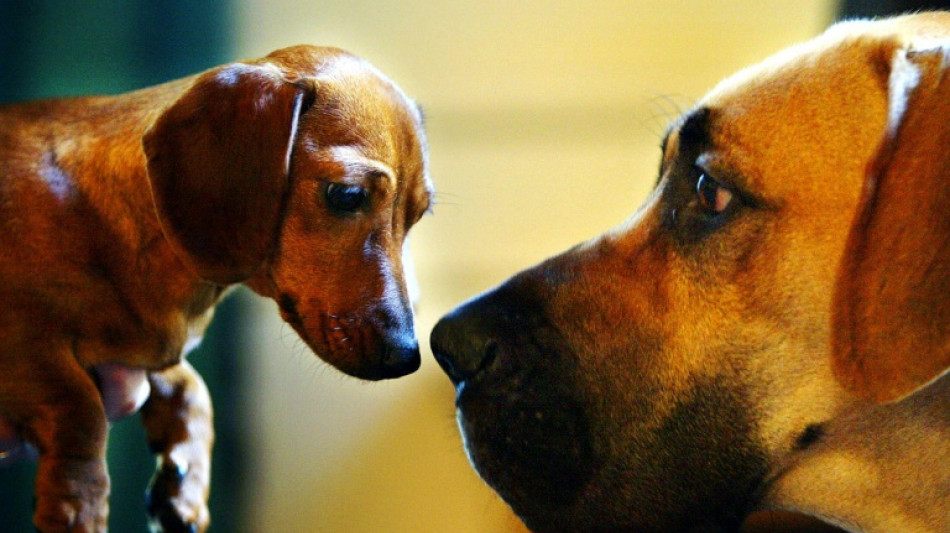
Dubai Telegraph - Oldest dog DNA suggests 16,000 years of human companionship

EUR -
AED 4.265142
AFN 73.7474
ALL 94.825822
AMD 427.629306
ANG 2.079324
AOA 1065.557779
ARS 1668.614586
AUD 1.645073
AWG 2.09047
AZN 1.977295
BAM 1.957118
BBD 2.340276
BDT 142.637302
BGN 1.963742
BHD 0.437959
BIF 3473.66439
BMD 1.161372
BND 1.488603
BOB 8.058428
BRL 5.909409
BSD 1.161983
BTN 109.81997
BWP 15.569487
BYN 3.216967
BYR 22762.896035
BZD 2.336974
CAD 1.625828
CDF 2694.383627
CHF 0.919339
CLF 0.026137
CLP 1028.697358
CNY 7.847915
CNH 7.847421
COP 3988.918801
CRC 529.256483
CUC 1.161372
CUP 30.776365
CVE 110.736504
CZK 24.147479
DJF 206.399115
DKK 7.474772
DOP 68.060081
DZD 154.322586
EGP 58.358025
ERN 17.420584
ETB 183.932293
FJD 2.59416
FKP 0.865076
GBP 0.865158
GEL 3.071852
GGP 0.865076
GHS 13.121687
GIP 0.865076
GMD 84.780141
GNF 10193.944601
GTQ 8.857042
GYD 243.063716
HKD 9.097383
HNL 31.011221
HRK 7.534744
HTG 151.752213
HUF 349.335541
IDR 20597.517481
ILS 3.390025
IMP 0.865076
INR 109.674158
IQD 1521.397643
IRR 1596886.839259
ISK 144.40533
JEP 0.865076
JMD 183.773782
JOD 0.823454
JPY 186.187742
KES 150.509241
KGS 101.561907
KHR 4660.009706
KMF 493.582785
KPW 1045.235429
KRW 1755.901781
KWD 0.357923
KYD 0.968352
KZT 566.656795
LAK 25585.030902
LBP 104000.884285
LKR 389.27555
LRD 211.543873
LSL 18.81368
LTL 3.42923
LVL 0.702503
LYD 7.403777
MAD 10.736917
MDL 20.276657
MGA 4877.76365
MKD 61.653348
MMK 2438.186534
MNT 4153.722136
MOP 9.375115
MRU 46.548091
MUR 54.735926
MVR 17.954508
MWK 2016.141924
MXN 19.979201
MYR 4.721905
MZN 74.208509
NAD 18.80873
NGN 1577.503424
NIO 42.518111
NOK 10.996395
NPR 175.710838
NZD 1.995226
OMR 0.446549
PAB 1.161983
PEN 3.963195
PGK 5.095811
PHP 70.09115
PKR 323.21364
PLN 4.237731
PYG 7090.776019
QAR 4.227982
RON 5.23256
RSD 117.38107
RUB 84.200238
RWF 1728.121903
SAR 4.357346
SBD 9.362314
SCR 16.392443
SDG 697.418767
SEK 10.864399
SGD 1.488636
SHP 0.867082
SLE 28.744096
SLL 24353.399583
SOS 663.722162
SRD 43.356369
STD 24038.060706
STN 24.853366
SVC 10.166936
SYP 128.368911
SZL 18.811087
THB 37.782346
TJS 10.771455
TMT 4.076417
TND 3.381626
TOP 2.796306
TRY 53.789339
TTD 7.893317
TWD 36.648281
TZS 3051.509058
UAH 52.0398
UGX 4298.895537
USD 1.161372
UYU 46.912002
UZS 13942.273293
VES 692.220136
VND 30567.317533
VUV 138.048782
WST 3.183573
XAF 656.39912
XAG 0.016508
XAU 0.000268
XCD 3.138666
XCG 2.094193
XDR 0.817255
XOF 656.175448
XPF 119.331742
YER 277.132485
ZAR 18.798205
ZMK 10453.740845
ZMW 20.537833
ZWL 373.96139
  • RBGPF

    0.0000

    62.87

    0%

  • BCE

    -0.2200

    23.82

    -0.92%

  • CMSD

    -0.0600

    22.26

    -0.27%

  • NGG

    0.7100

    82.28

    +0.86%

  • BCC

    -0.0300

    71.56

    -0.04%

  • RIO

    -0.1500

    105.74

    -0.14%

  • GSK

    -0.0100

    52.22

    -0.02%

  • CMSC

    0.0250

    22.365

    +0.11%

  • RYCEF

    0.4800

    18.59

    +2.58%

  • BTI

    0.3200

    61.38

    +0.52%

  • JRI

    0.0300

    12.81

    +0.23%

  • RELX

    -0.0400

    32.8

    -0.12%

  • BP

    -0.4400

    41.15

    -1.07%

  • VOD

    -0.1100

    14.89

    -0.74%

  • AZN

    1.4400

    178.71

    +0.81%

Oldest dog DNA suggests 16,000 years of human companionship
Oldest dog DNA suggests 16,000 years of human companionship / Photo: ADRIAN DENNIS - AFP/File

Oldest dog DNA suggests 16,000 years of human companionship

The discovery of the oldest ever dog DNA suggests they have been our best friends for nearly 16,000 years -- 5,000 years earlier than had previously been thought, new research said Wednesday.

Text size:

Despite being ubiquitous in the homes, backyards and hearts of people across the world, surprisingly little is known about where dogs come from.

"It's just an interesting mystery," Swedish geneticist Pontus Skoglund of the UK's Francis Crick Institute told reporters.

Dogs are most likely a mix of two types of grey wolves, he said. However exactly when dogs diverged from wolves has been difficult to trace, partly because their ancient bones are tricky to tell apart.

That is why scientists behind two new studies published in the journal Nature sequenced the genomes from archaeological remains, shedding light on the elusive origins of our furry friends.

The first study revealed that the world's oldest canine DNA was discovered in a piece of a skull in Pinarbasi in what is now Turkey.

The female puppy, which was perhaps "a few months old", probably looked like a small wolf when it lived roughly 15,800 years ago, according to study co-author Laurent Frantz of the Ludwig Maximilian University of Munich.

Before Wednesday, the oldest-known dog DNA was from 10,900 years ago.

Also breaking that record was genetic evidence the team found in southwest England dating back 14,300 years, which illustrated how early dogs had spread across Europe.

Frantz said scientists could not prove exactly what role these dogs had among humans living during the last Ice Age.

"But I think we can assume that they must have played a role because they would have been expensive to feed," he said.

Perhaps the dogs were used for hunting or protection, he speculated.

Even if these dogs were not treated the same as pets are today, there was likely still a strong bond, he said, adding that "kids will still have played with puppies".

Another sign of a close relationship was that puppies had been found buried above human graves in Pinarbasi.

- 'Search for the missing link' -

For the other study, a large team of researchers compared the genomes of 216 dog and wolf remains from across Europe.

This allowed them to chart how dogs evolved on the continent.

Starting around 10,000 years ago, there was a huge migration of people from southwest Asia to Europe during what is known as the Neolithic agricultural revolution.

This mass arrival of farmers resulted in human genetic mixing as people from different areas met and had children.

However, this genetic mixing did not happen at the same time with dogs, the researchers were surprised to find.

It seems the hunter-gatherers who had been living in Europe before the farmers arrived had already been keeping dogs.

"Dogs were clearly important to our ancestors, as the first farmers seem to have adopted previous hunter-gatherer dogs into their groups as they moved into Europe," said study co-author Skoglund.

This suggests that dogs must have been domesticated well before that point.

And there is still a "genetic abyss between dogs and wolves", Skoglund added.

"The search for the missing link continues."

G.Gopinath--DT