Dubai Telegraph - Japan approves stem-cell treatment for Parkinson's in world first

EUR -
AED 4.261526
AFN 73.10472
ALL 95.881948
AMD 436.783827
ANG 2.076785
AOA 1064.077656
ARS 1633.297354
AUD 1.650613
AWG 2.091602
AZN 1.971602
BAM 1.953947
BBD 2.336464
BDT 141.875431
BGN 1.911911
BHD 0.438002
BIF 3442.538576
BMD 1.160389
BND 1.48144
BOB 8.01557
BRL 6.109214
BSD 1.160035
BTN 106.371648
BWP 15.606735
BYN 3.407944
BYR 22743.63159
BZD 2.333167
CAD 1.585558
CDF 2622.480103
CHF 0.906616
CLF 0.02663
CLP 1051.509869
CNY 8.003782
CNH 8.017832
COP 4399.732323
CRC 546.802561
CUC 1.160389
CUP 30.750318
CVE 110.160038
CZK 24.380535
DJF 206.580289
DKK 7.470801
DOP 68.997232
DZD 151.81839
EGP 58.135745
ERN 17.405841
ETB 179.935508
FJD 2.565041
FKP 0.871348
GBP 0.868958
GEL 3.138808
GGP 0.871348
GHS 12.506407
GIP 0.871348
GMD 85.285293
GNF 10172.745617
GTQ 8.897522
GYD 242.705022
HKD 9.076531
HNL 30.706066
HRK 7.533289
HTG 152.10032
HUF 387.923391
IDR 19660.477042
ILS 3.580208
IMP 0.871348
INR 106.385078
IQD 1519.730563
IRR 1530637.701336
ISK 144.712393
JEP 0.871348
JMD 181.333474
JOD 0.822728
JPY 183.192958
KES 149.863776
KGS 101.468392
KHR 4655.724457
KMF 492.005651
KPW 1044.361185
KRW 1710.512585
KWD 0.357075
KYD 0.966737
KZT 571.140264
LAK 24846.503619
LBP 103886.734735
LKR 360.673441
LRD 211.708282
LSL 19.141034
LTL 3.426328
LVL 0.701908
LYD 7.39421
MAD 10.775711
MDL 20.064007
MGA 4793.618479
MKD 61.634701
MMK 2436.701567
MNT 4141.517492
MOP 9.345758
MRU 46.322259
MUR 54.996175
MVR 17.939423
MWK 2011.570028
MXN 20.53454
MYR 4.585279
MZN 74.154677
NAD 19.141117
NGN 1607.378809
NIO 42.690979
NOK 11.22205
NPR 170.202163
NZD 1.965949
OMR 0.446164
PAB 1.16
PEN 3.957563
PGK 4.996455
PHP 68.465227
PKR 324.18219
PLN 4.27325
PYG 7596.05696
QAR 4.230369
RON 5.090657
RSD 117.414005
RUB 91.293257
RWF 1695.443005
SAR 4.355505
SBD 9.343061
SCR 16.140991
SDG 697.975472
SEK 10.708531
SGD 1.48401
SHP 0.870593
SLE 28.429958
SLL 24332.784074
SOS 661.792249
SRD 43.766382
STD 24017.717076
STN 24.477732
SVC 10.150853
SYP 128.595978
SZL 19.147416
THB 36.900096
TJS 11.1247
TMT 4.072967
TND 3.399361
TOP 2.793939
TRY 51.13775
TTD 7.847996
TWD 36.796179
TZS 2985.104394
UAH 50.831857
UGX 4269.042773
USD 1.160389
UYU 45.526622
UZS 14120.606558
VES 493.330262
VND 30460.220879
VUV 138.430112
WST 3.163515
XAF 655.35516
XAG 0.01383
XAU 0.000227
XCD 3.13601
XCG 2.090834
XDR 0.815055
XOF 655.35516
XPF 119.331742
YER 276.870883
ZAR 19.306959
ZMK 10444.892751
ZMW 22.331588
ZWL 373.644903
  • RBGPF

    0.1000

    82.5

    +0.12%

  • CMSD

    -0.0900

    23.21

    -0.39%

  • BCE

    -0.4700

    25.98

    -1.81%

  • NGG

    -0.6900

    89.74

    -0.77%

  • GSK

    -1.5600

    55.27

    -2.82%

  • BCC

    -1.0100

    77.31

    -1.31%

  • RIO

    -2.8800

    93.37

    -3.08%

  • JRI

    -0.1100

    12.8

    -0.86%

  • CMSC

    -0.1990

    23.29

    -0.85%

  • AZN

    -4.0100

    197.52

    -2.03%

  • RELX

    1.0000

    35.18

    +2.84%

  • RYCEF

    -0.7700

    17.2

    -4.48%

  • VOD

    -0.4100

    14.62

    -2.8%

  • BP

    0.4600

    39.3

    +1.17%

  • BTI

    -2.4200

    58.59

    -4.13%

Japan approves stem-cell treatment for Parkinson's in world first
Japan approves stem-cell treatment for Parkinson's in world first / Photo: John SAEKI, Adrian LEUNG - AFP

Japan approves stem-cell treatment for Parkinson's in world first

Japan has approved ground-breaking stem-cell treatments for Parkinson's and severe heart failure, one of the manufacturers and media reports said Friday, with the therapies expected to reach patients within months.

Text size:

Pharmaceutical company Sumitomo Pharma said it received the green light for the manufacture and sale of Amchepry, its Parkinson's disease treatment that transplants stem cells into a patient's brain.

Japan's health ministry also gave the go-ahead to ReHeart, heart muscle sheets developed by medical startup Cuorips that can help form new blood vessels and restore heart function, media reports said.

The treatments could be on the market and rolled out to patients as early as this summer, reports said, citing the health ministry, becoming the world's first commercially available medical products using (iPS) cells.

Japanese scientist Shinya Yamanaka won the Nobel Prize in 2012 for his research into iPS, which have the potential to develop into any cell in the body.

"I hope this will bring relief to patients not only in Japan but around the world," health minister Kenichiro Ueno told a press conference.

"We will promptly carry out all necessary procedures to ensure it reaches all patients without fail."

In a statement, Sumitomo Pharma said it had obtained "conditional and time-limited approval" for the manufacture and marketing of Amchepry under a system which is reportedly designed to get these products to patients as quickly as possible.

The approval is a kind of "provisional license", the Asahi newspaper said, after the safety and efficacy of the treatment was judged based on data from fewer patients than in ordinary clinical trials for drugs.

A trial led by Kyoto University researchers indicated that the company's treatment was safe and successful in improving symptoms.

The study involved seven Parkinson's patients aged between 50 and 69, with each receiving a total of either five million or 10 million cells implanted on both sides of the brain.

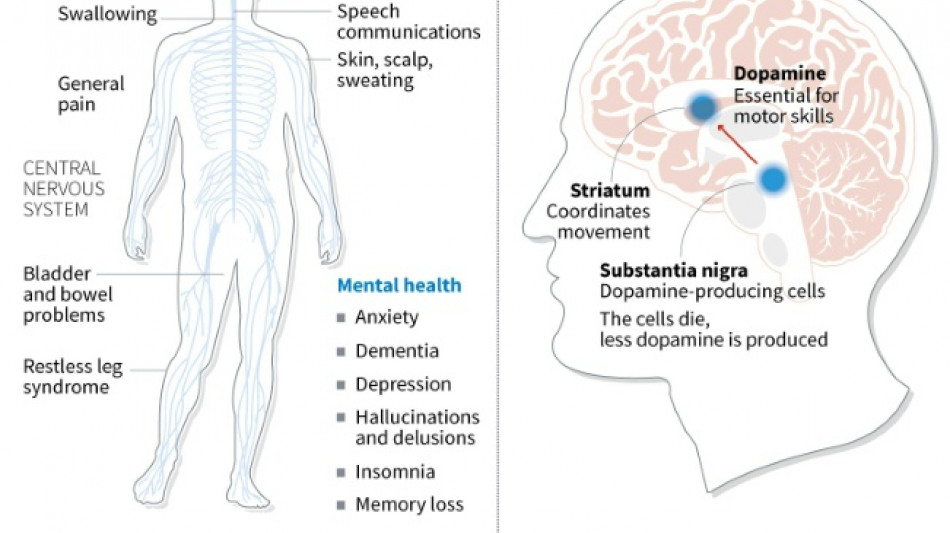
The iPS cells from healthy donors were developed into the precursors of dopamine-producing brain cells, which are no longer present in people with Parkinson's disease.

The patients were monitored for two years and no major adverse effects were found, the study said. Four patients showed improvements in symptoms.

Parkinson's disease is a chronic, degenerative neurological disorder that affects the body's motor system, often causing shaking and other difficulties in movement.

Worldwide, about 10 million people have the illness, according to the Parkinson's Foundation.

Currently available therapies "improve symptoms without slowing or halting the disease progression," the foundation says.

iPS cells are created by stimulating mature, already specialised, cells back into a juvenile state -- basically cloning without the need for an embryo.

The cells can be transformed into a range of different types of cells, and their use is a key sector of medical research.

D.Farook--DT