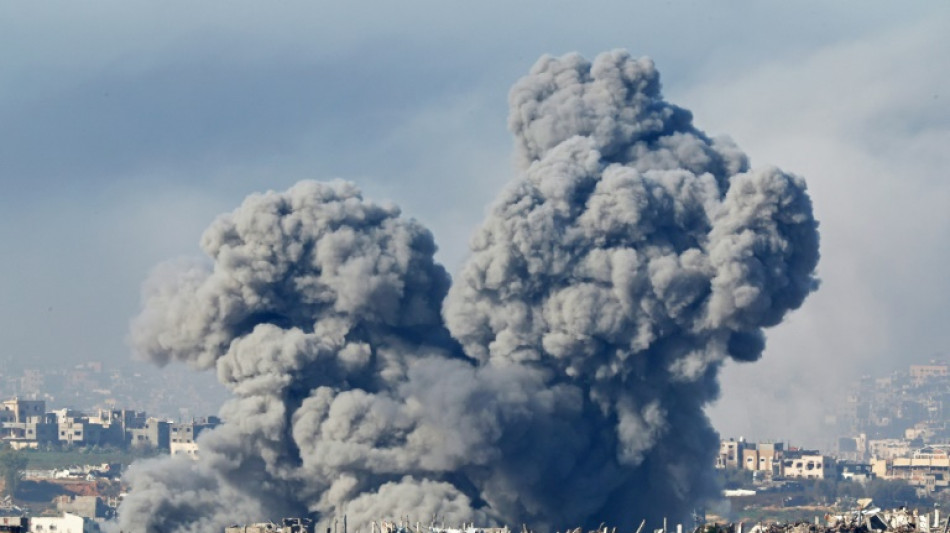
Foreign doctors in Gaza describe worst wounds 'they've ever seen' / Photo: Jack GUEZ - AFP/File
International doctors and nurses who treated Palestinians in Gazan hospitals described wounds more severe than civilians had suffered in other modern conflicts, according to a peer-reviewed study published Friday.
For the research in the leading medical journal BMJ, 78 humanitarian healthcare workers mostly from Europe and North America answered survey questions describing the severity, location and cause of the wounds they saw during their stints in the Gaza Strip.
The British-led team of researchers said it is the most comprehensive data available about Palestinian injuries during Israel's nearly two-year offensive against militant group Hamas, given that the territory's health facilities have been devastated and international access is heavily restricted.
Two thirds of the healthcare workers had previously deployed to other conflict zones, the vast majority of whom said the injuries in Gaza were "the worst thing that they've ever seen", the study's lead author, British surgeon Omar El-Taji, told AFP.
Up to three months after they returned from Gaza, the doctors and nurses -- aided by log books and shift records -- filled out a survey about the injuries they saw during deployments lasting from two to 12 weeks between August 2024 and February 2025.
They catalogued more than 23,700 trauma injuries and nearly 7,000 wounds caused by weapons -- numbers which broadly echoed data from the World Health Organization, the study said.
- 'Unusually severe' -
It is difficult to get data about injuries in any conflict, but the study described the wounds in Gaza as "unusually severe".
In the territory, which has been relentlessly bombed and shelled by the Israeli military, over two thirds of the weapon-related injuries were caused by explosions, according to the study.
That is more than double the rate of explosive injuries recorded among civilians in other modern conflicts, the study said.
Instead, it was similar to the rate suffered by US soldiers during the wars in Iraq and Afghanistan, it added.
El-Taji emphasised this was a "really significant" difference, because unlike civilians, soldiers have training and protection, and know that they are headed towards danger.
"The volume, distribution, and military grade severity of injuries, indicate patterns of harm that exceed those reported in previous modern-day conflicts," the study said.
El-Taji said patients also had an uncommonly "huge" proportion of third- and fourth-degree burns, which are burns that go through the skin.
When he deployed to Gaza last year, El-Taji said he saw a shocking "amount of children that came in with burns so severe that you could literally see their muscle and see their bone".
Malnutrition and dehydration were the most commonly reported illnesses in the territory, where UN-backed assessment declared famine in August.
Anthony Bull, a professor at Imperial College London's Centre for Blast Injury Studies who was not involved in the research, told AFP that "this is a very important piece of work".
Bull pointed out that the data only includes wounded people who "survived to the point of seeing a healthcare worker".
- 'The worst part' -
The survey also had a section allowing the healthcare workers to write freely about what they had witnessed.
"The worst part was mothers begging us to save their already-dead children," one physician was cited as saying.
Others described children "expressing suicidal intent" after watching family members die.
Many described operating in dire circumstances with almost no supplies or support, a situation that led to decisions about how to ration care for the patients most likely to survive.
El-Taji arrived at the Gaza European Hospital in May last year, just days before Israel launched a major invasion in the neighbouring southern city of Rafah.
For nights on end, groups of up to 70 seriously wounded people came to the hospital, he said.
One night El-Taji and other doctors and nurses gave blood to make up for dwindling supplies, he said.
The war was triggered by the October 7, 2023 attack by Palestinian militant group Hamas on Israel that resulted in the deaths of 1,219 people, mostly civilians, according to official data.
Israel's retaliatory campaign in Gaza has killed more than 65,500 people, also mostly civilians, according to figures from the Hamas-run territory's health ministry that the UN considers reliable.
More than 167,000 Gazans have been injured, according to the health ministry.
El-Taji lamented that international healthcare workers have been increasingly barred from Gaza.
In August, the WHO's representative in the Palestinian territories, Rik Peeperkorn, said that this "arbitrary denial" was leading to more preventable deaths.
W.Zhang--DT