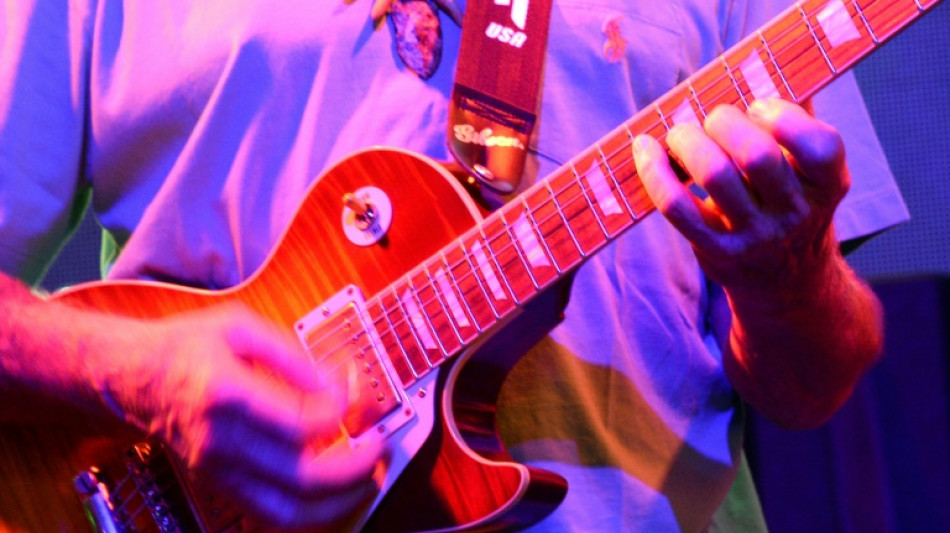
In already precarious industry, US musicians struggle for health care / Photo: RICK DIAMOND - GETTY IMAGES NORTH AMERICA/AFP/File
In 2019, American musician Jon Dee Graham suffered a heart attack that left him "dead" for several minutes -- a scare that inspired his album, "Only Dead For a Little While."
Eighteen months later he had a stroke. And now, the 66-year-old is facing his biggest health challenge yet -- and like most musicians, he's underinsured.
Graham suffered an infection following spinal surgery that's developed into sepsis, and his son said he needs intravenous antibiotic treatments twice daily.
But because his treatment is at home, William Harries-Graham said Medicare -- the US federal health program that insures elder adults -- won't cover his father.
Harries-Graham said the hospital demanded payment upfront in the "thousands of dollars."
The artist "fighting for his life" couldn't afford it, and recently launched a campaign to sell his drawings, a hobby that has become a means of survival.
Graham's story is not uncommon: Many musicians confront the same health insurance nightmares all Americans do, navigating a labyrinthian system rife with out-of-pocket costs.
But musicians are gig workers, which makes it even harder. Most working artists aren't rich and have variable income, in a cutthroat industry where employer-subsidized insurance for musicians is rare.
Pop phenom Chappell Roan underscored the issue on one of music's biggest platforms earlier this year at the Grammys, calling out record labels for not insuring their artists in front of industry heavyweights as she accepted the prize for Best New Artist.
Roan said she herself was dropped from her label and went uninsured for a time: "It was devastating to feel so committed to my art and feel so betrayed by the system and dehumanized," she said onstage.
"Record labels need to treat their artists as valuable employees with a livable wage and health insurance and protection."
- 'Just a patch' -
About a month after Roan's statement, glam punk pioneer David Johansen died at 75 years old. His death came just weeks after he had started a GoFundMe to support his cancer treatment.
In 2024, Matthew Sweet, the 1990s-era alt rocker, suffered a stroke while on tour.
He was uninsured, so his management created a similar online crowdsourcing fundraiser.
It's raised more than $640,000 to date to support his long-term recovery.
But such crowdsourcing is a stop-gap, said Tatum Hauck-Allsep, founder and CEO of the Nashville-based Music Health Alliance that helps musicians negotiate medical bills.
"In some cases, things like a GoFundMe is a great resource, but in other cases, it's just a patch. We want to find a long-term solution," Hauck-Allsep told AFP.
She applauded Roan for highlighting the issue, but said insurance from record labels isn't necessarily what artists want, because it could mean they need to become employees, rather than independent artists.
Still, "there should be an easier pathway to health care access," she said.
Bruce Iglauer, head of the blues label Alligator Records, echoed Hauck-Allsep's point, saying that artists are self-employed.
"We guarantee recording budgets and royalty rates, but have no input into, or knowledge of, what other income the artists are making," Iglauer said.
"They are not getting weekly paychecks from us."
And smaller labels say increasingly thin margins would make providing insurance impossible: "The costs of manufacturing have gone up, physical sales have gone down. Streaming sales pay paltry sums," said Kenn Goodman, founder and CEO of Chicago-based indie record label Pravda Records.
"It's just not financially feasible," he added. "I wish it was."
- 'Terrifying' -
Many US musicians get health care through the Barack Obama-era Affordable Care Act -- but that coverage is under threat by the Donald Trump administration, which is vying to complicate health care access, and perhaps eventually scrap the system altogether.
That would be a "disaster," said Paul Scott, director of the Healthcare Alliance for Austin Musicians, a non-profit that helps about 3,200 musicians a year in Texas get signed up for coverage under the government health care plan.
Many ACA plans still don't come cheap, but it's made a huge difference for access, he said.
Jettisoning the ACA would likely mean increased prices that would prompt a lot of artists to "drop their health insurance," Scott said. "And that will be a hit to our safety net hospitals and charity care."
As for Graham, selling his sketches has successfully funded his first few weeks of treatment.
But his son doesn't know if that will be enough.
And Harries-Graham worries about those who can't find fundraising support thanks to their fame.
"I don't know what someone else would have done," he said. "They would have been yet another person who goes into severe medical debt."
"That is terrifying."
G.Koya--DT